
Honeywell business jet forecast good news for Wichita-built aircraft
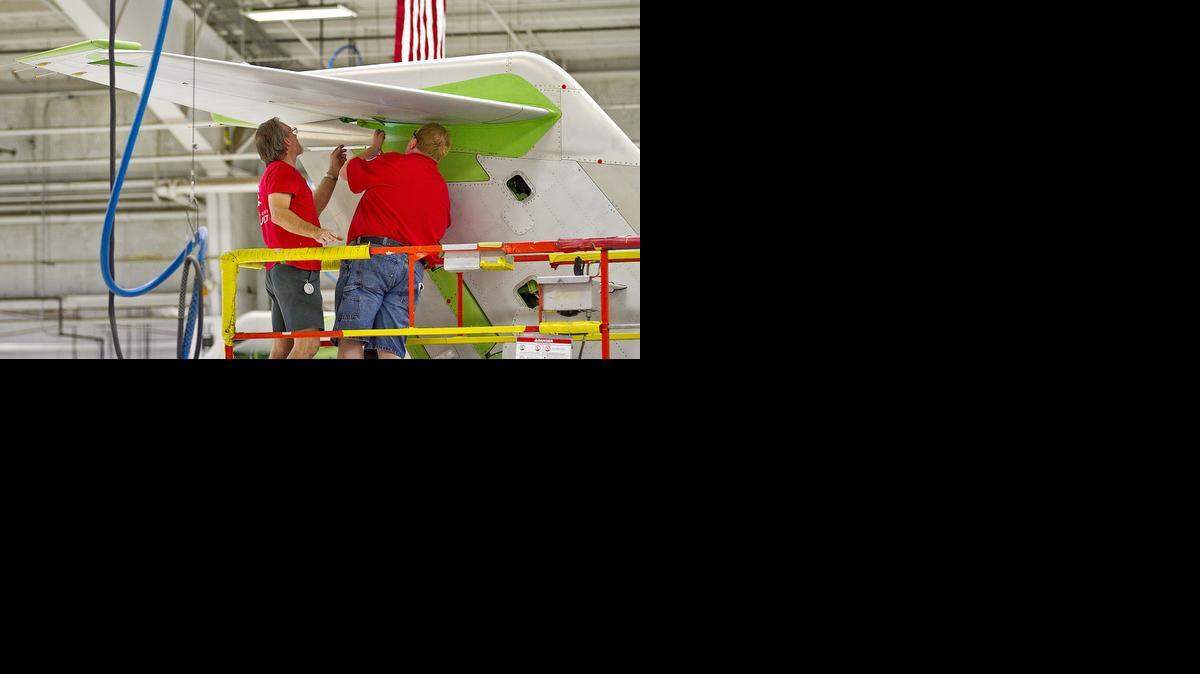
Honeywell Aerospace’s new business jet forecast projects moderate delivery growth in the next two years as companies introduce new models.
Over the next 10 years, the forecast projects, the industry will grow an average of 4 percent a year. It projects demand for up to 9,450 business jets worth $280 billion for 2014 to 2024.
That’s up from last year’s forecast when Honeywell projected demand for 9,250 jets worth $250 billion from 2013 to 2023.
Honeywell’s 23rd annual forecast was released Sunday afternoon in Orlando as the National Business Aviation Association’s annual conference and exhibition prepares to open.
The show opens Tuesday and runs through Thursday. A media day will be held Monday.
Honeywell’s forecast is based on a number of sources, including in-depth surveys and interviews with more than 1,500 business jet operators in the U.S. and around the world operating nearly 3,500 business aircraft.
Large business jets continue to be the most popular of the segments.
However, strength in the business jet market is starting to give more traction to the small and midsized segments of the industry, said Charles Park, director of market analysis at Honeywell Aerospace and author of its annual business jet forecast.
That’s good for Wichita, Park said, where Cessna Aircraft and Bombardier Learjet build small, midsize and super-midsize jets.
Forty-six percent of the jets sold are expected to be big-cabin jets, followed by 28 percent light-medium and medium-size jets and 26 percent small-cabin jets, the forecast said.
Big-cabin jets, however, will make up 75 percent of the dollar value of the jets delivered, it said.
The projections also predict deliveries of 650 to 675 new business jets this year. That’s up slightly from last year, when plane makers delivered 657 business jets.
Expected delivery improvements stem from recovered program schedules, new model introductions and additional demand from fractional ownership companies.
Jet operators told Honeywell that they planned to replace 23 percent of their fleets with new jets over the next five years. That’s down five points from last year.
Operators are cautious about slow growth in the economy and about geopolitical concerns.
In all business jet segments, range is the top consideration, said Brian Sill, Honeywell Aerospace president of business and general aviation. Buyers are also interested in cabin volume, advanced avionics, performance and other features, such as cabin connectivity, he said.
The pipeline of new models is still key for longer-term growth in the industry.
“There’s a number of new models that are coming online immediately and over the next 10 years,” Park said. “Those tend to support production rates.”
Large-cabin jets
Operators continue to focus on the larger-cabin business jet classes, from the super-midsize jet through the ultra-long-range and business liner, the forecast said.
Large-cabin jets make up 46 percent of purchase plans by operators over the next five years, the forecast said. That’s down from the past two or three years, when more than half of the operators who planned to buy jets said they wanted large-cabin models, Honeywell said.
Overall business jet demand from fractional ownership companies is expected to increase, the forecast said.
“We do think we’re seeing a fractional ownership re-equipment cycle begin,” Sill said. “There will be some deliveries to fractional providers over the next few years that will help bolster the typical flight department market, which might be a little bit soft in the short term.”
Regional demand
About 60 percent of the demand over the next five years is expected to come from buyers in North America, followed by 18 percent in Europe, 17 percent in Latin America and 3 percent each from Asia Pacific, the Middle East and Africa.
One bright spot and a surprise in the survey came from Brazil. Although the Brazilian economy isn’t that strong, Brazil had the strongest aircraft purchase plans of the survey.
Buying plans from Russia and China are down this year.
Russia slipped in its reported buying plans as Western sanctions expand because of the Ukraine crisis, the forecast said. Russian responses to the survey, however, were limited this year, and the small sample added an element of volatility not present in past years, it said.
In North America, 22 percent of operators surveyed said they planned to buy new planes. That’s down from an average of 25 percent over the past six years.
Still, North America accounts for nearly 60 percent of the projected demand for the next five years because of its larger installed business jet base. That affirms North America’s “unquestionable importance to the industry’s future,” the forecast said.
Reach Molly McMillin at 316-269-6708 or mmcmillin@wichitaeagle.com. Follow her on Twitter: @mmcmillin.
Forecast highlights
▪ 46 percent of new purchase plans are for large-cabin jets.
▪ 23 percent of fleet owners surveyed say they will replace or add new jets within the next five years.
▪ Forecasted deliveries are up 7 to 8 percent over last year’s 10-year forecast.
▪ 19 percent of the planned business jet purchases are to be completed by the end of 2015.
▪ 59 percent of the world’s sales will come from North America.
Source: Honeywell Aerospace
This story was originally published October 19, 2014 at 9:43 PM with the headline "Honeywell business jet forecast good news for Wichita-built aircraft."