New COVID relief bill could help bring back Wichita aviation jobs. Here’s how
A piece of legislation buried in the new federal COVID-19 relief bill could help Wichita-area aviation manufacturers keep some workers on the payroll and avoid further cuts, a year into a pandemic that ravaged the industry and led to thousands of layoffs in Wichita.
Rep. Ron Estes helped introduce the Aviation Manufacturing Jobs Protection Act last fall as a standalone bill, but voted against the legislation when it was included in the American Rescue Plan, the COVID-19 relief package passed by Congress and signed by President Joe Biden late last week.
The president’s signature on the COVID-19 relief bill means employers like Spirit AeroSystems and Textron Aviation, and smaller supply chain aerospace companies in Kansas, might be able to make use of federal funds to help keep their workers employed.
A spokesperson for Textron Aviation did not directly address whether the company was eligible for the payroll support program.
“As the Act was just recently signed into law, we continue to review, assess our ability to participate and await further guidance from the Secretary of Transportation as to how it will be administered,” the spokesperson said.
“We appreciate the efforts of both Senator Jerry Moran and Representative Ron Estes in championing the Aviation Manufacturing Jobs Protection Act. This legislation creates a public-private partnership between the federal government and aviation manufacturers to protect the aviation manufacturing industry, workforce and supply chain impacted by COVID-19.”
A spokesperson for Spirit said the business is eligible to participate as an aerospace manufacturing company.
“We look forward to the next steps in the process as the federal government defines the rules and guidelines for the program and determines how it will be implemented for industry,” the Spirit spokesperson said.
“We appreciate the leadership of Senator Moran and Congressman Estes, who worked in a bi-partisan manner, for helping ensure Congress gave consideration to the needs of aviation manufacturers as well as the broader aviation industry as we bridge to a period of recovery.”
Despite bipartisan negotiation to introduce the act with Washington state Democratic Rep. Rick Larsen, Estes voted against the full economic stimulus bill that included his legislation.
“Most of the bill is partisan bailouts for states and pensions and other non-COVID-related wish list items, which will take away from the few positive aspects like the inclusion of my bipartisan Aviation Manufacturing Jobs Protection Act that will actually help out-of-work Kansans,” Estes said in a statement. “With cases down 77% over the last six weeks, Congress should instead focus on crushing the virus and reopening our economy.”
Sharice Davids, the lone Democrat in the state’s delegation, was the only Kansas lawmaker who voted for the overall stimulus bill.
Sen. Moran, Sen. Roger Marshall, Rep. Tracey Mann, Rep. Jake LaTurner and Rep. Estes all voted no.
“I’m pleased our workforce retention bill was included in the relief package, however I could not support the final $1.9 trillion package because of the unnecessary spending unrelated to COVID-19,” Moran said in a statement.
Estes was also glad to see his legislation included.
“I was grateful to introduce this legislation last fall with Republicans and Democrats in both chambers and am pleased that this targeted measure was included despite the many other failings of the $1.9 trillion spending bill,” he said.
What does the Act do?
The Aviation Manufacturing Jobs Protection Act provides $3 billion for a payroll support program. It is a public-private partnership in which the federal government contributes 50% of the compensation for eligible employee groups, as long as the company commits to continuing employment of those workers.
The $3 billion in federal funding will remain available until Sept. 30, 2023. However, the federal government won’t contribute to an employee group for more than six months.
The employer must use the funds only for employee wages, salaries and benefits. An eligible group of employees can’t be more than 25% of the employer’s total U.S. workforce as of April 1, 2020.
Companies can also use the funding to rehire or recall workers who have been furloughed or laid off. However, a business cannot use the money for back pay of those employees.
Not all aviation manufacturing companies are eligible to participate under the Act. To qualify, the business must have involuntarily furloughed or laid off at least 10% of its workforce last year, or have experienced at least a 15% decline in revenue in 2020 compared to 2019.
Aviation businesses that received certain prior aid under the CARES Act are also ineligible. If the employer received relief under the Payroll Support Program for airlines or is currently using assistance from the Paycheck Protection Program when it submits a new application, the company won’t be able to participate in the Aviation Manufacturing Jobs Protection Act.
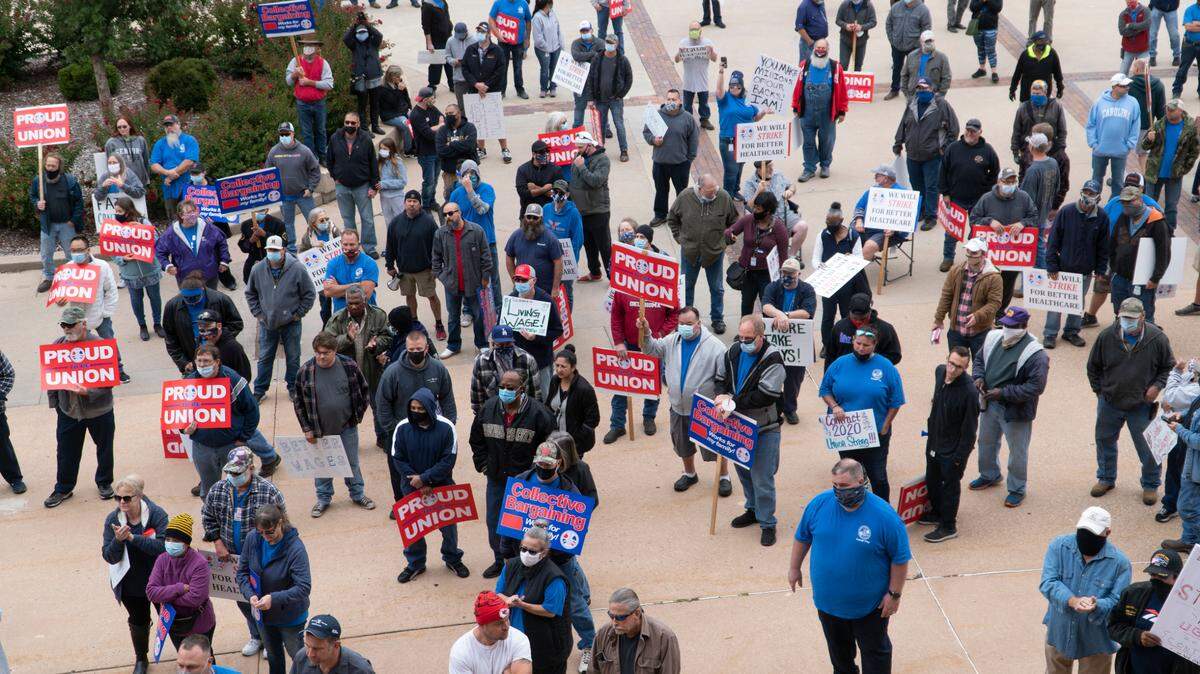
The national Machinists Union, which has local lodges representing workers at Spirit AeroSystems, Textron Aviation and Bombardier/Learjet in Wichita, applauded the American Rescue Act for provisions that would help its members, such as extending the Payroll Support Program for airline workers and including the Aviation Manufacturing Jobs Protection Act.
“Hundreds of thousands of IAM members in the airline, transit, aerospace, manufacturing and other critical industries will have their jobs saved because of the American Rescue Plan,” Machinists Union international president Robert Martinez Jr. said in a statement.