
‘Superhighway’ power line opens in Kansas
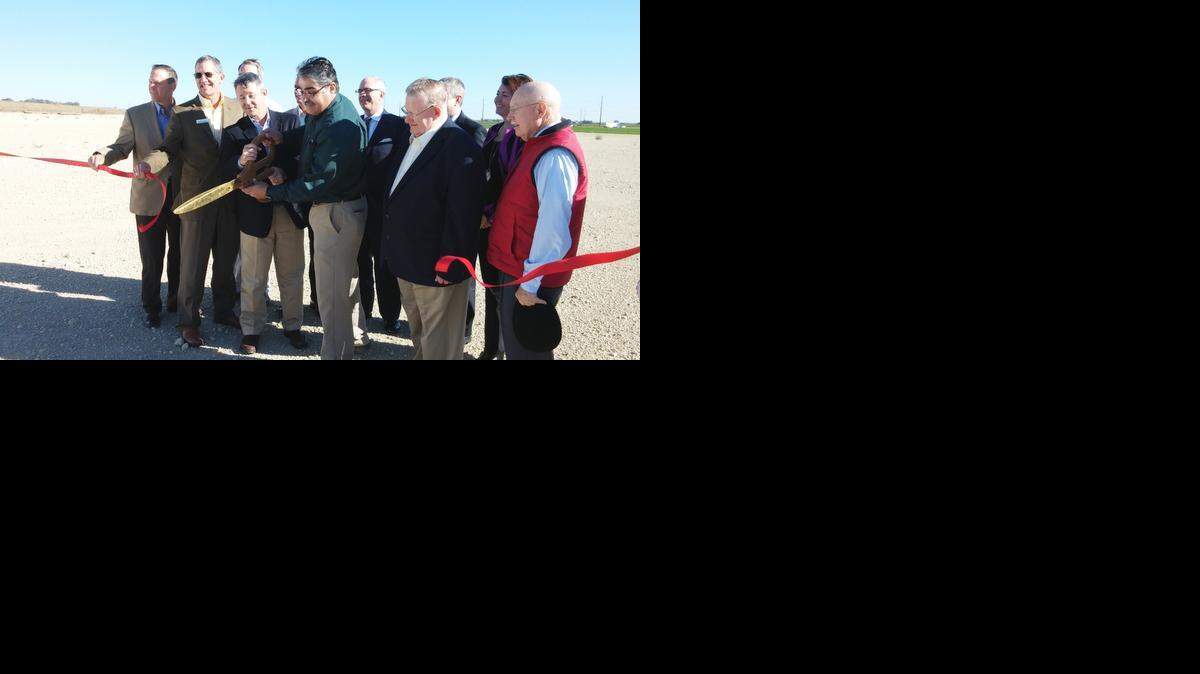
The “electric power superhighway” is open for business.
Utility officials from around Kansas and beyond gathered Thursday at a windswept former construction storage site in Garden Plain to cut the ceremonial ribbon on the new 108-mile-long power line, part of the “V plan.”
Not far away runs the twin 345-kilovolt power line that now connects Westar’s Gordon Evans Energy Center substation, near Colwich, to a substation near Medicine Lodge and then extends to the Oklahoma state line. In Medicine Lodge, it will connect with a second project, a line coming from near Dodge City, that will be complete in a few weeks.
The Prairie Wind Transmission line cost about $160 million, about 30 percent below one early estimate, said Kelly Harrison, president of Prairie Wind Transmission, the partnership between Westar Energy and Electric Transmission America that owns the line. It is the highest-capacity electrical line in Kansas.
“It’s a huge day for the state of Kansas,” Harrison said.
What makes it a “superhighway” is that it is part of a network of high-voltage lines recently completed or now under construction that would connect the region’s windiest areas in western Nebraska, Kansas, Oklahoma and Texas to one another and to the region’s population centers.
The new lines make possible 3,000 megawatts of wind power generation, about 30 average-sized wind farms, in the High Plains areas of Nebraska, Kansas, Oklahoma and the panhandle of Texas, Harrison said.
Jim Eckelberger, chairman of the Southwest Power Pool – which does power transmission planning for all or parts of Kansas, Oklahoma, Nebraska, Missouri, New Mexico, Texas, Arkansas and Louisiana – said the group approved the line, and similar “superhighway” lines, for two reasons: to develop wind power and to develop the ability to move the lowest-cost electricity generated – whatever the source – to wherever it’s needed around the region.
The demand for electrical power peaks in different places at different times, he said. Electrical power peaks in the south part of the region in the summer and in the winter in the north part of the region. And wind power generation is intermittent.
Eckelberger said a study estimates that the region’s utilities are already saving a collective $300 million to $400 million in electricity costs by being able to shop around for the lowest-cost power. That savings could double when the string of “superhighway” projects is finished, at a cost of about $4 billion and over the course of three years, although federal environmental regulations could limit savings.
Electricity costs in the Southwest Power Pool region are lower than in most of Texas or in the rest of the Midwest, which is a real competitive advantage, Eckelberger said.
“We’re going to get cheaper and cheaper as we boost our ability to generate and transmit the lowest-cost power,” he said.
Reach Dan Voorhis at 316-268-6577 or dvoorhis@wichitaeagle.com. Follow him on Twitter: @danvoorhis.
This story was originally published October 30, 2014 at 6:07 PM with the headline "‘Superhighway’ power line opens in Kansas."