
Selling some used items to Wichita businesses may not require fingerprinting for long
Wichitans who sell used appliances and trinkets to local businesses are used to having their fingerprint scanned and their personal information collected to share with police.
That may not be the case for much longer.
It’s standard protocol for discouraging thieves from attempting to sell stolen items, but some Wichita officials say the city’s secondhand dealer regulations are a burden on businesses and not particularly effective at preventing illegal activity.
Assistant City Manager Troy Anderson told the City Council last month that police are putting too much time and effort into enforcement activities that ultimately don’t lead to arrests.
“What we found out was a lot of the stolen merchandise is now being resold either online or by other means,” Anderson said, noting that Facebook Marketplace has become a particularly popular platform for illegal sales.
In Wichita, secondhand dealers have been regulated under the same ordinance as pawnbrokers and precious metals dealers since 1991.
Secondhand dealers, who sell everything from used cars and mowers to musical instruments and antiques, are required to input the name, phone number, address and driver’s license number of everyone they buy from into a police database. They also have to invest in a fingerprint scanning machine and collect sellers’ prints.
“These regulations are unbalanced — the balance between law enforcement and promoting a healthy business environment are unbalanced,” Anderson said.
He presented the City Council with a proposal to do away with Wichita’s secondhand dealer licensing requirement altogether, forgoing the annual fees collected from the city’s current 148 licensees. Records show the city collected $15,122 in secondhand dealer license revenue last year.
“What we’re proposing by striking the secondhand dealer from that category allows the Wichita Police Department to shift focus of their law enforcement resources, as well as create a more business-friendly environment,” Anderson said, noting that the change wouldn’t stop police from pursuing leads about missing items.
But Vice Mayor Mike Hoheisel, who represents south Wichita’s District 3, said he worries that nixing the oversight would give bad actors the wrong idea.
“In my district, we have a lot of theft, and we’ve had a couple of people who have had high-profile incidents of stuff being stolen from a house they’re renovating or a business that they’ve been working on for a while, or even their own homes,” Hoheisel said.
“I’m just uncomfortable giving kind of a blanket opportunity for some less-than-reputable businesses to pursue this.”
Rather than striking the licensing requirement altogether, council members instructed city staff to talk to secondhand dealers and create a list of business types that should be exempt from fingerprinting and collecting personal information before the council takes the matter up again on April 11.
The secondhand dealers ordinance already has carve-outs for businesses whose merchandise is limited to secondhand books, magazines, collectible cards and posters, cassette tapes, CDs, records, VHS tapes, DVDs and computer software. Licensed scrap metal processors and charitable organizations that receive used merchandise for resale are also exempt, city spokesperson Megan Lovely told The Eagle.
Hearing from business owners
Deb Gronniger, owner of City Blue Print, said what her business most commonly resells is surveying equipment.
“If somebody has at their worksite a bunch of them stolen, like Eby Construction or one of these big construction sites, and people come in here and try to sell them to us, we check the serial numbers and make sure from the first sale if they’ve been on the stolen list,” Gronniger said.
Every so often that cross check, which is required under the ordinance, will turn up a stolen item.
“We’ve had a couple times where we see this is stolen or ‘We didn’t sell this to you. We sold this to Wildcat. How did you get it?’” Gronniger said. “But most people that do buy those instruments and maybe would sell those instruments, they’re not going to resell them here.”
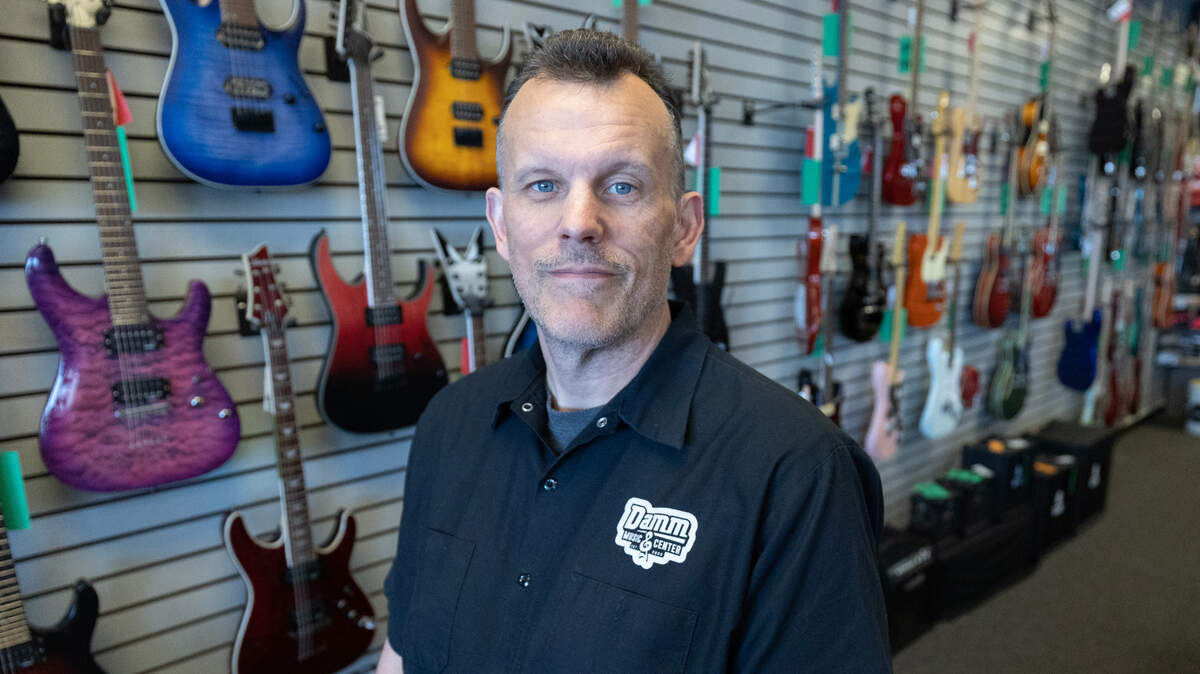
“Fingerprinting is a burden for us that I would love to do without,” said Kevin Damm, owner of Damm Music Center.
But he said he’s not so sure Wichita should get rid of regulation and licensing altogether.
“They use a website that we fill out and put in a person’s name and their address, put in their birth date . . . and their driver’s license number. Then, whatever we’re buying from them, we put in the make and the model and the serial number if it has one,” Damm said.
“I think it’s good that that information’s being collected.”
Grant Hewitt of Hewitt’s Antiques said that in his 40 years of business, he’s never fingerprinted the people he purchases items from, despite being a licensed secondhand dealer.
“Some policeman came in once and told me I needed to start doing reporting on stuff I was buying,” Hewitt said.
“If there’s TVs or there’s guns or there’s something that has serial numbers, we’re supposed to report those. But our stuff is 100 years old. There is no serial number.”
City Manager Robert Layton said his office began evaluating the usefulness of the secondhand dealer ordinance when they were approached by a prospective business owner who wants to open a used toy store without having to fingerprint everyone they buy from.
“I think it would be highly unlikely that we would be able to prosecute a case of stolen Legos,” Layton said during the meeting, noting that toy dealers will likely be among the carveouts city staff present to the council in April.
But Layton said he’s not convinced keeping the secondhand dealer ordinance on the books will do much to discourage thieves.
“I still believe that this is an obsolete section of the code and that we’re not going to have much enforcement action.”