
Artificial intelligence, robot baristas? You can find both at new Smart Factory at WSU
Want a robot to make you a coffee? The Smart Factory at Wichita State has you covered.
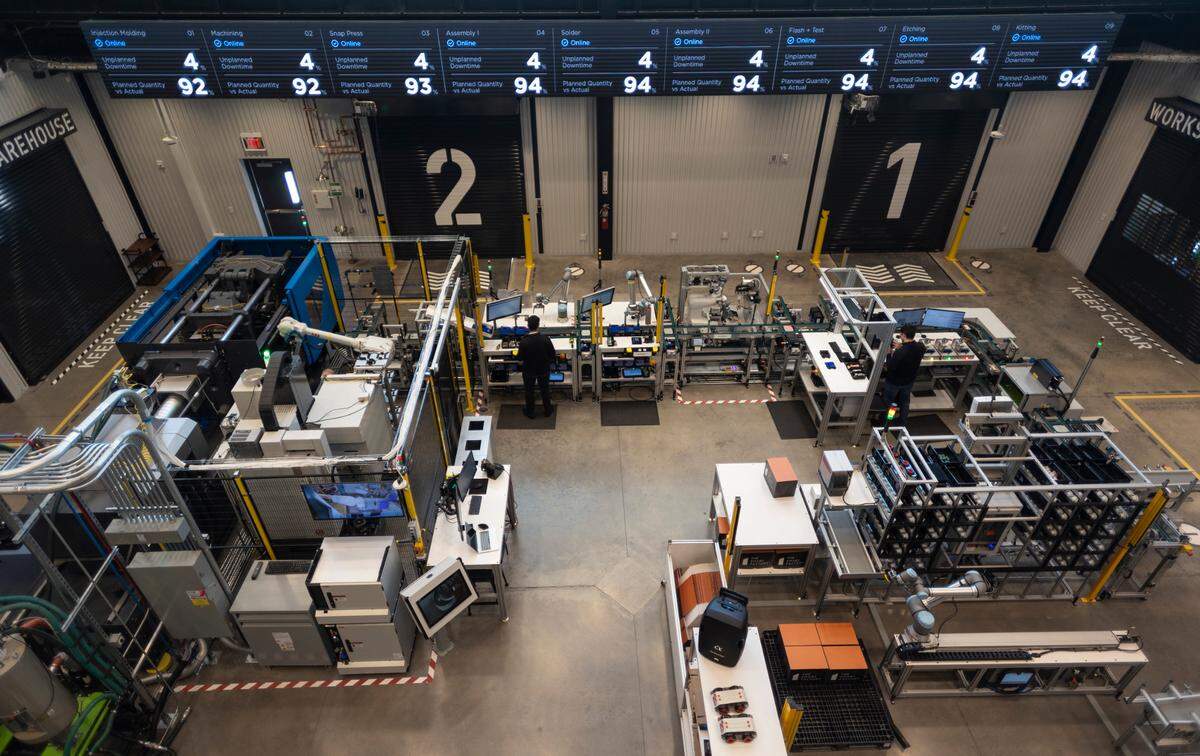
The Deloitte Smart Factory is the most recent business to open on WSU’s Innovation Campus. The factory has advanced technology, focusing on the future of manufacturing. It uses a mix of artificial intelligence, cloud data, machine learning, vision solutions and more. And yes, it includes a robot barista.
“Visitors at the Smart Factory of Wichita will experience [the] smart factory concept that bring together ... cloud, artificial intelligence, computer vision and more to create interconnected systems that use data to drive intelligent actions,” said Stephen Laaper, principal and Smart Factory leader.
The factory had an opening event Tuesday featuring six speakers and a tour of the facility.
The factory focuses on four pillars: experience, sustainability, community and philanthropy.
For experience, visitors will have the opportunity to “be involved in real world demonstrations, hands on workshops and see practical applications,” Laaper said. The factory is expected to draw 5,000 visitors its first year, according to Laaper.
For sustainability, the 60,000-square-foot building runs off of renewable energy on a smart grid.
The factory finds community through its partnership with Wichita State University.
“In support of a community that is known for its deep roots in manufacturing, the smart factory at Wichita is working with Wichita State University .... to bring together the latest technology expertise with the university’s research, educational and innovation capabilities,” Laaper said.
The factory is being used to manufacture the Smart Rover STEM education kits, a partnership between Elenco Electronics and Amazon Web Services. These education kits will be sent to Wichita middle schools, and give students the opportunity to assemble and code a smart rover.
“What we do is take ... housing and pair it with these individual components,” Matt Tomblin, Smart Factory operations manager, said. “When this is introduced, it has a microcomputer inside and brings in an aspect ... of computer coding to where you can write code and it sends signals through the pins to be able to actually control the rover.”
Over the next four years, the factory hopes to reach 800,000 students through the donated rover kits.
“ [The goal is] really to start developing interest, start developing skills and start developing the future of what we want to make manufacturing and technology,” Nishita Henry, Deloitte chief innovation officer, said in the opening speeches.
The factory is taking advantage of WSU’s applied learning focus, which uses community partnerships to give students access to learning opportunities out of the classroom. The factory has ten students as interns now. They hope to involve more as the factory grows.
“[WSU’s] applied learning program here actually uses their students and actually brings them here to the factory for internships, where they will participate in tours on the floor, programming the robotic system and making sure that the stem kits reach students and making sure that the teachers have the curriculum,” Henry said.
Wichita’s smart factory is a part of the wider Global Smart Factory network, a project by Deloitte intended to help “leaders design, test and understand how to scale capabilities across their value chain,” according to its website.