Are unemployment benefits causing a Wichita labor shortage? It’s not that simple
Jennifer Hughes has been unemployed from her Wichita health care job for almost a year. Although she sends in about 15 job applications a day, she still hasn’t been hired anywhere.
The 40-year-old, single mother of three is able to get by on extended federal unemployment, which provides her family continued benefits after she exhausted state unemployment. She’s willing to take a pay cut to go back to work — she’s applied to McDonald’s and other lower-wage positions that she said wouldn’t take her.
“I’ve worked 20 years doing the same thing and worked my way up to $21 an hour,” Hughes said. “Now they’re expecting me to go back below $13 an hour and start all over.”
Hughes is just one Wichita area worker caught in the region’s difficult labor market as the economy recovers from the coronavirus pandemic.
Twenty-three states, all with Republican governors, have already set an early end date for the $300-a-week federal benefits program, which is intended to expire on Labor Day. Spurred on by restaurant owners who say there’s a shortage of workers, Kansas Republicans are calling on Democratic Gov. Laura Kelly to cut the program short, saying the money has kept people from returning to work.
But talk about a shortage of workers doesn’t capture the full picture, said Jeremy Hill, director of Wichita State University’s Center for Economic Development and Business Research.
Employees like Hughes are caught up with friction in the region’s tight labor market, where open jobs aren’t in line with unemployed workers’ experience.
“We shouldn’t all be lumped into this category,” Hughes said.
Hiring troubles and unemployment
Wichita’s economy is experiencing a tight labor market, especially in leisure and hospitality — much like the nation, said Hill. The mismatch between workers and employers is particularly strong in fast food and chain restaurants.
Recent labor market reports for Wichita and Kansas show the region’s employment numbers have dropped while the number of people in the labor force has grown.
“That’s a signal saying households are looking for a job and can’t find a job,” Hill said.
The April labor market report from the Kansas Department of Labor, released Friday, showed Wichita’s employment and labor force numbers both dropped from March. But Hill said the month-over-month change isn’t significant.
Overall, the report shows, there are still more people looking for jobs than there are jobs being filled.
That might come as a surprise to some Wichita area business owners, particularly in the restaurant industry, who are having trouble hiring enough staff to keep up with demand.
Dee Little owns Little Firehouse Cafe in Derby with her husband, Charlie. The cafe employs four people, but Little said they desperately need to hire at least two more.
Finding willing workers has been a struggle, which she blames on the federal government’s unemployment benefits.
“People need to come in here and work for a decent living and make a paycheck instead of free money,” Little said. “They’re paying people not to work. It’s ridiculous.”
Little said servers at her cafe make the federal minimum of $2.13 an hour plus tips. Other workers start at $10 an hour.
Hill said extra unemployment income isn’t the problem though.
“I think it’s misleading to say that $300 a week is that lucrative to really discourage people” from seeking a job, Hill said. “It’s not that the incentive is so high that it would decentize someone from wanting to be in the labor market.”
LaKara Washington agrees. She lost her job as a breakfast attendant at a Wichita hotel last March when COVID-19 first began to cause layoffs.
With an associate’s degree in restaurant and hospitality management, Washington would prefer to find something in her field.
“But I’m not being too picky at this point,” she said.
Washington, like others in Kansas, experienced a months-long wait to receive unemployment benefits from the labor department. She made $10.40 an hour at her job and now receives a weekly unemployment benefit of $240, plus the extra $300 in federal benefits.
“The reality is so many folks who are on unemployment right now are not even getting a dime,” Washington said.
Instead, Hill thinks four other issues have led to the current problems for employers and employees alike: Labor allocation and wages, disruption from the pandemic, friction around types of available jobs and the retirement of older workers.
Employee wages
Workers in leisure and hospitality, particularly at restaurants, aren’t returning to the same jobs that were available before, because the types of open positions within the food industry have changed, Hill said.
For example, there are more open jobs in fast food and chain restaurants than nicer, fine dining establishments.
For food service workers, those are two different positions. Someone with the experience of working in a higher-end restaurant isn’t likely to switch gears and work at a McDonald’s.
“We have more demand in fast food restaurants than we have labor,” Hill said.
Nationally, the average hourly wage for fast food and counter workers is $11.80, while the average hourly wage for servers more generally was $13.20 as of May 2020, according to the Bureau of Labor Statistics. Fine dining workers typically make most of their income in tips.
Spangles Director of Operations Rene Steven said almost all of her stores are hiring, with some seeking as many as eight to 10 additional employees.
“It is the most frustrating thing to want to be able to serve guests and not have the staff to do so — and with no fault of ours,” Steven said. “People just don’t have to work.”
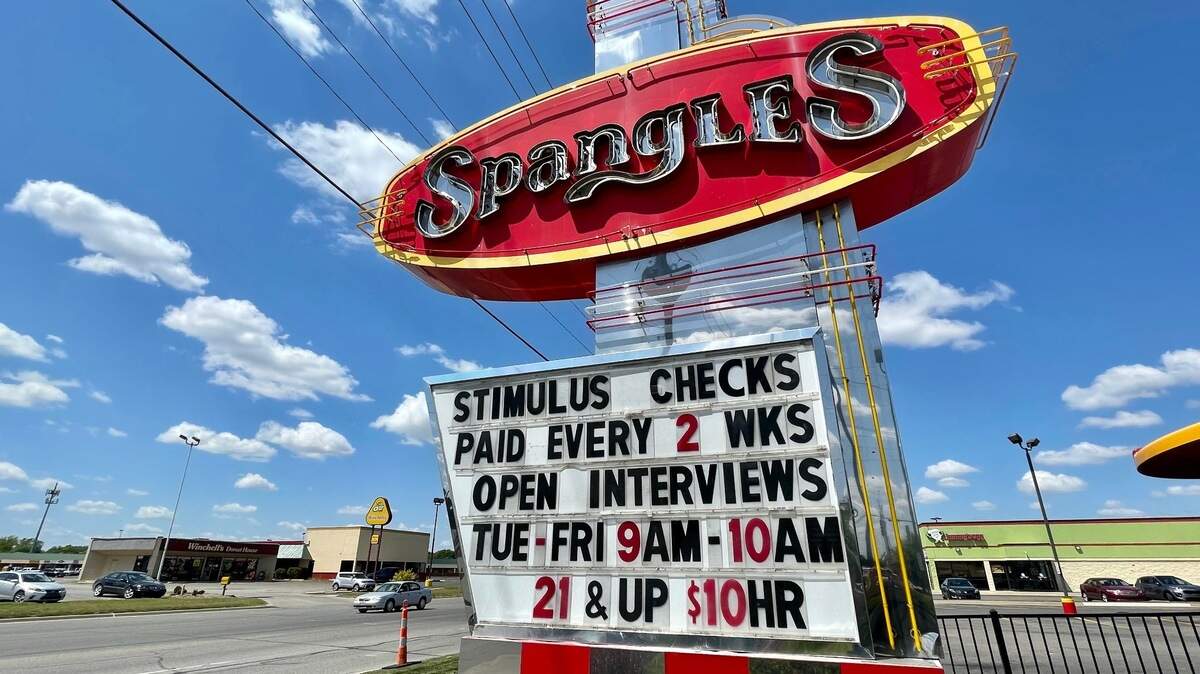
In recent weeks, signs outside of several Spangles locations have adopted a snarky tone in an effort to entice workers: “Stimulus checks paid every 2 wks.”
Most Spangles employees are hired on at $10 an hour, but several stores are offering higher rates, she said.
“I have some stores in some areas that are 12 bucks an hour,” Steven said. “That’s fast food. That’s crazy.”
When demand rises in a free market, employers should raise wages to meet that demand, Hill said.
In Wichita and across Kansas, employers have not raised wages on the same competitive level as the rest of the country.
Steven said it’s untenable to offer prospective employees more than she already is.
“Fast food was not designed to pay 15 bucks an hour,” she said.
But business never slowed down for Spangles during the pandemic, which has put a strain on existing staff.
“Our staff and other places, they’re working — we’re killing our staff,” Steven said. “It’s so unfortunate, because they’re working and they don’t have to work.”
She said many of her general managers are working seven days and 70 hours a week. When she found out that one of her managers worked 86 hours last week, Steven insisted that she take Tuesday off.
She said general managers make at least $50,000 a year. As salaried employees, they don’t get paid overtime.
Steven said her general managers are desperate to hire more hourly workers.
“You’ve got to have those bodies to be able to run that shift, and if they’re not, then [managers] have to stay late or they have to come in early,” she said.
Without enough employees to adequately staff stores, Steven said Spangles is currently offering crew members time-and-a-half overtime pay. Federal law requires most hourly employees to be paid overtime.
“Time and a half — you do the math. That’s 18 bucks an hour,” Steven said. “Wouldn’t you be okay making 18 bucks an hour?”
Asked if she believed she would have a shortage of workers if she advertised $18-an-hour jobs, Steven said the higher rate is unsustainable.
“Fast food used to pay $7.50 or 8 bucks an hour. Do you understand that?” Steven said. “Fast food was a stepping stone. It’s an eight, nine-bucks-an-hour job.
“It can’t survive long-term paying 18 bucks an hour. Fast food can’t. Because when you come in, you spend 6 bucks.”
But Hill said the unsustainable part is not raising wages when the demand for labor is so high.
“If you really want labor, you need to increase wages,” he said.
Disruption, friction and aging workers
Wages aside, there are still some workers who have not returned to the labor force to search for a job because they are taking care of family or seeking flexibility as a result of the pandemic, Hill said.
“Our labor force would be even larger if employers could handle that disruption,” Hill said.
Wichita is also experiencing friction in its labor market in which open jobs are not aligned with the skills of unemployed workers — much like Hughes.
This is often industry-specific, Hill said. For example, someone who was laid off from a job in aviation manufacturing won’t quickly switch to a food service job, or vice versa.
Many workers would have to receive new training, trade certification or education before they have the required skills to switch jobs or even careers.
“That takes months and years to happen,” Hill said.
Wichita also has a smaller economy because it’s not as large as other cities, making it more difficult to transition into a new position for those who seek to do so.
“It’s harder for labor to move around in a market this size,” Hill said. “It’s less flexible because we have less people.”
Wichita and Kansas were already facing a tight labor market before the pandemic hit, Hill said. The labor force has shrunk as older workers retire.
That trend goes back to at least 2018, and the pandemic might have accelerated retirement for some employees in the baby boomer generation, who had health concerns about the virus in the workplace.
At the same time, other baby boomers have delayed retirement. Some lost planned income and others found remote work more manageable.
“With an older workforce age population here, those are the ones we’re struggling with in Kansas,” Hill said.
Labor market recovery
The employees hit the hardest in the hospitality industry at the beginning of the pandemic are still struggling to recover, even as other workers have been able to save their stimulus funds from the COVID relief bills.
“The labor market hasn’t been equal in its recovery,” Hill said.
Washington, the hotel employee, knows her industry is changing as post-pandemic travel will fluctuate and businesses rethink the breakfast buffet model.
She would consider working in restaurants or fast food for a management position. At the end of the day, she has to make enough money to take care of herself — and doesn’t think fast food or chain positions will cut it for herself or others.
“I have to be able to pay my bills and put food in my mouth and survive,” Washington said.
Hughes, the unemployed health care worker, got her first job cleaning and sterilizing health care equipment for surgeries. Until June last year, she held that position at the Robert J. Dole VA Medical Center in Wichita.
She recently interviewed for a job with a credit union. However, the business decided to hire someone else because they thought Hughes wouldn’t stay long if they hired her at a much lower wage than what she made before.
Without an associate’s or a bachelor’s degree, Hughes said she would take any opportunity to get new training or education if it would help her get back on her feet with her kids. In the meantime, she said she’s ready to take any job that will hire her.
“I’ve done everything possible,” she said.
“Anything I apply for is a $10 an hour paycut automatically. It is hurtful, but I’m willing to do that.”