
Tax refunds boost Wichita-area businesses’ bottom lines
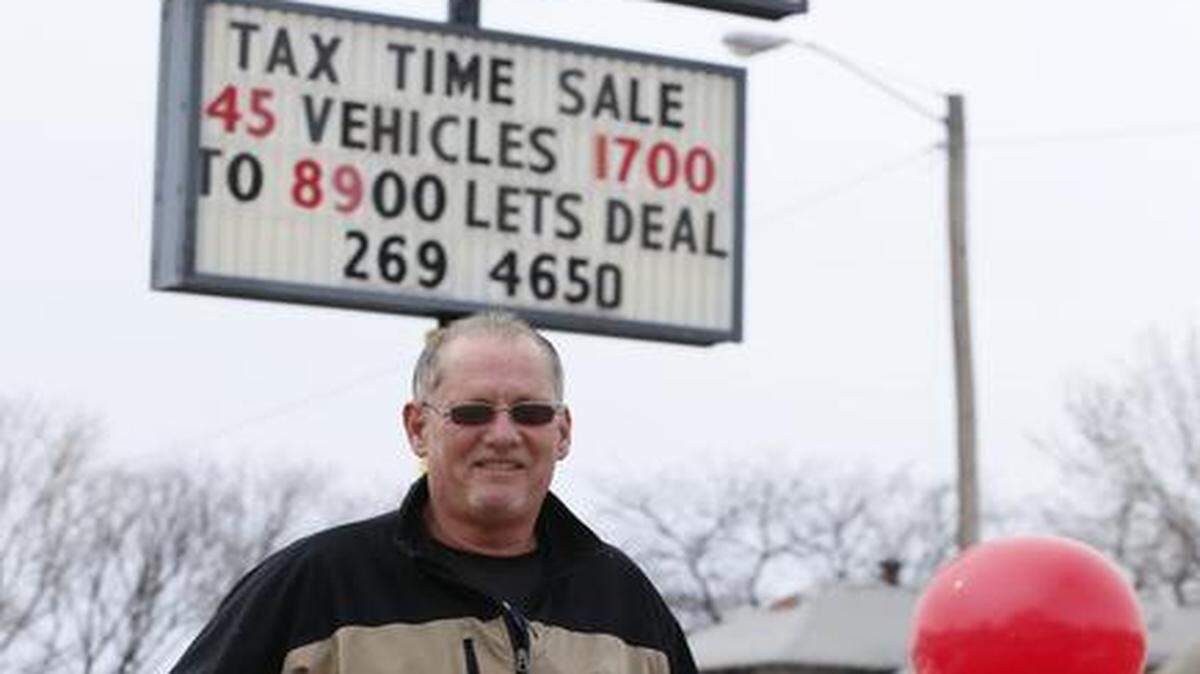
Hooray for tax season.
It’s a boon to some businesses, because it means customers are suddenly walking in with a few thousand dollars in their pockets.
In 2012, the most recent year for which figures are available, taxpayers in the five-county Wichita metro area got back nearly $600 million in federal individual tax refunds, an average of about $2,500 per return. About 18 percent of that 2012 total, $109 million, comes from the earned income tax credit, according to the IRS.
That’s quite a wad of cash arriving all at one time.
For people living paycheck to paycheck, fretting about the cost of gas or medical bills, it may be the one time all year they feel as if they have money to spend.
On South Broadway, the salesmen are keenly aware of that fact.
“For a lot of the lots, it can make or break a year,” said Peter Germes, sales manager of Etezazi Auto Plaza, 1728 S. Broadway.
He sells cars in the $2,000 to $6,000 price range.
At tax time, he’ll see a lot of families come in looking for vans or SUVs – “kid cars,” he calls them – or grandparents seeking an inexpensive car for a grandchild.
He normally sells five to 10 cars a month, but that might jump to 25 or 35 a month during the late winter and early spring.
He runs what is called a “cash lot,” which sells cars for cash or the money from conventional bank-supplied auto loans, he said. But other lots “tote the note” by financing the cars themselves. Financing opens up a whole range of more expensive cars for the $2,000 or $3,000 down payment, although the interest rates can make the monthly payments hard for some buyers to maintain, he said.
A substantial tax refund, of course, may be proof that taxpayers haven’t calculated their tax liability very well and had too much taken out of their paychecks in the first place.
But the truth tends to get obscured when that big check arrives, and people think: This is free money to get what I’ve been needing – or wanting.
Jay Storey, who has benefited from tax refunds greatly over the years, said the phenomenon is spread across a range of income brackets.
He opened the budget-conscious Furniture on Consignment 26 years ago and the midpriced Ashley Furniture HomeStore on the west side in 2001. He added an Ashley on the east side in 2014, and he sees the uptick this time of year in all of his stores.
“The first quarter is always our best quarter,” he said. “That’s when they are able to go for the things they’ve been wanting.”
What he sees in the first quarter is more volume rather than more expensive versions of what he sells the rest of the year. That tells him that most people simply don’t have the money for a large discretionary purchase until the refund arrives.
“It’s unfortunate, but it’s really a government savings plan,” he said.
Another industry that sees an increase in sales at tax time is mobile phones.
Jeremy Harrell, sales manager for Mobilcomm, which has five locations in the metro area, said that his sales are 25 to 50 percent higher between late January and early April.
“It’s a lot of new phones and accessories,” he said. “People put off buying a new phone, and when they get the refund, they come in and splurge.”
He said his stores prepare by stocking up on new phones and accessories, and they do more advertising.
It’s also a big time for people to pay off the bills for things they’ve already bought.
Ryan Deitchler, a counselor for the nonprofit Consumer Credit Counseling, also volunteers to do tax preparation in the United Way of the Plains VITA program.
He said that tax refund season is huge for paying down or paying off debts. People will come in – sometimes at the order of the bankruptcy court – to talk about how to handle their difficult financial situation, and he’ll let them know he also does taxes for free, and he’ll ask what their intention is for the refund.
They have to do what they think is best, he said – sometimes another car or a medical procedure is a higher priority – but most are anxious to pay debts. For many, he said, it presents a once-a-year opportunity for some peace of mind.
“Most of the people I talk to, maybe 80 or 90 percent, use the refund to pay off debt,” he said. “It’s very common this time of year.”
Reach Dan Voorhis at 316-268-6577 or dvoorhis@wichitaeagle.com. Follow him on Twitter: @danvoorhis.
Where the refunds went
Sedgwick County federal individual tax refunds by adjusted gross income for 2012
Number of returns | Average refund per return | |
All incomes | 180,420 | $2,682 |
Under $1 | 980 | $4,009 |
$1 to under $10,000 | 30,180 | $914 |
$10,000 to under $25,000 | 47,540 | $2,686 |
$25,000 to under $50,000 | 46,080 | $2,642 |
$50,000 to under $75,000 | 24,380 | $2,794 |
$75,000 to under $100,000 | 15,010 | $3,192 |
$100,000 to under $200,000 | 14,220 | $4,034 |
$200,000 or more | 2,030 | $14,529 |
Source: IRS
What is the EITC?
Described as a “benefit” by the IRS, the earned income tax credit subsidizes low-income working families. According to the Tax Policy Center, the credit equals a fixed percentage of earnings from the first dollar of earnings until the credit reaches its maximum; as income continues to rise, the credit will hit a point at which it starts to phase out. Here’s a look at the number of Sedgwick County taxpayers who received an earned income tax credit for 2012
Number of returns | Total amount | |
All incomes | 39,020 | $91,572,000 |
Under $1 | 150 | $137,000 |
$1 to under $10,000 | 10,760 | $12,879,000 |
$10,000 to under $25,000 | 17,470 | $57,887,000 |
$25,000 to under $50,000 | 10,640 | $20,669,000 |
$50,000 to under $75,000 | – | – |
$75,000 to under $100,000 | – | – |
$100,000 to under $200,000 | – | – |
$200,000 or more | – | – |
This story was originally published March 4, 2015 at 3:21 PM with the headline "Tax refunds boost Wichita-area businesses’ bottom lines."