
Wichita makes push to help companies increase global sales
Wichita relies on trade more than almost any other city in America.
Our products – aircraft and aircraft parts, machinery, grain, meat, chemicals and more – have lots of buyers overseas.
And, of course, there are the imports: toys, clothes, electronics and specialty machinery.
In 2012, 27.7 percent of the Wichita metro area’s more than $30 billion economy was tied to trade, placing it third among large cities, according to a Brookings Institution study. For the U.S. economy as a whole, the figure was 13.2 percent.
But, given the sluggishness of the economic rebound here, more – and more diverse – trade would drive revenue, profits and, eventually, jobs, say local trade officials.
Part of the reason Wichita’s recovery from the recession has lagged behind that of the nation as a whole is because its biggest export, aircraft, just haven’t sold that well.
In the best year, 2008, Wichita aircraft makers exported $4.4 billion worth of aircraft, 64 percent of all Wichita exports. In 2013, they sold $1.4 billion, or 37 percent of exports. Fortunately, the region made some of that up with strong agricultural and agricultural machinery exports.
Now local exports appear to be on the upswing. Plane makers sold more planes outside the U.S. in 2014, and 2015 looks to be stronger.
And now is the time for other Wichita companies to get on board with rising exports, despite a strengthening dollar that makes exports more expensive relative to other currencies, say local business and economic development leaders.
BG Products of Wichita and El Dorado generates 20 to 22 percent of its sales of vehicle-related products from exports to more than 60 countries. Its biggest foreign market is China, with some significant sales in Europe and the Middle East.
“We made a strategic choice in the early part of the last decade to grow internationally,” said Aiden Dunleavy, senior vice president of sales and marketing and managing director of international trade operations for BG Products. “It’s pure demographics but also a chance to show the brand.”
Too many Wichita companies, he said, don’t truly understand what a big world it is out there.
“One of the things we try to point out to people is that, at least for small to midsize businesses, how big the opportunity is,” he said.
Export effort
Boosting the local economy, and recovering the 20,000 lost jobs that still haven’t come back, is the reason behind a broad effort by local officials to raise exports, with help from the Brookings Institution.
Spearheaded by Kansas Global Trade Service, a Wichita-based group devoted to assisting trade, the project began with a study of exactly who exports, how much and why or why not.
The study, the Wichita Regional Export Planning Initiative, shows that most companies don’t export or don’t do it aggressively.
“We got ‘We don’t know who to call. We don’t know what to call for, and we are afraid of exports anyway,’ ” said Karyn Page, president of the trade service.
The initiative is about to come to fruition with an export plan that officials say will offer specific strategies and measurable goals. It will be released at a March 26 news conference at Newton’s Meridian Event Center. The event will be held in Harvey County to emphasize the 10-county regional nature of the project.
The authors have a tentative goal of 10 percent growth in exports over five years. Since each additional $1 billion in exports equals 6,000 jobs, according to studies cited by the trade service, hitting a 10 percent target could mean another $400 million to $500 million in the Wichita economy and roughly 2,500 to 3,000 more jobs.
Page said development officials won’t target the biggest players in well-known industries, such as Spirit AeroSystems, Textron, Agco and CNH. They will instead go after niche players and suppliers.
They are looking for companies that make products or services, such as any companies in the aircraft industry, for which there likely is to be a growing global market.
The rest of the world is far bigger and growing faster. And the companies to be targeted are already making world-class products or offer world-class services, because they already compete against worldwide competitors in the U.S.
Wichita's economy has been tied to the cycles of the aircraft industry for decades. City leaders have said for years they want to diversify to ease the sharp ups and downs. This is one way to provide some diversity for the local economy.
“It will be the best work this community has put together so far,” Page said.
RedGuard’s story
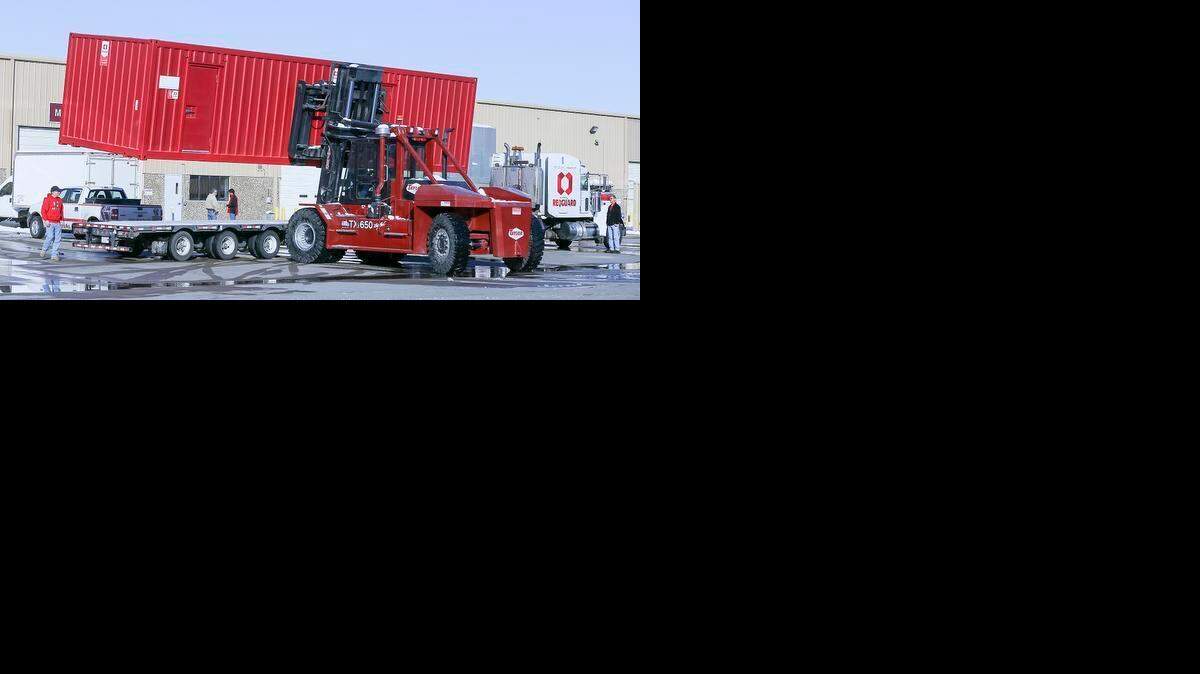
One example of a fast export ramp-up is RedGuard, a maker of blast-resistant, pre-fabricated steel buildings for refineries, chemical plants and other dangerous industrial locations.
Owner Jeff Lange said the company is just getting into exporting. Ten percent of sales are now international, twice the percentage of a year ago.
“I think we could be at 50 percent in the not-too-distant future,” he said.
It took three years to get into the Canadian market, a grueling ordeal, he said. But RedGuard then went to Qatar, and now companies from all over the Persian Gulf are calling. It is also in Mexico, and it’s looking to get into southeast Asia.
“Anywhere but China,” he said. “Reverse engineering is a problem there.”
Even though the company is growing rapidly in the U.S., Lange is interested in overseas sales to preserve future market share.
“We have a chance to be the dominant leader in our arena ,” he said. “And our clients are asking us. They are asking us to serve them around the world. We are following the pull rather than driving the push.”
First learning to export was “beyond difficult,” Lange said, but he said there are a lot of local and national resources to get started.
A.J. Anderson, director of the Wichita office of the U.S. Commercial Service for the Department of Commerce, recommended that any company interested in exporting start with him or the Kansas Global Trade Service. Other helpful groups are the Small Business Development Center at Wichita State University; the Small Business Administration office in Wichita; bankers who specialize in trade, such as Dina Aaby, senior vice president at Intrust Bank; or freight forwarders such as Held & Associates.
“We all stay in touch with each other,” Anderson said.
“I don’t think it’s hard at all to be an exporter, depending on the product or service,” Anderson said. “But there is a learning curve. A lot of it comes down to the commitment of the U.S. company. If they commit the resources and time, it can be very quick, a matter of weeks or even days.”
Reach Dan Voorhis at 316-268-6577 or dvoorhis@wichitaeagle.com. Follow him on Twitter: @danvoorhis.
Wichita metro exports
(in billions of dollars)
2005 | 2006 | 2007 | 2008 | 2009 | 2010 | 2011 | 2012 | 2013 |
$3.9 | $5.3 | $5.7 | $6.8 | $5 | $5.5 | $4.2 | $4.3 | $3.8 |
Source: U.S. International Trade Administration
This story was originally published February 27, 2015 at 6:00 AM with the headline "Wichita makes push to help companies increase global sales."