
Kansas researchers developing battery alternatives with nature’s ‘wonder material’
Imagine recharging your smartphone almost instantaneously or folding it up and putting it in your purse or pocket.
That might be reality one day thanks to the research of some Kansas State University scientists.
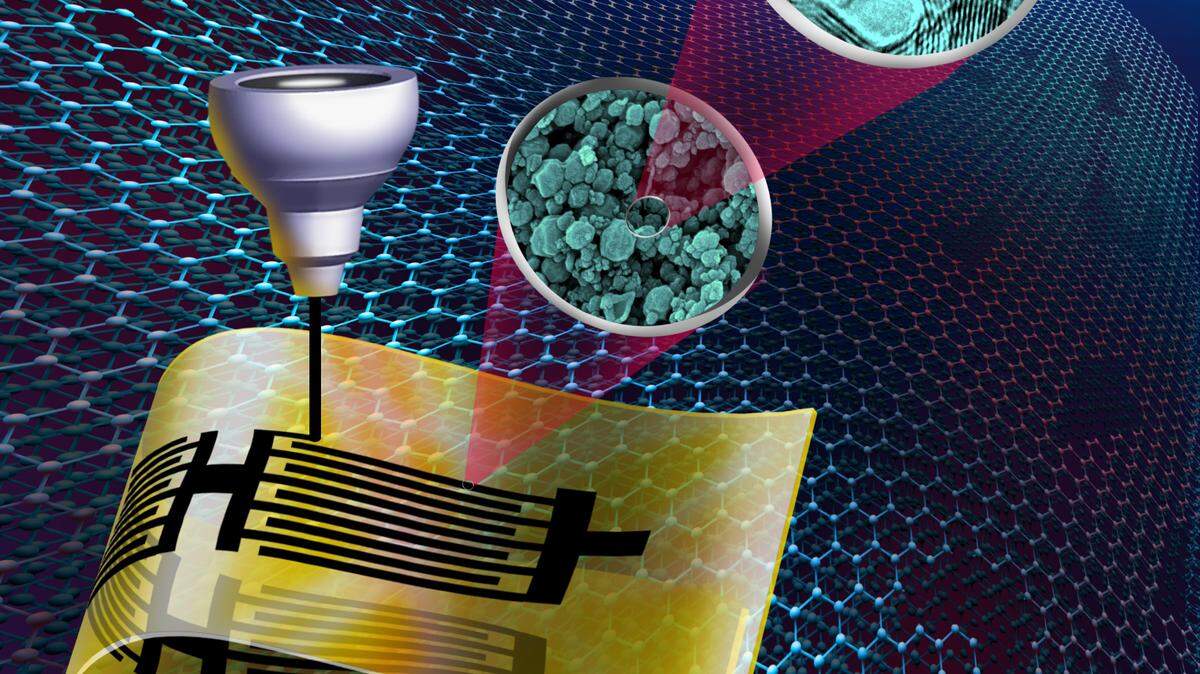
They recently published a study showing the potential of using graphene, dubbed a “wonder material,” to print supercapacitors that could one day replace batteries and lead to flexible electronics.
“We showed that we can very well print a number of devices in any kind of architecture we want,” Suprem Das, an assistant professor of industrial and manufacturing systems engineering at Kansas State University and one of the study’s authors, said.
The team used graphene inks to print tiny electrodes on flexible materials and tested how well they charged and discharged.
“If we can make flexible electronics with our cheap inks, that’s going to have all kinds of applications. I mean, we can almost imagine having sensors on our clothing and gathering sunlight as we walked down the street to charge our cell phones, I mean, all kinds of crazy things,” Christopher Sorensen, a university distinguished professor of physics at Kansas State University and one of the study’s authors said.
What is graphene and why is it called a wonder material?
Graphene is a two-dimensional form of graphite, with its carbon atoms arranged in a honeycomb shape. As graphene is only one atom thick, it is the world’s thinnest material.
Despite being so thin, it’s one of the strongest materials in the world, estimated to be hundreds of times stronger than steel while being more flexible.
Given its strength as well as other properties such as being more conductive than copper, researchers have dubbed it a “wonder material.”
Its discovery and extraction from graphite won the Nobel Prize in Physics in 2010.
How the researchers made graphene
Graphene is typically produced by ripping sheets of graphene off of graphite or by heating metals in the presence of a carbon-rich gas like methane. These methods can be time consuming to do and can produce graphene of varying quality.
Sorensen’s method is different and he discovered it completely by accident.
“I wasn’t trying to make graphene,” he said.
In the early 2000s, he was studying soot formation in flames and discovered that soot could form a gel.
It’s like putting a tablespoon of gelatin into a quart of water, Sorensen said.
Sorensen’s later research moved away from using flames and instead started using a metal chamber with an automotive spark plug as the source of energy. By mixing acetylene and a small amount of oxygen in the chamber, he could use the spark plug to create an explosion.
Instead of opening the chamber and letting the smoke out, he left it alone for a few minutes and discovered the smoke formed a gel that he described as “black angel food cake.”
When he looked at the gel under a microscope, he expected to see little round balls of carbon. Instead though, he saw flat sheets.
“I realized we made graphene, but I didn’t know just how significant my discovery was because I wasn’t in this big horde of people studying graphene at the time,” Sorensen said. “I had my own agenda.”
Lorenzo Mosca, a professor of chemistry at the University of Rhode Island who was not involved in the study, described Sorensen’s method as a “definite improvement over other fabrication methods.”
In addition, Das described Sorensen’s method as environmentally friendly compared to more conventional methods for creating graphene.
“It’s very novel in the sense that it does not produce any kind of environmentally harmful products,” Das said. “The process is green.”
How the researchers created their supercapacitor
Using Sorensen’s process, the research team created a graphene ink. Then through a process similar to 3D printing, they printed tiny graphene electrodes on a flexible surface. They even created one in the shape of Kansas State’s mascot, Willie the Wildcat.

The researchers then tested how well the electrodes worked after 10,000 cycles of charging and discharging. They found that the electrodes retained 80% of its capacitance ability over those cycles, which Das said was “very stable” and “pretty good.”
In comparison, a study from 2019 reported that the lifespan of lithium ion batteries in use today ranged between 150 and 2,300 cycles.
In addition to improving battery lifetimes, graphene supercapacitors might also be able to improve charging speeds.
A graphene supercapacitor could reach full charge in only minutes compared to the hours it takes for the lithium-ion batteries currently found in smart phones, power tools, and other portable electronics, according to Mosca.
The future of graphene
While the properties of graphene make it interesting for electronics, Sorensen said that graphene could have other applications too.
He said that graphene could be used to make stronger concrete and reduce the carbon footprint of producing concrete.
“If we could use less of it, that [carbon dioxide] footprint would be smaller, and that would be good for our environment,” Sorensen said.
In addition, he said that graphene might be able to be used to deliver nanoparticles into the human body to detect cancers quicker than we can now without causing harm to the body.
While applications of graphene are still active research areas, they may not be too far off into the future.
“I think we will see a lot more of them in our lives than people would expect in the next 10-15 years,” Mosca said.