
Cure what ails you in Arkansas’ Hot Springs National Park
The same week I returned from visiting Hot Springs, Arkansas, I noticed a large display of Mountain Valley Spring Water’s iconic green glass bottles at the Sprouts grocery store within a mile of my East Wichita home.
I passed on the purchase because I had two glass jugs in my refrigerator filled from a water station in the same Ouachita mountain range where Mountain Valley has sourced its water for the past 150 years.
The water I transported across state lines didn’t last long. It tasted great, plus drinking it sparked memories of the couple of days I spent exploring the forest and the historic downtown while learning about the geology and culture that in one decade of the late 1800s turned the area from a rough frontier town into an elegant spa city attracting celebrities, athletes and others hoping that “taking the waters” would alieve arthritis, back pain and other ailments.
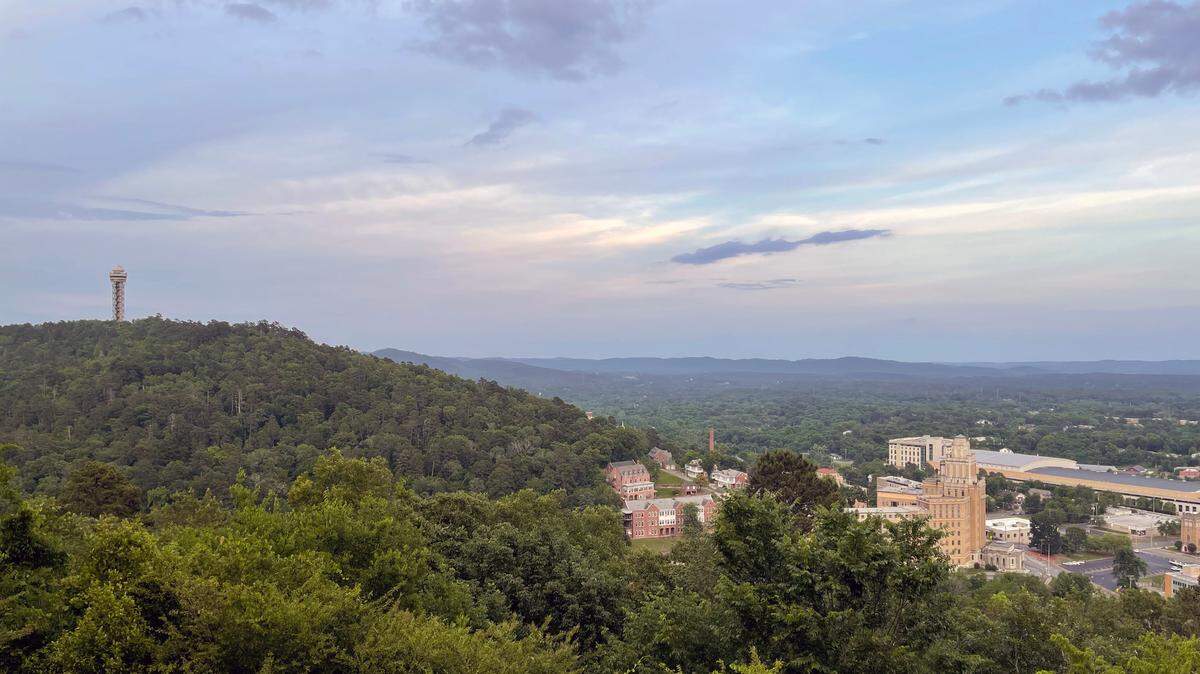
I wasn’t sure what to expect on my first visit to Hot Springs, a road trip triggered by news that Hot Springs National Park was celebrating 100 years as a national park. I made the roughly 400 mile drive southeast of Wichita in late spring and the drive through the west central area of Arkansas was breathtaking, with heavily forested layers of every shade of green stretching as far as I could see. I could imagine a drive here in the fall would be beautiful with a different palette of colors (the area typically hits peak fall foliage in early November).
At 5,500 acres, Hot Springs National Park is second smallest, behind St. Louis’ Gateway Arch National Park. I appreciated that it was overwhelming to get a good feel for what it offered even with a short stay in the area. I was surprised that I spent as much time enjoying the urban experiences as I did within the park’s 26 miles of trails and two scenic byways.
That’s a testament to how well the city and the National Park System have integrated the recreational opportunities of the park with Magnolia-lined Central Avenue, where you’ll find historic Bathhouse Row structures on one side and shops, restaurants, museums and other attractions on the other side.
Behind Bathhouse Row is a wide pathway called the Grand Promenade. The 1 mile paved walk separates the lower slope of the mountain and the historic downtown. Walking this route takes you past collection boxes for the 700,000 gallons of thermal water flowing daily, steam rising at display springs and streams, manicured lawns with seating and paths leading farther into the forest.
What are the hot springs?
Though Hot Springs National Park is 100 years old, that only accounts for its time as a national park. Park officials say it is the oldest area in the national park system when you factor in that Congress created Hot Springs Reservation in 1832 to preserve the area’s 47 thermal springs, 40 years before Yellowstone became the country’s first national park.
The waters had long been attracting Indigenous people for medicinal and spiritual properties, then early European settlers and eventually the masses arrived as the country’s transportation infrastructure developed. Simple shacks morphed into elaborate spas that reached their height of popularity in the 1920s. They remained popular until the 1950s, when interest in therapeutic bathing declined as medicine evolved.
According to the National Park Service, the namesake of the area is nearly 4,400-year-old spring water. It starts as rain falling and entering rock formations at the tops of the mountains and traveling 6,000 to 8,000 feet deep into the earth. When it reaches a major fault on the west slope of the mountain, it is propelled to the surface. It emerges at the base of Hot Springs Mountain, directly behind Bathhouse Row, at an average temperature of 143 degrees Fahrenheit. The water’s high temperature kills most harmful bacteria, and it is monitored to U.S. standards for safe drinking water and use in the spas.
The park collects that spring water and distributes it unfiltered and unaltered. You can soak in the geothermal waters (indoor at spas or hotels only), you can drink the water in its natural form by filling your water bottle or jug at several thermal spring fountains, or you can try it brewed into a beer at Superior Bathhouse Brewery.
The thermal water is rich in minerals and is advertised as not having an odor or a predominant taste, which I found to be true.
Today’s Hot Springs
There are eight historic bathhouses remaining on Bathhouse Row, all constructed between 1892 and 1923 and renovated in recent years. Two operate as spas, one serves as a visitor center with a free museum, another is home to the first brewery in a national park. There’s also a cultural center with free gallery exhibitions for the park’s artist-in-residence program, a gift shop operated by the America’s National Parks organization and a boutique hotel and restaurant with a mid-century modern style in the row’s oldest visible structure (1892).
You can visit at least the lobby of each free of charge to see displays on the history of the building. I found them all worth visiting but if you’re not interested in having your own spa experience, opt for walking through Fordyce Bathhouse; its historical displays will give you a feel for what a Hot Springs spa looked like in 1900 and some of the hydrotherapy techniques used that seem wacky by today’s standards.
Of the two operating spas, Buckstaff Bathhouse has been in continuous operation since opening. It features original bathtubs and equipment to offer a traditional bathing package visitors could have found when it opened in 1912.
I opted to go to Quapaw Bathhouse, which offers $20 public soaks in their indoor, thermal mineral water pools that range from 96 degrees to 104 degrees. They also have private baths and a full-service spa.
My best piece of advice no matter your budget: stay within walking distance of the park and Bathhouse Row. You can get an affordable room at the modest Happy Hollow motel right across the street from the national park and just a couple blocks from Central Avenue, or opt for one of the hotels that plumb water directly from the hot springs into your room’s tub.
You’ll appreciate being close to the park and the historic district, though if you have time you might want to drive to other areas of the city of Hot Springs for Oaklawn Racing Casino Resort, the Mid-America Science Museum, the 210-acre Garvan Woodland Gardens or one of the area’s lakes and state parks.
One more tip: Be sure to stop at Lamar Bathhouse, the park’s official gift shop, and pick up a 100th anniversary glass jug that you can fill from either the thermal spring or cold spring fountains. While “taking the waters” or “quaffing the elixir” — phrases that conjure the area’s heyday of being “America’s Spa” — might not cure you of what ails you, these are experience you shouldn’t miss when in Hot Springs.
Ranger Ashley Waymouth’s hiking suggestions in Hot Springs National Park
Ashley Waymouth, a park ranger at Hot Springs National Park, offered these hikes for first-time visitors depending on fitness level and available time.
Grand Promenade is a paved 1 mile loop around Bathhouse Row with views of the bathhouses, the thermal springs and beautiful landscaping. There are waysides, benches and checker board tables along the Promenade.Goat Rock Trail is a moderate, 1.1 mile trail full of interesting geological formations and stunning views of the Ouachita Mountains and the recharge zone for the springs.
Peak Trail to Hot Springs Mountain Loop combines several trails to create a 2.9 mile loop from Bathhouse Row to the top of Hot Springs Mountain.
West Mountain Loop is a moderate to strenuous 3.3 mile loop taking hikers to the top and around West Mountain, with views of rocky outcroppings and downtown Hot Springs from a distance.
Oertel Trail to Goat Rock to Upper Dogwood to Hot Springs Mountain to the Peak Trail offers a fun 5.4 mile loop around Hot Springs Mountain on some of the most popular trails in the park, including the Oertel Trail that ranges from moderate to steep grade.
If you go
Hot Springs, Arkansas
400 miles southeast of Wichita
More info: Visit Hot Springs hotsprings.org and Hot Springs National Park nps.gov/hosp