
Animal sanctuaries let you encounter nature at its wildest
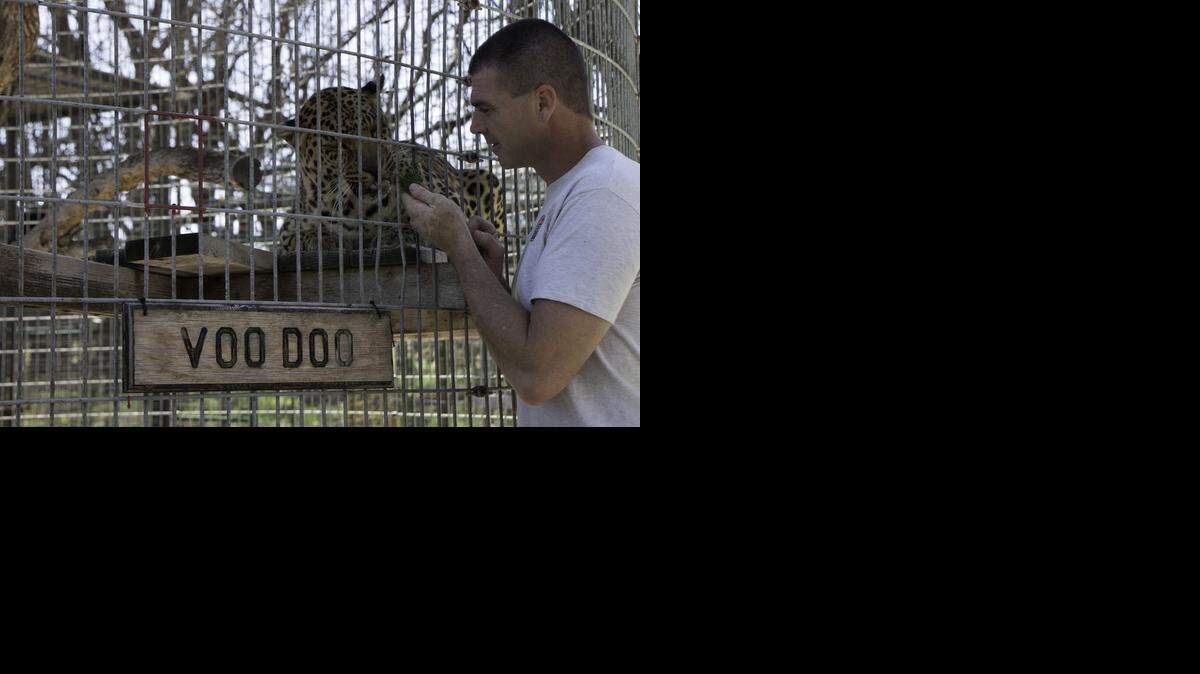
Voo Doo the leopard was bought as a kitten to be a playmate for a family’s dogs. After only six months, though, the family realized that the “wild” in this wild animal was too much to handle as a pet. The family called Cedar Cove Feline Conservatory and Education Center for advice and eventually asked the center to take the cat.
Now 14 and with a beautiful orange-brown coat spotted with black rosettes, Voo Doo is one of 26 animals that have a permanent home under the care of the all-volunteer staff at Cedar Cove, a nonprofit organization 20 miles south of Kansas City on U.S. 69 near Louisburg. Founded in 2000, the center is devoted to the care and preservation of endangered large cats. Among tigers, lions, leopards and cougars there are also bobcats, caracals (also known as the desert lynx) and wolves.
Cedar Cove is one of hundreds of animal sanctuaries in the U.S. that rescue and provide care for animals that have been abused, injured, abandoned or are otherwise in need. The animals come from people who either tried to raise them or found them on their property, from government agencies, from zoos and from other wildlife facilities.
Only a few sanctuaries are open to the public. Cedar Cove offers tours because founder William Pottorff felt sharing the stories of Voo Doo and others could help reduce demand for exotic animals as pets.
“Conservation through education. The impact that I can see on groups of kids when I’ve reached them is amazing. They leave here, and they’ve got a new perspective, and that could be a seed for change somewhere down the line,” said Steve Klein, who is Cedar Cove’s president, director of facilities and risk management and its senior curator. Klein studied aerospace engineering at Wichita State University before transferring to the University of Kansas to study journalism. He began volunteering on construction projects at the facility in 2001 while working in advertising in Kansas City and has stepped into a leadership role with fellow longtime volunteer B.J. Auch since the center’s founder died in 2012.
Cedar Cove is open on the weekends year-round (adults, $7; seniors and ages 4-12, $5; ages 3 and younger, free) and hosts group tours by appointment on weekdays. Admission includes a guided tour covering the animals’ behavior, physiology, habitats and threats of extinction. About 50,000 people visit Cedar Cove annually, including 750 for its Halloween special event.
The tours and special events help raise funds for the care of the animals, including building spacious, natural habitats to get them out of smaller, temporary structures.
Fall is an optimal time to visit animal sanctuaries, which often host special events during the cooler temperatures when the animals can be more active. In addition to Cedar Cove, following is a list of sanctuaries to consider visiting. All are nonprofit organizations and are open year-round; check their websites for exact hours and tour details.
▪ Eagle Valley Raptor Center, Cheney; eaglevalleyraptorcenter.org
Established in 2003, Eagle Valley Raptor Center is licensed with the U.S. Fish and Wildlife Service and the Kansas Department of Wildlife and Parks and Tourism to provide food, shelter and veterinarian care for injured and orphaned Kansas birds of prey. Some will remain at Eagle Valley. Others get the care they need until they are ready to be returned to the wild.
The center takes in about 150 birds a year and has one of the largest collections of birds of prey in the state, including bald and golden eagles, six species of owls, falcons, American kestrels, red-tailed hawks, turkey vultures and Harris hawks.
Ken and Susan Lockwood offer guided tours of the center to educate visitors on the role the birds play in the Kansas environment. Tours average 90 minutes and must be arranged in advance (a $5 donation per person is suggested, with a minimum of eight people). Private tours also are available, including a Lovebird tour for couples.
▪ Turpentine Creek Wildlife Refuge, Eureka Springs, Ark.; turpentinecreek.org
Turpentine Creek Wildlife Refuge was founded in 1992 when a breeder and black market dealer showed up on the Jackson family’s doorstep with 42 big cats crammed into three cattle trailers. Having now rescued abandoned, abused and neglected wildlife from across the country, the refuge – seven miles south of Eureka Springs – is home to more than 130 animals, including tigers, lions, leopards, cougars, bears and other wildlife.
Entrance to the 450-acre refuge (adults, $20; ages 13-19, $15; ages 4-12, seniors and veterans, $10; ages 3 and younger, free) allows visitors a self-guided tour of the concrete cages where rescued animals are housed until larger natural habitats are available; a guided, half-mile walking tour of the habitats; and keeper talks on the weekends. Visitors learn about the species and the rescue stories behind each animal.
The refuge’s goal is to house all rescued animals in natural habitat enclosures with natural grasses, trees and undergrowth. About 70 big cats and six black bears are in habitats ranging in size from 8,000 to 20,000 square feet, while the remaining animals wait for more to be built.
Special events as well as photography and behind-the-scenes tours are available. The refuge also has on-site accommodations, from cabins to tree houses to RV sites.
▪ The Wild Animal Sanctuary, Keenesburg, Colo.; wildanimalsanctuary.org
Established in 1980 and open to the public since 2003, The Wild Animal Sanctuary is 30 miles northeast of Denver on 720 acres of rural, rolling grasslands with areas under development on 400 additional acres.
The sanctuary specializes in rescuing large carnivores, although its animal population of more than 350 includes a wide variety of species. Visitors will see animals in enclosures at the central compound as well as in large, natural habitats. Species-specific habitats include tiger, wolf, black bear, grizzly bear, African lion, leopard, lynx and bobcat. In 2011, the sanctuary expanded to take in 25 lions rescued from Bolivian circuses. Extensive media coverage doubled annual attendance to more than 100,000 visitors.
Visitors use elevated walkways and observation decks for views into the enclosures and habitats. Detailed printed guides share animal rescue stories and maps, and docents are available for questions. Regular admission is $15 for adults, $7.50 for ages 3-12. Private guided tours also are available.
▪ Cleveland Amory Black Beauty Ranch, Murchison, Texas; blackbeautyranch.org
The Fund for Animals purchased 85 acres in Murchison, Texas, to house hundreds of burros rescued from the Grand Canyon in 1979, and over the years, the acreage grew as the facility became the fund’s national animal sanctuary. Today the Cleveland Amory Black Beauty Ranch and the adjacent Doris Day Equine Center occupy 1,300 acres and are home to more than 1,000 animals rescued from abuse, including chimpanzees and other primates, horses and burros, bobcats, iguanas and African tortoises, antelope, deer, ostriches, llamas, American bison and dozens of other domestic and exotic species.
Cleveland Amory, a best-selling author and animal advocate, created the Fund for Animals in 1967 and served without pay as its president until his death in 1998. His vision for the ranch, which was founded in 1979, was that it “would be a place where animals are looked after, not looked at.”
Therefore, the facilities – 95 miles east of Dallas – are open to the public only during spring and fall open houses. The fall open houses are scheduled for Oct. 11 and 18 and offer guided walking and bus tours, horsemanship demonstrations, introductions to adoptable horses, hayrides through both centers and information about volunteering. Most open house activities are free, but donations are appreciated.
▪ Black Hills Wild Horse Sanctuary, Hot Springs, S.D.; http://www.wildmustangs.com
North America’s largest wild horse sanctuary is the 11,000-acre ranch that is home to more than 600 wild Mustangs in western South Dakota. Black Hills Wild Horse Sanctuary is part of a larger organization called the Institute of Range and American Mustang. The wild horse sanctuary was founded in 1988 by rancher Dayton O. Hyde when he convinced the Bureau of Land Management to send him its captured wild mustangs that were destined for slaughterhouses. The unadoptable and unwanted wild horses live out their lives at the sanctuary, where there is also a research area dedicated to solving wild horse herd management.
There is no charge to make the three-mile drive into the sanctuary, during which visitors might see bands of wild horses as they pass an 1890 schoolhouse and homestead. Several corrals near the visitors center hold preservation herds, giving an up-close view of Choctaw Indian ponies and their foals.
Tours to see hundreds of wild horses living in their natural habitat range from two hours to three days, starting with a guided bus tour ($50 for adults, $45 for seniors 55 and older, $15 for ages 13-18, $7.50 for ages 6-12.) There also are American Indian petroglyphs, a sundance ceremonial site and a movie set among the prairie and canyon lands. The sanctuary has two cabins it rents out overnight.
▪ Colorado Wolf & Wildlife Center, Divide, Colo.; wolfeducation.org
After a decade of rescuing unwanted wolf-dogs, Darlene Kobobel wanted to provide more education about the importance to the ecosystem of wolves, coyotes and foxes. Opened to the public in 2003, the Colorado Wolf & Wildlife Center is 25 miles northwest of Colorado Springs.
There are typically 30 resident wolves, coyotes, red foxes and swift foxes. The Colorado Wolf and Wildlife Center has been certified by the Association of Zoos and Aquariums, which allows it to house endangered canid species like the swift fox and the Mexican gray wolf, the rarest subspecies of gray wolf in North America. Earlier this year, the center transferred a male Mexican gray wolf to the Sedgwick County Zoo for reproduction purposes, getting three Mexican gray females in return.
Standard one-hour educational tours ($15 for adults, $8 for ages 12 and younger) teach visitors about hunting, howling and hierarchy while sharing the personal rescue stories of each resident. Feeding tours are similar but ensure more visibility, as the habitats are large and the animals are not always visible from the walkway. The center is serious about its camera rule: No lens longer than 70mm allowed. Photography tours that do allow more equipment are available, though, and they are popular in the fall and winter, when the animals’ coats are at their most beautiful. The center also organizes special events and animal encounters.
This story was originally published September 14, 2014 at 3:48 PM with the headline "Animal sanctuaries let you encounter nature at its wildest."