
Separate but together: Wichita’s oldest Jewish congregations to be in one building
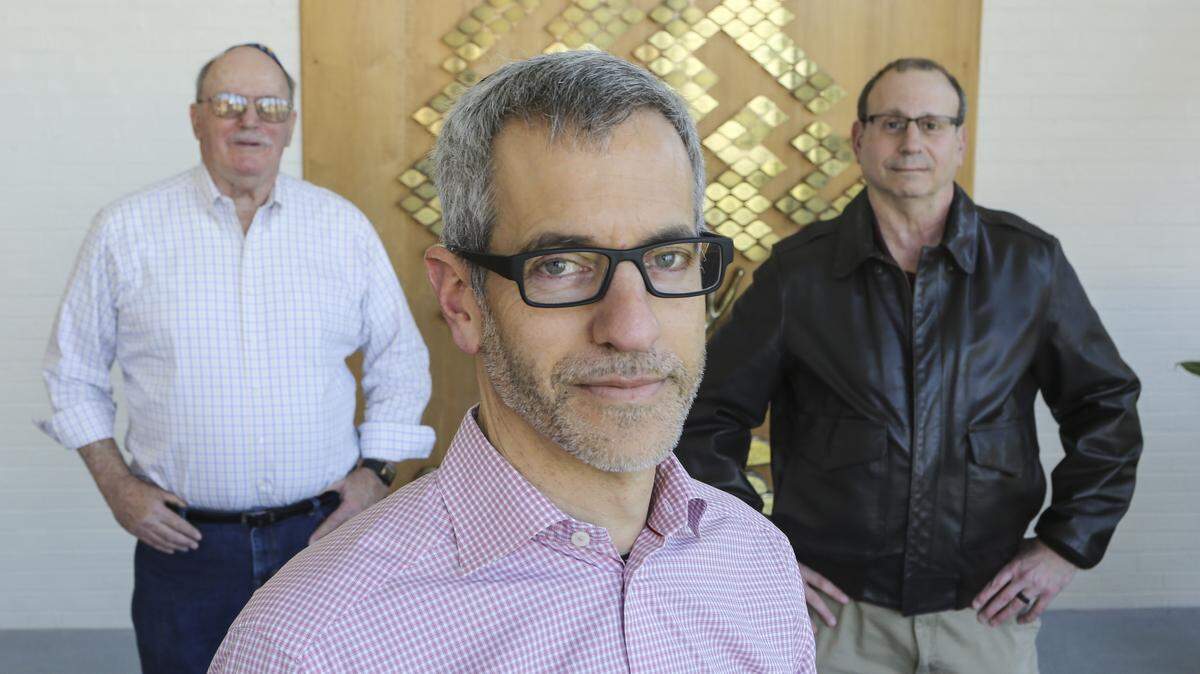
Before her 2016 death, Wichitan Joan Beren was a member of Ahavath Achim: The Hebrew Congregation of Wichita, but she also was supportive of Congregation Emanu-El and was a beloved regular presence there.
“She was always one of these people trying to bring the Jewish community together,” said Congregation Emanu-El member Daniel Solomon.
Beren has achieved that posthumously through her family’s foundation, which is helping bring both congregations under one roof — a wrenching decision that’s been discussed for decades but now is happening.
“Everybody knew that was what Joan would have wanted,” said Ryan Bendell, treasurer of the Wichita Jewish Community Center.
The combined campus at 1850 N. Woodlawn will be known as the Joan S. Beren Campus of the Wichita Jewish Community Center.
Currently, that is the home of Hebrew Congregation, which is known as the Hebrew Synagogue. By late this year, it also will be home to Congregation Emanu-El, which is also known as Temple Emanu-El.
Each congregation will remain separate but will be in one place. To say there was a lot that led to this decision is a serious understatement.
“Nobody wanted to give up their home, right?” Bendell said.
It’s part of why previous attempts at combining the places of worship or even merging the congregations have failed.
“It was a tough process,” said Solomon, WJCC president. “I have a lot of emotion, too, but I think we all kind of recognize that we need to have something that’s sustainable for the long term.”
Dwindling numbers at both congregations, changes in Wichita’s economy through the years and two aging buildings are some of the major reasons for combining resources.
It’s a chronic situation that has become acute, said Scott Wagner, president of Congregation Emanu-El.
“Change is difficult for everybody, but we eventually get used to new things, and I think that’s what’s going to happen as we go forward.”
Wagner said what will be critical as they proceed is the attitude of congregation members.
“I’ve supported it since the very beginning,” he said. “Our community is stronger together.”
Most of the congregants appear to agree. More than 80% of each congregation voted favorably in November to combine resources in one place. Hebrew Congregation’s 1962 space is the larger of the two.
Now, Congregation Emanu-El’s 1961 building at 7011 E. Central, between Woodlawn and Rock Road, is on the market.
“I grew up in this building,” Solomon said.
For him and other members of the congregation, significant life events have happened there.
“On a very gut level, we are leaving this building in which we have worshiped and celebrated and mourned and prayed and learned,” said Congregation Emanu-El Rabbi Michael Davis.
Both congregations held fundraisers to renovate the Woodlawn space, which will include a second sanctuary, a second kitchen and updated spaces that will become shared spaces.
Paul Wolff, president of Hebrew Congregation, said it’s a period of transition.
“There will be a lot of changes in our building for us, and then for them, it’ll be new,” he said.
“It’s like a marriage when two people move in together and then adjust to each other. That’ll take a little doing.”
‘We’re all Jews’
In 1885 — 21 years after Wichita became a city — Congregation Emanu-El formed. Hebrew Congregation followed in 1907.
Hebrew Congregation is conservative, and Congregation Emanu-El is reform, and both will remain so.
“We may practice Judaism differently, but . . . we’re all Jews,” Davis said.
Congregation Emanu-El once had about 200 member families. Today, it has about 100. Hebrew Congregation also had about 200 families at its peak. A decade ago it had 100, and now it has close to 70.
“It became a question of what are we going to do to preserve the Jewish community?” Wolff said. “We are such a small presence of the population.”
Davis said the congregations are more important than the buildings.
“I felt my role in this process was to assure that whatever decisions were made . . . that the congregation wasn’t torn apart.”
Still, Congregation Emanu-El’s Judaica — Jewish art and objects — are a concern for him.
“They all make up a little bit of the building,” Davis said.
He admits he’ll be disappointed if the 7-foot menorah that serves as a greeting on Congregation Emanu-El’s front lawn does not make the move.
“It’s just a magnificent piece.”
Wolff said seating will be moved from Congregation Emanu-El to Woodlawn to make congregants feel more at home in their new sanctuary.
Solomon said a joint committee is working to make the updated space reflective of both congregations.
“One of the things that we’re trying to do . . . is to emphasize that both congregations are both giving up and gaining,” Davis said.
Congregation Emanu-El’s 3.85 acres and 18,217-square-foot building are listed with ReeceNichols South Central Kansas.
There will be a sealed bid process to sell the property. Bids are due by 2 p.m. on May 15.
“We’re just allowing the buying market to make their determination of value on the property,” said ReeceNichols broker John Rupp.
“This is such a unique opportunity and offering.”
There are no restrictions on potential usage, so the sale could be to a group, such as another place of worship that wants to use the current building, or to developers who want to tear it down and redevelop the property.
“Our objective is to maximize the value for the community,” Solomon said.
Congregation Emanu-El members also want to be good to their neighbors, who have been particularly supportive over the years, such as when they offered a gift in solidarity after a Pittsburgh synagogue shooting in 2018.
“It will be tough to leave that neighborhood,” Solomon said.
What about Deli Day?
Of all the practical details that have yet to be worked out, there’s one of chief concern for the greater Wichita community: What about Deli Day?
Congregation Emanu-El has hosted the popular meal and sale of Jewish food for more than half a century.
“This is one of the core community events from Congregation Emanu-El’s perspective that we didn’t want to lose by virtue of moving,” Solomon said.
For now, the event is slated for the second week of November, but whether that will take place at Congregation Emanu-El’s current building or its new one is unclear.
Though there’s uncertainty for this year’s event, Solomon said, “We have really worked hard to coordinate to keep that.”
Community school
The Joan S. Beren Jewish Community School also is moving.
Previously, the religious school for children ages 4 through ninth grade has split its academic year between Congregation Emanu-El and Hebrew Congregation.
School director Jamie Smartt said that while children love both buildings, that constant transition is difficult for the younger children.
“It really throws them for a loop no matter what building we’re in.”
She said that’s going away since the school will be at Woodlawn permanently, and she said there are other benefits as well.
“It will streamline everything,” she said. “We’re forever going, ‘Oh, no, that’s at the other building.’ ”
Smartt said the school is “testament that we can do some really good things together,” and she thinks locating both congregations in one place is an opportunity to further set an example.
“It is positive when we can come together as a community and show our children that we’re a really strong group of people who can do hard things. We can show our kids that we can work through our problems.”
Bendell said a friend of his said there is one aspect of the decision to come together that is more important than anything else.
“He saw it as a small community being together . . . and that it was getting rid of . . . ‘them and us’ and it became ‘ours.’ ”