
Father Kapaun’s remains not likely among those returned from North Korea, priest says
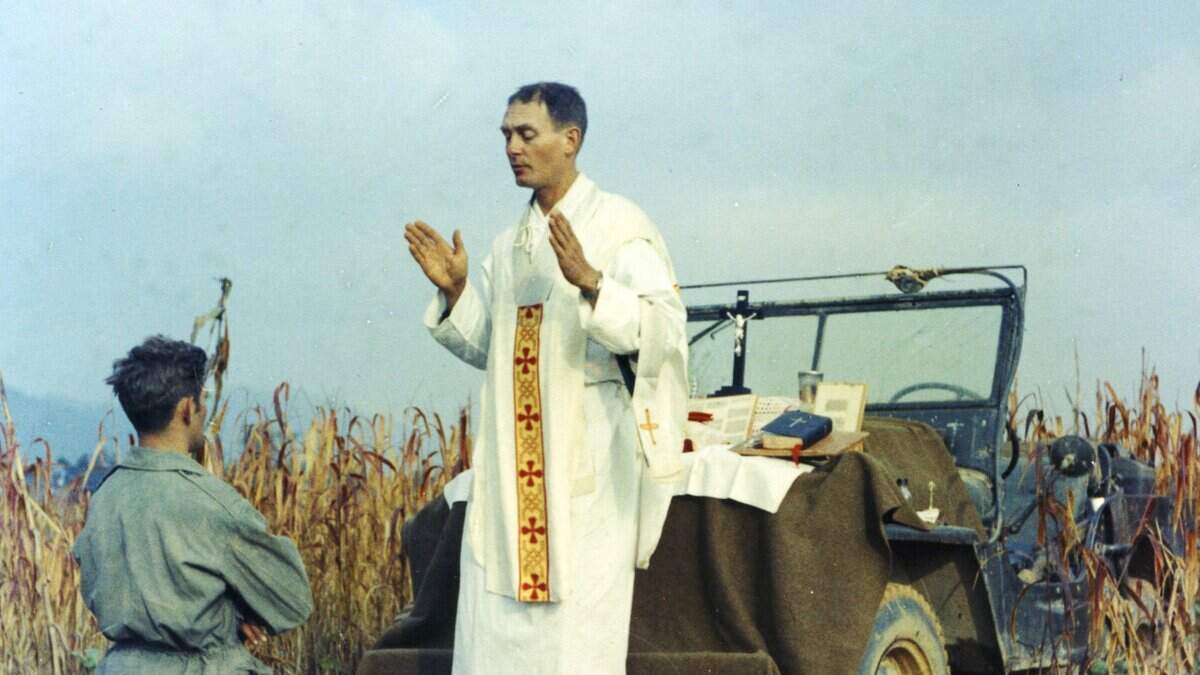
The return of U.S. soldiers’ remains from North Korea has raised hopes that Father Emil Kapaun, Kansas saint-to-be, may be among them, but the priest in charge of the local canonization effort says he thinks the chance is “little to none.”
The first set of remains to be returned after President Donald Trump’s meeting with North Korean leader Kim Jong Un landed in South Korea on Friday. It contains 55 boxes of remains and a single military identification tag.
The Rev. John Hotze, the priest in charge of the local effort to elevate Kapaun to sainthood, said he thinks it is more likely that Kapaun’s remains are among other unidentified soldiers in Hawaii — or that his remains are still in North Korea.
Kapaun, a Kansas farm boy born in 1916, died of illness and starvation in a North Korean prison camp in 1951. He was a chaplain, with his regiment fighting during the first year of the Korean War.
“As time goes on and if North Korea does allow the United Nations or United States to go into look for the remains, I do have great hopes that his remains would be found then,” Hotze said.
For years, there has been speculation that Kapaun’s remains may be among those at the National Memorial Cemetery of the Pacific in Honolulu.
Remains marked “Father Kapaun” were among those returned to the United States after the Korean War, but experts identified the remains as belonging to a man much younger than Kapaun.
Remains were also found of a Sgt. Lusk, who passed away about three months after Kapaun and was buried in the vicinity.
“They believe Father Kapaun’s remains are there in Hawaii, because if Sgt. Lusk’s remains were returned and he was buried near Father Kapaun, they thought surely Father Kapaun’s remains would have been returned also,” Hotze said.
However, after years of believing that Kapaun had been buried in a mass grave near the Yalu River, researchers learned that Kapaun may instead have been buried underneath a lean-to closer to the “death house” or camp hospital, Hotze said.
If Kapaun’s remains were not in the same grave as Lusk, then they may still be in North Korea.
Kapaun was given a posthumous Medal of Honor in 2013 and was named a “Servant of God” by the Catholic Church in 1993, meaning his cause for canonization had begun. A theological committee is currently reviewing Kapaun’s Positio, which includes details of his life and works, as the Catholic Diocese of Wichita works to compile information on alleged miracles attributed to Kapaun.
Hotze said he hopes to hear more news from the canonization process by the fall.
The return of Kapaun’s remains would bring closure to his family, Hotze said, and also be meaningful to other Americans.
“It would be a comfort to us knowing that somebody, one of us who went to a foreign land to try to bring peace and justice into that land and died during that process, that he too had made it back home,” Hotze said.
This story was originally published August 1, 2018 at 3:42 PM with the headline "Father Kapaun’s remains not likely among those returned from North Korea, priest says."