
After a turkey trot, it’s all gravy
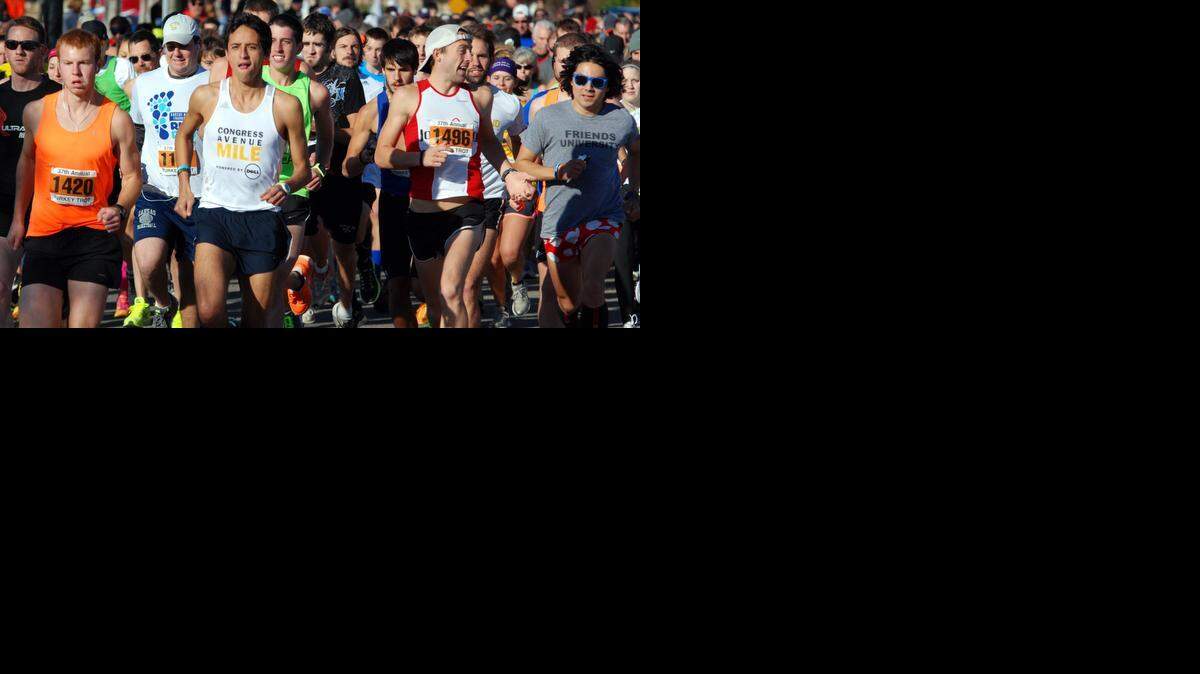
For the health-conscious, Thanksgiving can present something of a challenge. Travel, cooking, family — plus all that football to watch — leave little time (or motivation) to exercise.
But for the truly dedicated, there’s a fun, simple solution: the turkey trot. Over the past few decades, this road race has become something of a national holiday tradition.
This year dozens of turkey trots are being held across the United States. The Wichita Turkey Trot was held Sunday while the Say Grace Thanksgiving Day Race is scheduled for Thursday. The events are typically held Thanksgiving morning — perhaps to both whet the appetite and lessen the guilt of overeating later — and are often fundraisers and include events for children. For many participants, the race is an occasion to dress in an outfit that reflects the spirit of the holiday: a fuzzy-bird costume, say, or a pilgrim’s hat. One pair of racers have been spotted running with a canoe over their heads for the whole race.
But for all the whimsy surrounding this event, the turkey trot has a serious claim on running history: The race, which debuted in Buffalo in 1896, is older than the storied Boston Marathon, which began the following year. Indeed, the Buffalo Turkey Trot claims the title as the oldest continually held foot race in North America.
The inaugural turkey trot, sponsored by the local YMCA, was a decidedly low-key event. There were few racers — only six of the 15 registrants showed up for the five-mile race — and not one of them dressed for laughs. The race, along dirt roads lined with a few spectators on bicycles and in carriages, proved formidable for a couple of the participants, according to an 1896 account. One runner dropped out after two miles; a half-mile later, another withdrew after his “late breakfast refused to keep in its proper place.” The winner, Henry A. Allison, finished the race in 31 minutes and 12 seconds, roughly a six-minute-per-mile pace.
The YMCA Buffalo Niagara Turkey Trot is now one of the largest such races in the country, with registration capped at 14,000 runners this year. For many in Buffalo, the race is a family tradition. Mary Snyder, 76, has run the race since 1978 (women were forbidden to participate in the Buffalo event until 1972), when her husband drove beside her in the car; this year, she will run it with 12 grandchildren and later host a meal for 26. “It’s invigorating and fun,” she says, and a great way “to earn your dinner.”
How did the turkey trot grow from a sleepy late-fall race in Upstate New York to the nationwide extravaganza it is today? One guess: “It’s a catchy name for a race,” says running guru Hal Higdon, who has won many trots himself, including several years in which the prize was a free dinner. “It’s a holiday, everyone has a free day, so you can have your run, burn the calories and make room for the turkey,” he says.
Carla L. Larrick, who co-founded the YMCA Bethesda-Chevy Chase Turkey Chase in Bethesda, Md., in 1982, says that when the members of the Y’s board first discussed holding a race on Thanksgiving, they thought it would either “be a bust or everyone would come.” The latter turned out to be true, especially after the organizers eliminated swimming as part of the event after the first year. The race has raised more than $4 million for youth and families in Montgomery County, Md., and attracts more than 9,000 runners, according to organizers.
Among the participants in the Turkey Chase on Thursday will be Lindsay Jauss, 38, of North Bethesda, who will be running it for her 10th straight year. Jauss, a human resources consultant and mother of two, typically participates in the 10K. Her parents, in their 60s, run the two-mile race, and her children, 3 and 5, participate in the 50-meter kids’ run. (Her husband stays home to cook.)
“It has become as much a part of the tradition as sitting down to dinner with the family,” Jauss says. Whatever her pace, she says, “I come home feeling very victorious. Whatever happens for the rest the day, it’s all good,” including, she jokes, eating a slice of pecan pie “the size of my head.”
In fact, running a fast 10K is about as much as you’ll need to burn off a (typical) slice of pecan pie, which can contain roughly 500 calories, according to the USDA. The rest of the Thanksgiving meal can add up to as many as 3,100 (more if you count all the snacking), according to Jessica Matthews, an exercise physiologist and senior health and fitness editor for the American Council on Exercise. To burn off a 3,100-calorie meal, Matthews says, a 150-pound woman would have to run for approximately 5.5 hours at a 12-minute-mile pace. That’s a lot of trotting.
Thanksgiving Day race
What: Say Grace Thanksgiving Day 5K Race
When: 9:30 a.m. Thursday (Race day registration is 8-9:15 a.m.)
Where: GraceMed Clinic, 1122 N. Topeka.
How much: Registration $15-$35 at gracemed.org; ($40 for adults day of race)
This story was originally published November 25, 2014 at 9:08 AM with the headline "After a turkey trot, it’s all gravy."