
Body image and breast cancer
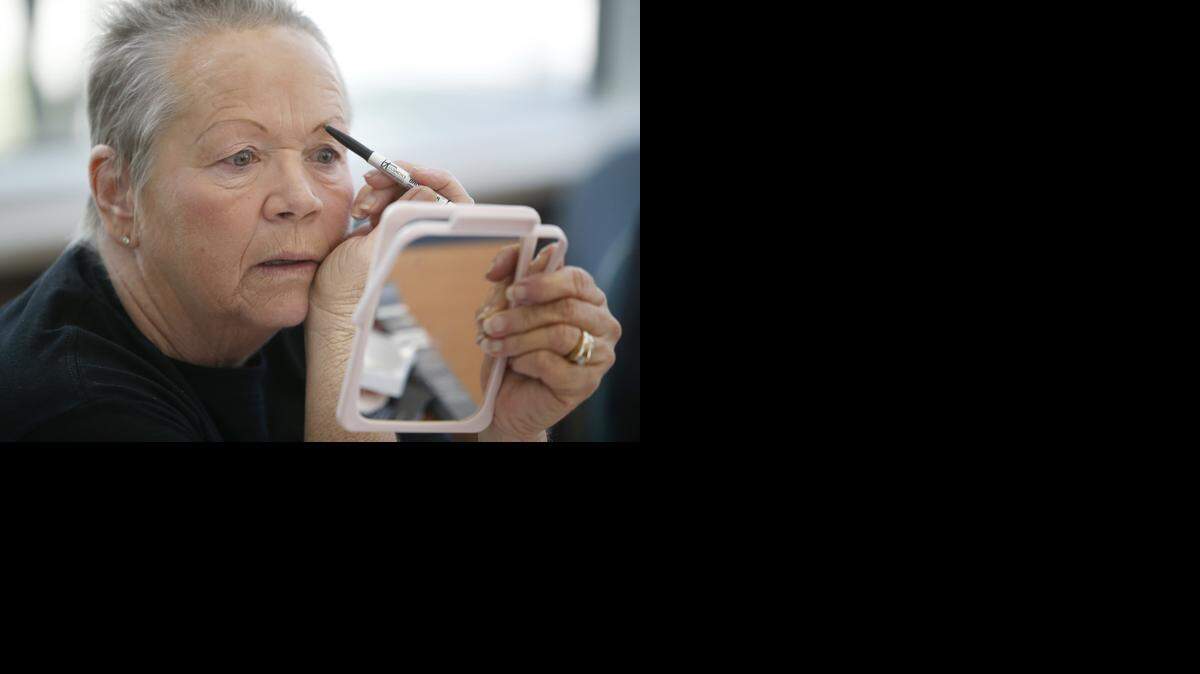
Bonnie Mendez was having fun putting on lipstick to make her look “sexy and pouty.”
Mendez, whose visible signs of breast cancer treatment include burns from radiation treatment along the right side of her neck and a new hair growth on her head, was learning about the do’s and don’ts of makeup and options for wigs, scarves and other head coverings at the American Cancer Society-sponsored “Look Good … Feel Better” seminar.
Because losing eyebrows and eyelashes during cancer treatment is common, Mendez and the other women who attended also learned how to use makeup for fuller eyebrows and to mask the absence of eyelashes.
“I had really long eyelashes so it was so hard” losing them, remarked Sisie Holliday.
Body image issues are a major part of the cancer journey, particularly because the results of treatment – a bald head, a flat chest – are so visible. Skin becomes super-sensitive, dry and scaly and even burned during radiation. Some women say they hate looking at themselves in the mirror when their faces became swollen and puffy from chemotherapy.
It’s natural to grieve a changed body or feel like you’ve lost a part of your identity, experts say. Advancements in breast reconstruction, free makeover services by cancer support organizations, counseling and support groups are available to help women cope.
“They have to go through that grieving process,” said Gina Wendt-Blasing, a licensed Wichita psychotherapist who counsels many breast cancer patients. “Some will feel guilty because they’re being cured so why have issues” with body image. She tells her patients not to discount what’s happened to the body and what’s happened emotionally during their cancer treatments.
Breast reconstruction
Women who undergo mastectomies can face self-esteem issues. To improve the way they feel about themselves or to restore the look of the breast, some women opt for reconstructive surgery.
“We can make a beautiful breast and some women are happier with their breasts” than their real ones after surgery, said Therese Cusick, a certified Wichita breast surgeon with Breast Care Specialists.
One of the biggest advancements has been what doctors call “nipple sparing,” said Jackie Osland, a board-certified surgeon with Breast Care Specialists, and Richard DeSplinter, a plastic surgeon with Via Christi Plastic Surgery & Aesthetics.
In the past, women who underwent mastectomies not only had breast tissue removed, but also the nipple and areola (the darker part of the breast around the nipple). If a woman wanted a more natural-looking breast, complete with a nipple and areola, she had to undergo a reconstruction of that area, after the breast had time to heal, with doctors taking tissue from other parts of the body and even tattooing the darker area, according to the American Cancer Society.
For some women now, breast surgeons can leave the natural areola and nipple in place when removing the breast tissue during a mastectomy, depending on the location of the malignant area.
Other advancements include better tissue expanders and better soft tissue replacements that help create a more natural-looking breast shape, said DeSplinter, who does about one reconstruction a week. It’s not uncommon for a woman to express she wants bigger breasts, if she’s going to have to undergo treatment and reconstruction.
“There are so many different shapes and sizes now and there are multiple methods we can use,” noted DeSplinter’s nurse, Donya Rawlings. Breast reconstruction “draws away the attention they have breast cancer, and they can still look great.”
Mendez, who attended the “Look Good ... Feel Better” seminar, joked, “Sometime I’ll be getting new boobs and they are going to be the youngest part of me.”
Dealing with hair loss
Hair loss during treatment is another obvious sign of cancer, and it can be a traumatic one for some women.
When Debbie Christiansen, 61, was diagnosed with breast cancer 14 years ago at age 47, she opted to get a wig that looked very similar to her own hair. A financial adviser with Carson Investment Group, she didn’t want her clients or co-workers to be able to tell she had cancer or feel uncomfortable around her if she would have chosen to wear scarves.
“I worked for several months, and I never told anyone,” she said.
Kalee Beal, who was diagnosed at age 22, said she hated it when strangers commented on her condition whenever she wore scarves to cover her bald head.
After getting some advice about wigs, she started buying a variety of them to change up her looks. She said even as her hair grows back, she’ll probably continue to wear her wigs that range in looks from a long wavy blond one to a cropped burgundy bob.
“I’m having fun with my wigs,” Beal said. “And I can get ready a lot faster, which my boyfriend likes.”
Mendez, an accountant, said she decided to do some crazy things with her hair during treatment. When one of her daughters, then in middle school, declared she would shave her head bald in solidarity with her mom, Mendez said it would be more fun to change her hairstyle instead.
“So for a couple of weeks, I wore a turquoise faux-hawk,” she said of matching her daughter’s hairstyle of short hair on the sides and dyed, longer hair on the top. Later, she sported a flower design shaved into her short hair.
Looking good
Pampering and makeup tips can make a big difference in a woman undergoing treatment.
Diana Thomi, executive director of Victory in the Valley, a local cancer education and support organization, likes to tell the story of a breast cancer patient who visited the organization to take advantage of a free, private makeover. Thomi recalls how the transformation affected the woman, who entered the building looking fatigued but left declaring she looked so beautiful she was going to insist her husband take her to lunch.
Premature aging of the skin, rashes, sensitivity, dryness and scaliness are often side effects of breast cancer treatment.
Certified cancer esthetician Kallie Hutcheson has been offering free, private facials for breast cancer patients for the past two years through Victory in the Valley.
“Cancer patients may not want to go to a spa or want to tell an esthetician they are going through cancer,” Hutcheson said. She’s seen the difference a 45-minute facial, using products specially formulated for sensitive skin, can provide for a woman.
“They are so appreciative for this service, and it’s so good to see them happy at that moment,” Hutcheson said.
She educates her clients about skin products to use or avoid, such as exfoliation products, and how to draw in eyebrows.
“We are in this beauty world, and we’re expected to live this certain way,” said Hutcheson of society’s emphasis on a woman’s looks, “and I look at (what I do) as being able to teach them they can still be beautiful.”
During the “Look Good ... Feel Better” seminar, Erni McCormick, a Goddard cosmetologist, was doing much the same thing.
Besides showing how to pencil in eyebrows by using small, short strokes in an arch over the eye, she also recommends women not use false eyelashes because the glue can irritate sensitive skin. Instead, she said, use eyeliner to define the eye.
Other tips she offers: Use an upward motion when applying cleanser and makeup to counteract and not contribute to gravity’s effects of pulling the skin downward and causing one to look older. Also, use inward strokes to the eye, not away from the eye, to help prevent loosening of the skin and muscle that can cause wrinkles.
She also reminds women that they should be more diligent about throwing away makeup after about three months, which is a more frequent schedule than the typical six months advised by most beauty consultants, because of the risk of bacteria in cosmetics.
Makeup products, she advised, should also be free of fragrances and be suitable for sensitive skin.
“It’s not just about the looks,” said McCormick, about the seminars. “A lot of times the women are down when they come ... sometimes there will be tears or crying ... but most importantly by the end of the session they’re smiling and they realize they’re not in this alone.”
Boutiques, classes available
Victory in the Valley, a cancer education and support group, and the Wichita office of the American Cancer Society each have boutiques that provide free wigs, scarves and other beauty items to women undergoing cancer treatments.
Both organizations also have services for makeovers. Victory in the Valley offers private facial services, while the American Cancer Society offers its “Look Good ... Feel Better” two-hour makeover seminars at two area hospitals.
Victory in the Valley’s boutique and facial services are by appointment only at its location, 3755 E. Douglas. Call 316-682-7400, weekdays from 8:30 a.m. to 4 p.m.
The American Cancer Society’s boutique is available for walk-in services weekdays from 8:30 a.m.-4 p.m. at the society’s office, 330 S. Main, Suite 100.
During the “Look Good ... Feel Better” seminars, women receive a bag of donated name-brand cosmetics, valued at $250, and learn to apply the makeup and get tips on makeup and hair options.
Upcoming sessions are scheduled from 10 a.m. to noon Oct. 20, Nov. 17 and Dec. 15, at the Via Christi Cancer Center, 817 N. Emporia; and from 6:30 to 8:30 p.m. Oct. 6 and Dec. 1, at Wesley Medical Center, 550 N. Hillside. For more information, go to www.lookgoodfeelbetter.org.
Upcoming events
▪ 6:45 a.m Saturday, Waterwalk Plaza, 515 S. Main, Susan G. Komen Race for the Cure. For more information on how to register, donate or volunteer, go to www.komenkansas.org/komen-race-for-the-cure or call 316-683-8510.
▪ 11:30 a.m. Oct. 14, at Botanica, 701 N. Amidon, Via Christi’s Women’s Connection luncheon – “Breast cancer: Knowledge is power” by oncologist Jeremy Deutsch, Cancer Center of Kansas. Cost: $5. RSVP by Oct. 10 to Tanya Merritt, 316-719-3354 or www.viachristi.org/breast-cancer-luncheon.
▪ 2-3 p.m. Oct. 22, at Corporate Caterers, 2949 N. Rock Road, Wesley Medical Center’s Women’s Health from A-Z program – “Hereditary breast cancer” by breast surgeon Christina Nicholas and a patient. Cost: $4. RSVP to 316-962-8400.
This story was originally published September 23, 2014 at 6:58 AM with the headline "Body image and breast cancer."