
Dillons in the Wichita area will be among Kroger stores that phase out plastic bags
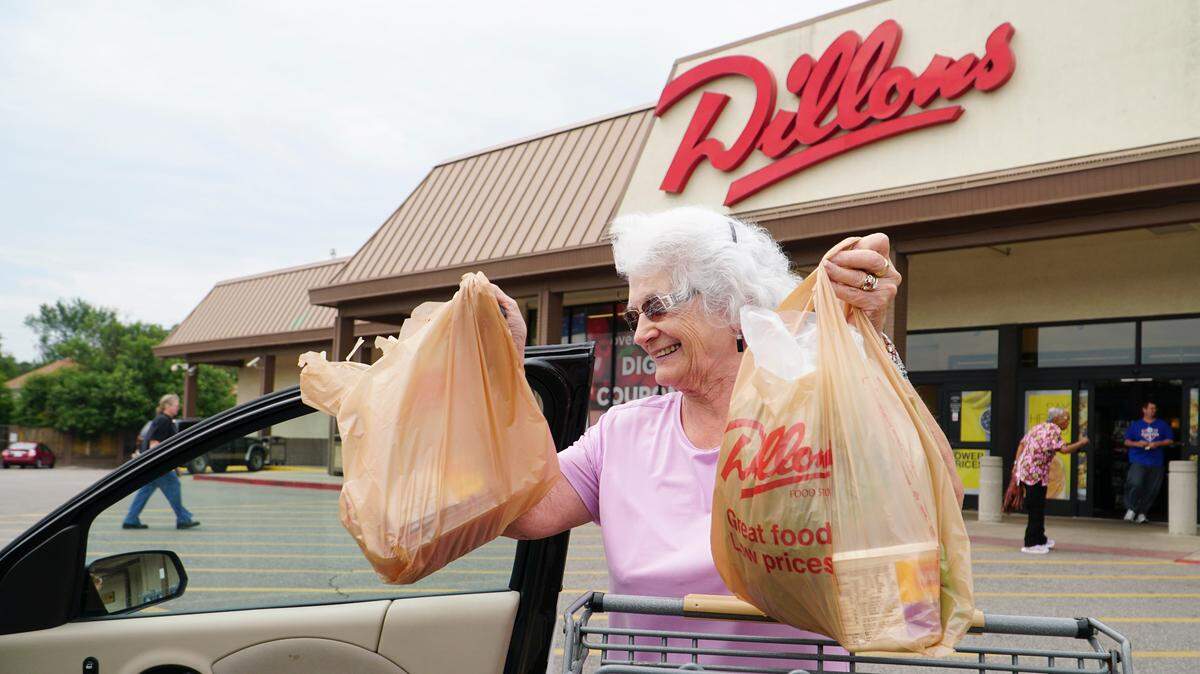
Thursday’s announcement by Dillons parent company Kroger Co. about its plans to phase out the use of single-use plastic bags by 2025 came as a surprise to many Wichita shoppers.
Some were pleasantly surprised. Some not-so-much.
And many had questions about how exactly the transition would look.
What will the grocery store use instead? What about paper bags? What about plastic bags in the produce section?
And what, exactly, are we supposed to scoop the litter box contents into now?
Kroger, the nation’s largest grocery chain, has already started the process to phase out the use of plastic bags as more Americans grow uncomfortable with their impact on the environment. It began implementing the change on Thursday at its QFC stores in and around Seattle, with the goal of using no plastic bags at those stores at some point next year. The company said it will be plastic-bag free at all of its nearly 2,800 stores by 2025.
Kroger Co. orders about 6 billion bags each year for its stores in 35 states and the District of Columbia, which cater to almost 9 million people daily through two dozen different grocery chains.
The grocer, based in Cincinnati, is seeking customer feedback and will be working with outside groups throughout the transition to reusable bags. Customers will be able to buy reusable bags at its stores for $1 to $2 a piece. While brown paper bags will also be available for free, Kroger says that its goal is to fully transition to reusable bags.
Sheila Lowrie, a Dillons spokeswoman, said on Thursday morning that Wichita’s Dillons stores will be included in the transition, though she does not know exactly when the change will happen locally. She stressed that customers will have plenty of time to transition and that the company will be welcoming customer feedback about the change.
“It’s a big change for our company, and for our customers, but one we know will help better protect our planet for future generations,” Lowrie said in a news release. “We want to give our customers time to transition to a new way of doing things, and we want to take the time necessary to solicit customer feedback and work with our partners to determine the most sustainable, long-term replacement for single-use plastic bags.”
Contacted later, Lowrie said that Dillons will continue to sell its reusable bags, just like it does now, and will also encourage people to bring their own reusable bags. The company is still not sure how it will deal with the plastic bags that people use in the produce section for things like vegetables and fruits.
“It can be a complicated issue with produce bags, but we’ll be reviewing,” she said.
As for paper bags, she said, the company doesn’t have a definitive plan for those but will “review paper bags” during the transition.
“We firmly believe reusable bags are the best solution,” she said.
After the announcement on Thursday morning, local shoppers were either celebrating or questioning the decision.
On Facebook, some Wichitans said they hoped other stores followed suit and wondered why banning plastic bags had taken so long.
Others were lamenting that they were about to lose the bags they use as trash-can liners or litter box scooping receptacles. One even suggested hoarding them while Wichita waits for Dillons to implement its plan locally.
The U.S. each year generates more than 4 million tons of plastic bags, sacks and wraps, according to the Environmental Protection Agency. Only about 13 percent of that plastic is recycled.
A number of cities are attempting to put into place new bans on single-use plastic bags, but there has been pushback from industry groups, saying that discarding plastic bags will hurt lower-income populations disproportionately.
There has been a pushback from lawmakers as well in a number of states when cities and towns attempt to put into place ordinances that prohibit the use of plastic bags, or charge fees if customers do not bring reusable bags.
According to the Pew Charitable Trusts, since 2015 state lawmakers in Arizona, Missouri, Idaho, Michigan, Wisconsin and last year, Minnesota, have prevented local ordinances that ban plastic bags. They followed similar state actions in Florida, Indiana and Iowa, according to Pew.
But companies are free to make their own choices on that front, and increasingly, they are doing so.
There is a broader shift under way at major U.S. corporations to reduce waste. Disney, Starbucks, Marriott and McDonald’s are getting rid of plastic straws. McDonald’s said this year that it will use only recycled or other environmentally friendly materials for its soda cups, Happy Meal boxes and other packaging by 2025. Dunkin’ Donuts is phasing out polystyrene foam cups by 2020. Ikea plans to eliminate single-use plastic products from its shelves by 2020.
David Pinsky of Greenpeace hailed the shift at Kroger, saying plastic pollution is killing sea life as well as impacting the health of humans.
“Kroger’s decision to phase out single-use plastic bags is a testament to how consumers are demanding action on plastics from retailers nationwide,” Pinsky said. “Kroger should build upon this effort by getting rid of additional types of single-use plastic. Plastic bags are important for retailers to eliminate, but so are plastic bottles, Styrofoam trays, and plastic-wrapped fruit and vegetables.”
Contributing: The Associated Press