
Flashback Friday: 1960s Wichita restaurant owner snipped off customers’ neckties
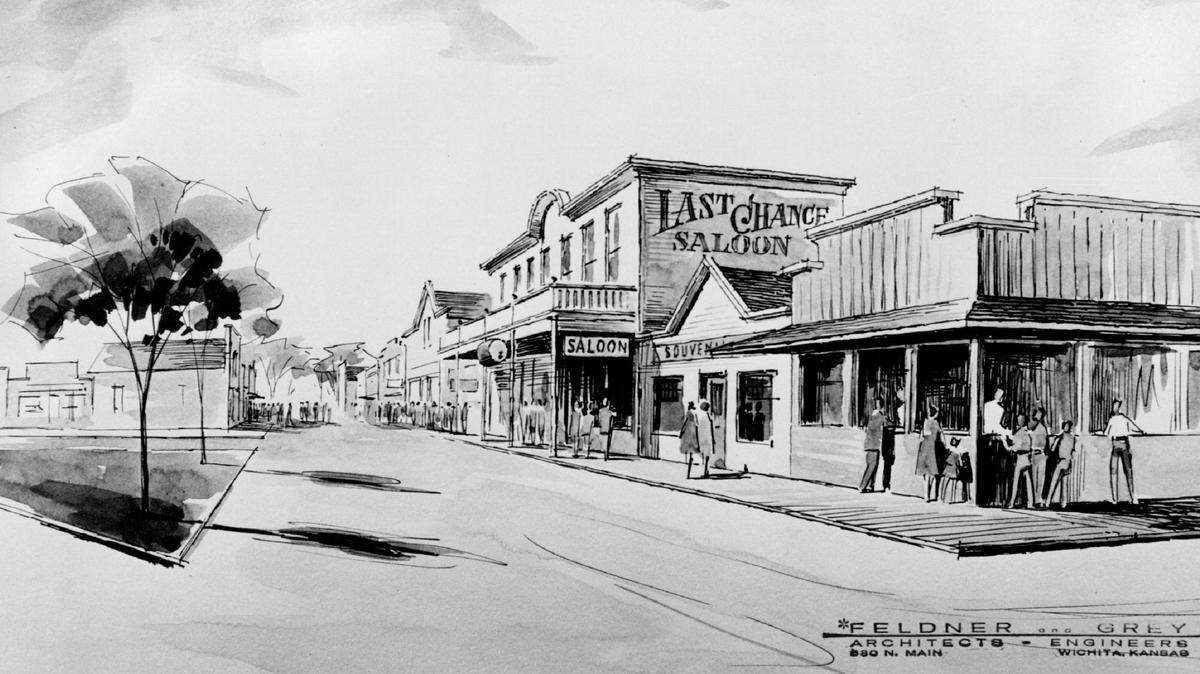
In 1961, Wichita threw a 100th birthday party for the state of Kansas, and once it was over, the city got to keep one of the restaurants that had opened on the centennial grounds — a unique operation called Golden Chance Saloon.
The restaurant is probably best remembered for the stunt that owner and chef Carl Murrell pulled on his customers: He enforced a strict “anti-dresscode,” meaning that if someone wore a necktie into his restaurant, he’d pull out his scissors, snip the tie off and nail it to the rafters.
Murrell — who throughout his life in Wichita became known as a colorful entrepreneur with no shortage of unusual ideas — was the first tenant to sign a lease for Frontier Village, a Old Cowtown-esque attraction built to look like an authentic 1860s Kansas street front. Frontier Village was a part of the Kansas Centennial grounds, a 220-acre parcel at 13000 W. Highway 54 built by Wichita Centennial Enterprises to attract celebratory crowds.
The fairgrounds, which sat 3 miles west of the Wichita airport, included more than 100,000 square feet of exhibit space in steel buildings as well as a concrete stadium with seating for 6,000 and a 10-acre lake. Frontier Village was perhaps the new development’s most anticipated attraction, though, and in addition to the Golden Chance Saloon, it had an opera house, an antique museum, a livery stable, a carriage shop, and a steam train.
The centennial celebration ran from June 14 to Sept. 4 of 1961, and when it was over, the grounds were supposed to become a tourist attraction that officials said would draw crowds for years to come.
That didn’t happen, though. Just two years later, Murrell’s Golden Chance Saloon was the only business still operating at Frontier Village, which when it opened had 37 different shops and cafes.
Golden Chance Cafe served a two-pound charcoal broiled sirloin steak, lobster, shish kabobs and fried shrimp, and diners also could get “dark German beer.” On Sundays, the restaurant offered all-you-can-eat fried chicken served family style with “mashed tatos” and chicken gravy
The interior boasted 20 tables, each featuring a different Western scene. It also featured a 100-year-old bar and a “19th-century jukebox.”
But the Golden Chance was most famous for Murrell’s rule, printed in most of his advertisements: “Don’t dress up, or we’ll cut your necktie off.”

According to a July 1963 story in the Wichita Beacon: “Murrell explains to all his victims that it is an honor to leave half a tie nailed to the rafters of the Golden Chance with the owner’s name or business card attached hereto.”
Most people knew about the dress-down rule, and if they wore neckties to the restaurant, they wore ones they didn’t mind donating to the whimsical cause.
Some customers, though, were unaware of the rule and would protest. Murrell made no exceptions and showed no mercy to the necktied, according to news accounts.
“One recently-wed couple appeared, and the husband was shorn of a tie, Murrell recalled,” read an article published in The Wichita Beacon in 1963. “The man all but cried. ‘We learned that the tie was a birthday present from his wife,’ Murrell explained. The wife solved the dilemma by offering to buy a new tie, saying, ‘We’ll always know our 24th birthday tie is hanging where everyone can admire it.’”
The fairgrounds, once promised as a big tourist draw, were quickly in trouble though.
In June of 1963, the grounds were foreclosed upon, though Golden Chance Saloon, a bowling alley where Murrell was the concessions manager, and the concrete stadium — which had been home to rodeos, horse shows and circuses — remained open.
After a lawsuit, though, Westinghouse Credit Corp., which held the mortgage on the property, was awarded the grounds and the buildings. Golden Chance Saloon was evicted, and in December of 1964, Murrell relocated the it to 4205 S. Seneca. He kept the frontier motif and even moved the 105-year-old bar into the new building.
He also brought all the clipped ties with him, though he loosened his rules, saying that at the new restaurant lunchtime visitors could remove their ties once they entered to keep them from being snipped. But the original rules still applied at dinnertime.
The Golden Chance lasted on South Seneca until 1971, when Murrell closed it down. About then, he began selling new and used furniture at a store called Garage Sales of America. His campy television commercials, which starred his 6-year-old daughter, Heather, developed a bit of a cult following. In them, little Heather shouted, “Wow, what a bargain, dad! Gosh, we hope you like us!”
Murrell filed a bankruptcy petition to reorganize Garage Sales of America in 1982, and that same year, another of his business ideas hit a snag when a judge ordered that a skin-care pill called ReVital that Murrell was distributing across Kansas be seized and embargoed after health officials found bacteria in two samples of the medication, which was made from ground chicken feet.
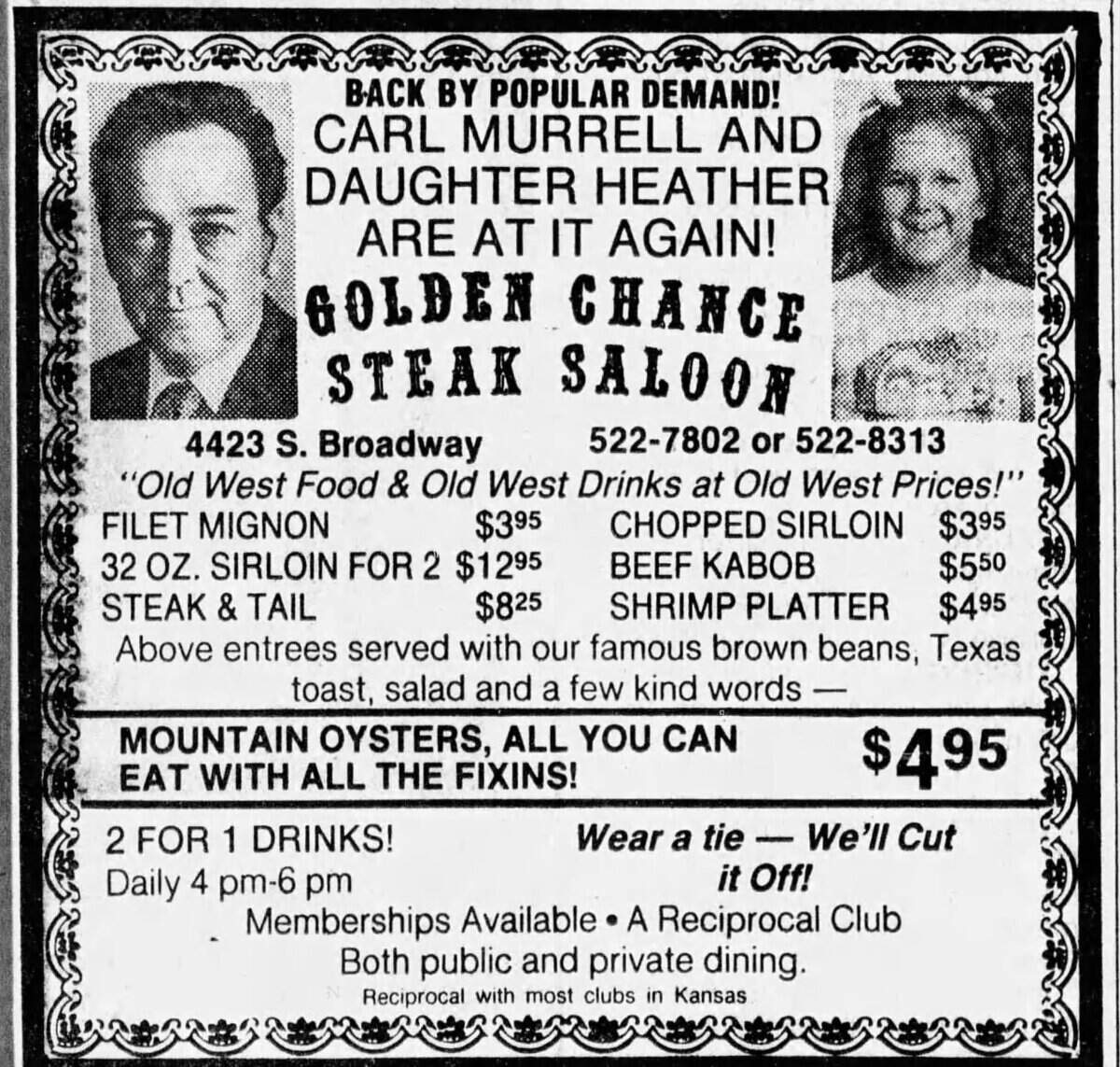
Two years later, in September of 1984, Murrell sharpened his tie-cutting shears and reopened Golden Chance at 4423 S. Broadway — the same building that the Rhinelander Restaurant had once occupied. But it appears to have lasted there less than a year. (Today, the building is home to BC’s Bar & Grill.)
Murrell died in 1990 at the age of 64. He was remembered as stubborn but creative — an idea man who loved a good gimmick.
Though Frontier Village did not last, the centennial grounds were used for years to come. Through the decades, they were home to a giant, indoor amusement park called Frontier Circustown and also to a speedway, a horse-racing track, and an ice-skating rink called Silver Skate Arena. As late as 1995, The Wichita Sports Center was still operating on the grounds.
Since 1999, a series of self-storage facilities have operated at the centennial grounds address. Today, it’s called Prime Storage.
This story was originally published June 6, 2025 at 6:03 AM.
.jpg)