
Wichita brewery now making thousands of gallons of hand sanitizer as demand keeps growing
When the Sedgwick County Sheriff’s Office called Wichita Brewing Company co-owner Jeremy Horn last week and asked him if his brewery could start producing big batches of hand sanitizer alongside its beer, Horn wasn’t sure.
He’d never brewed anything but beer at his big production facility in south Wichita before, and he wasn’t sure what kind of demand there would be if he did.
But he quickly got the answer. After news got out of his plans to try to make hand sanitizer, which is in short supply across the country during the coronavirus pandemic, the requests started flooding in — and they haven’t stopped coming.
Doctors’ offices, dentists’ offices and police departments all over the area have been sending Horn requests, and if all goes as planned, he’ll have been able to supply 2,250 gallons of hand sanitizer by early next week.
On Tuesday, Horn and his staff mixed their first 750 gallons in one of his giant beer fermenters, and on Wednesday, he recruited volunteers to help fill 1,500 half-gallon jugs, all destined for Sedgwick County.
WBC, which four years ago opened a big production facility at 727 E. Osie, is one of many breweries across the country that has been recruited to help produce hand sanitizer over the past couple of weeks. Horn said was interested after that call from the county, but he couldn’t agree to get started unless the state director of Alcoholic Beverage Control allowed an exemption in the law allowing Kansas breweries, farm wineries and distilleries to buy non-beverage alcohol for the purpose of making hand sanitizer.
That happened quickly last week, Horn said, though the temporary law change allows him to make sanitizer only for law enforcement and medical needs. He immediately got to work collecting the ingredients needed to produce the hand sanitizer recipe recommended by the World Health Organization: denatured ethanol, glycerin, distilled water and hydrogen peroxide.
The hardest thing to find, he said, has been the alcohol, which is in short supply across the country because of the demand for hand sanitizer. But he managed to find some at El Dorado’s Barton Solvents.
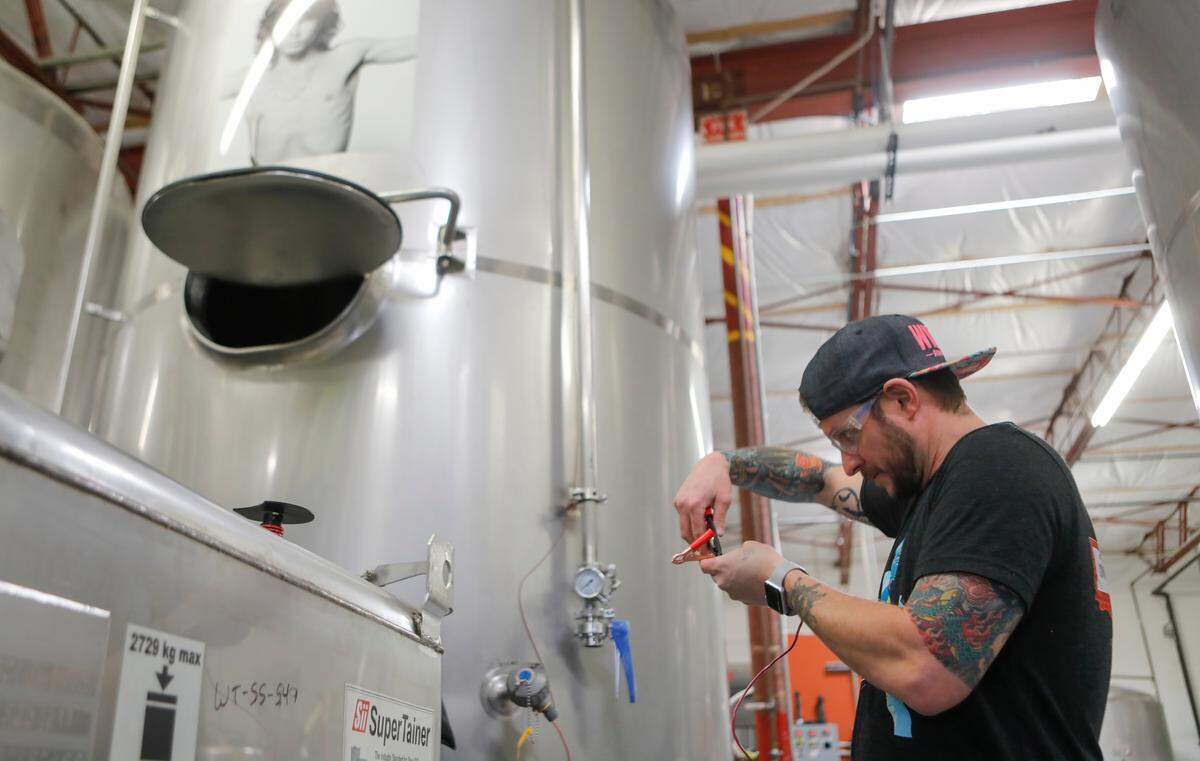
After that, he and his head brewers dove into researching how to safely mix the ingredients in their big metal tanks, each of which can hold 1,800 gallons. The process included a forklift, lots of hoses and lots of complicated adjustments inside the brewery.
On Wednesday morning, volunteers showed up and were spaced out among three different tables. A splitter allowed hoses to deliver the sanitizer — more liquid-y and spray-able than the gel stuff at the store — out of the tank and to each table, where it was funneled into half-gallon plastic jugs. One volunteer would slap a label listing the ingredients on the side of a jug while another filled and capped it.
The first 1,500 jugs were donated by Wichita’s SFB Plastics, Horn said, and that donation allowed him to cut the price per jug for Sedgwick County. Instead of selling each for $5, he was able to cut it to $4, he said.
Horn said he expects another supply of ethanol to arrive later this week, and he’ll brew another batch that will be split between other places that have put in orders, including the Robert J. Dole VA Medical Center in Wichita and the police departments in Maize, Newton and Derby.
If he can secure another batch of ethanol, he’ll start a third batch early next week.
“We have orders piling up that we currently don’t have enough ethanol for,” he said.
Before last week, Horn said, he never envisioned making anything but his 5:02 Amber and other popular WBC beers in his giant warehouse.
But this project came around at just the right time for so many reasons, he said, including the fact that WBC’s beer sales have taken a hit with the closing of local bars and its two Wichita brew pubs.
“It’s keeping us busy and keeping our staff busy,” he said. “There’s so much bad news out there with layoffs and people stuck at home... It’s nice to have a project that really is a positive thing for everyone involved.”
This story was originally published April 1, 2020 at 1:38 PM.
.jpg)