
‘Empire on the Edge’ looks at American Revolution through British eyes
“An Empire on the Edge: How Britain Came to Fight America” by Nick Bunker (Alfred A. Knopf, 371 pages, $30)
The Boston Massacre.
The Boston Tea Party.
The battles of Lexington and Concord.
Each is a famous and pivotal event in our nation’s history that set the stage for revolution and the overthrow of British rule. The list of American patriots is also well-known: George Washington, John Adams, Thomas Jefferson, Benjamin Franklin, Paul Revere and Patrick Henry, among others.
But how many people are familiar with the British credit crisis of 1772, the Gaspee incident, or the Coercive Acts of 1774? And what about names such as Lord Frederick North, Thomas Gage or William Lege, the second Earl of Dartmouth? We may think we know the story of America’s birth as a nation, but no doubt many are woefully ignorant about what was going on across the pond that helped shape events.
Enlightening readers of history is English author Nick Bunker, former journalist and investment banker, who provides meticulous details of British missteps, confusion and fateful decisions that led up to the Revolutionary War.
Bunker sets the starting point for his story in 1763 at the conclusion of the Seven Years’ War between France, Spain and Austria and their enemy, Great Britain and Prussia. With new territories acquired from the French, the British were now in possession of a vast area from Quebec to Alabama.
But in a wilderness area that the British could neither adequately support nor defend, despair and exhaustion set in. Thomas Gage, commander in chief of all British troops in America, received little help from his government and finally decided the area had to be abandoned.
With full retreat from the British Empire’s western boundary in America, the Mississippi River, came the inevitable dissipation of British authority in the Colonies. “As Benjamin Franklin put it at the time,” writes Bunker, “ ‘a great Empire, like a great Cake, is most easily diminished at the edges.’ ”
Against that backdrop, Bunker follows the events on both sides of the Atlantic as British politicians ignored, delayed and sent mixed signals about their intent even as the Colonists increasingly resisted British rule. Stepping into this maelstrom in 1770 as prime minister was Lord Frederick North. His immediate influence helped ease anger in the Colonies. He would play a crucial role in Britain’s actions – and inactions – toward America and would remain in office until five months after General Cornwallis’s surrender at Yorktown.
But was the war inevitable? As often happens in history, events outraced good intentions and well thought-out plans. Economic crises in the banking industry, the near collapse of the powerful British East India Company, contending political parties and the lack of any systematic oversight of the 13 Colonies – “a loose mosaic made from tiles without a pattern” – helped precipitate the movement toward open rebellion.
Throughout the British rule of the Colonies, Bunker writes, two things were strictly forbidden by the British: “The laws Americans passed must never clash with those of England, and the colonies must never harm its economic interests.” Both were destined to fail from the start.
For the British, a key event in the deterioration of relations with America was the Gaspee Incident in 1772. A British patrol ship, the Gaspee, had been intercepting merchant ships near Rhode Island confiscating cargo and detaining the vessels. While chasing a ship leaving port, the Gaspee ran aground on a sandbank.
At night, while the ship waited for high tide, dozens of rebels in longboats attacked it, took the crew ashore and then set fire to the Gaspee. The British were never able to prosecute the attackers, and the incident became an ongoing sore spot in Britain even as the rebellion increased. “From the British perspective,” Bunker writes, “the Gaspee raid was the first step along the road to war.”
There were a few British politicians such as Edmund Burke and Charles James Fox who were sympathetic to the American cause, though their influence was minimal. Even a high-ranking official such as Lord Dartmouth, colonial secretary for the British government, desperately wanted peace with the Colonists if only they would moderate their actions toward Britain. If they would, Dartmouth urged, perhaps the removal of the tea tax could eventually be negotiated. But if they continued their rebellious acts, Dartmouth said, “there is an end to all reconciliation.”
Throughout the growing crisis, news about unrest in the Colonies was often late in coming to Britain and less than complete and accurate. Political parties were often divided on how to respond to reported illegalities. Meanwhile, acts of defiance gained more and more support throughout the Colonies; it was only a matter of time before the powder keg would explode.
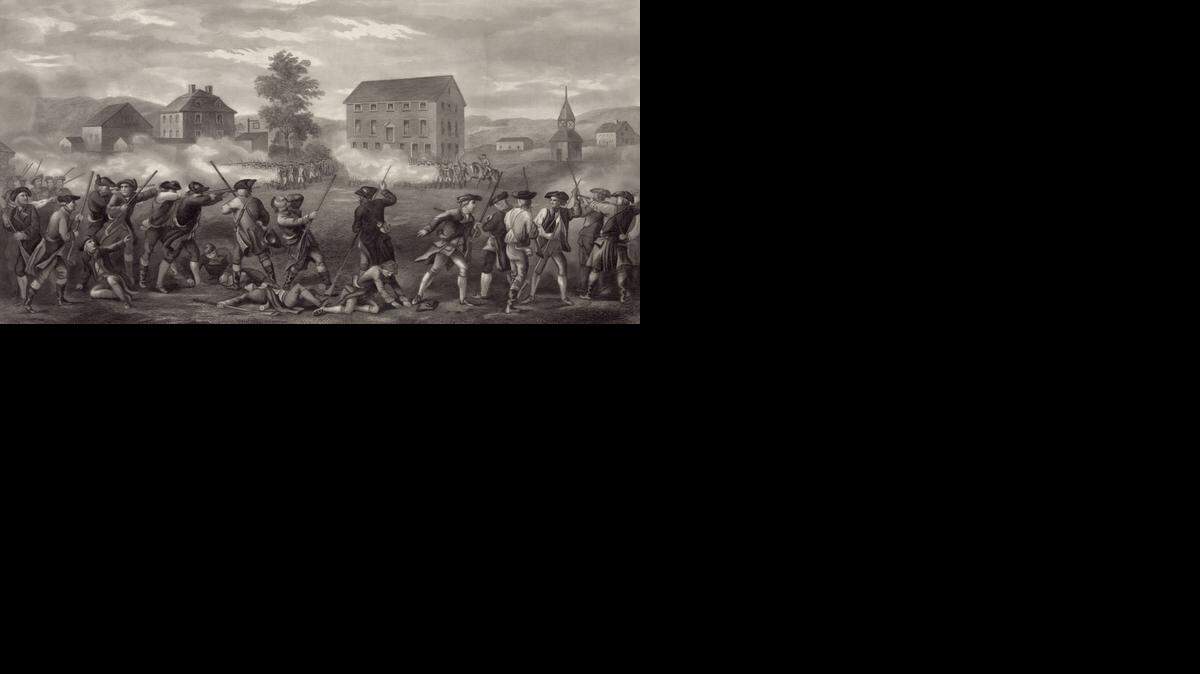
The spark of war was ignited when General Gage decided to capture a cache of arms hidden by the rebels in a town called Concord. With his troops on the march, they took the road that led through Lexington. “The battle followed at Concord Bridge, small but bloody, and then came a still more bloody retreat to Boston,” Bunker writes. “And so the war began.”
Bunker, who previously wrote “Making Haste From Babylon: The Mayflower Pilgrims and Their World: A New History,” contends that the war was “the product of an empire and a system deeply flawed, the work of ignorance and prejudice and of men well-meaning but the prisoners of ideas that were obsolete and empty.” He provides ample evidence and compelling examples of how the British leaders were unwilling to loosen their hold on the Colonies and unable to act decisively.
Looking at the American Revolution through British eyes can help us better understand how people and governments, captive to the mindset of a specific time in history, fail to see the light of inevitable change ahead of them and adapt to it. In the eyes of 18th-century America, however, the light revealed an opening door to a new world and a new nation. For the Colonists, there would be no turning back.
Tom Schaefer is a former columnist and religion editor for The Eagle. He lives in Wichita.
This story was originally published December 6, 2014 at 6:25 PM with the headline "‘Empire on the Edge’ looks at American Revolution through British eyes."