
In new book, Dan Glickman chronicles his political journey
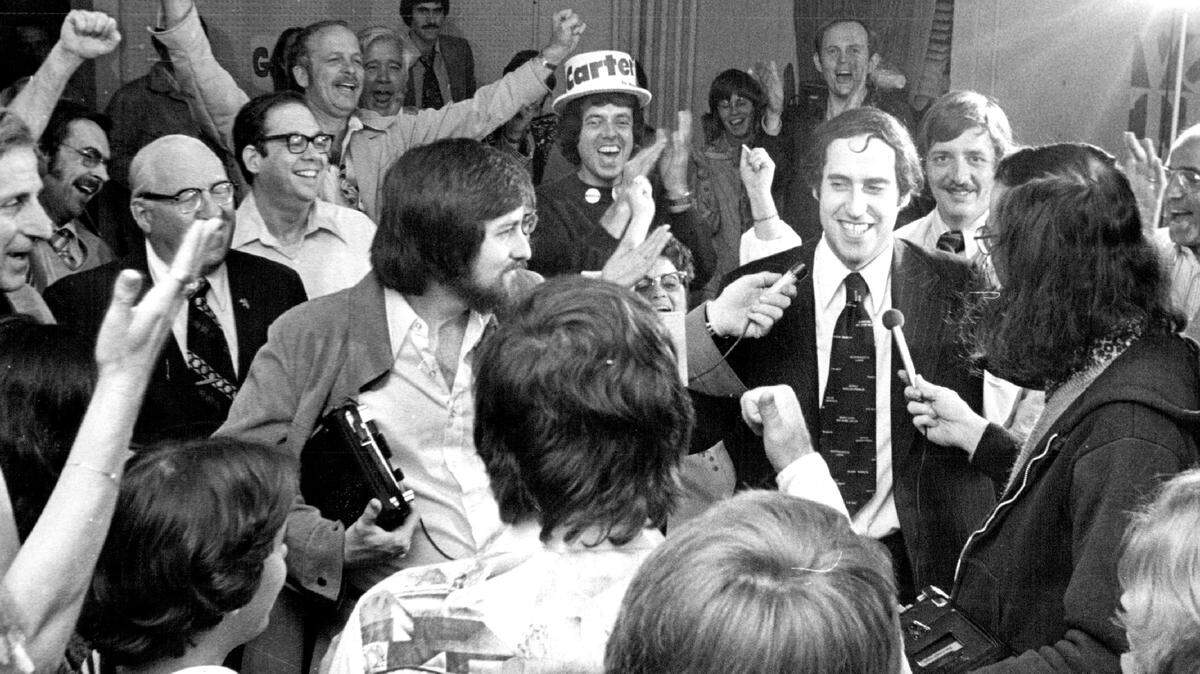
Editor’s note: The following is excerpted from “Laughing at Myself,” written by Dan Glickman, who represented Kansas’ 4th District from 1977 to 1995 and served as U.S. Agriculture Secretary from 1995 to 2001. The book will be published June 8 by the University Press of Kansas.
I won the election!
I became the first Jewish congressman in Kansas history. What a country!
It cannot be overstated how impossible that 1976 campaign would be today. First and foremost, the death grip political parties have on drawing congressional districts makes the primary the determinative election, with the general election mostly becoming a foregone conclusion. My district was winnable because it was drawn by people who were not committed to gerrymandering, although it did have a Republican edge. At that time, all Kansan districts leaned Republican, although a majority of voters held loose party affiliations and were proud of their independent views. In to-day’s gerrymandered district maps, incumbents are protected from a candidate from the other party and only worry about candidates from their own party, since each district is overwhelmingly faithful to one party or the other. The primary opponents are usually the ones steering Republicans more to the right and Democrats more to the left. That is why we are witnessing a much larger number of extremists winning elected office while moderate voices, like mine, are being drowned out.
On top of that conundrum, I did not have to spend inordinate amounts of time fundraising, which meant I could devote my energy to meeting the voters—in person. This is a luxury that modern candidates no longer enjoy. The $100,000 I spent on that first campaign was—to me at least—a large amount of money in 1976, but that figure is laughably low by today’s standards. Freedom from constant fundraising made me a much better candidate, and in re-turn, a much better representative. I could focus on getting to know my constituents and learning about their issues, rather than begging some huge donor (the majority of whom have zero connection to the district) to write me a check.
Most members of Congress are decent human beings of good character, interested in serving their communities.
Individually, most members are decent people, but the tribal nature of our politics puts allegiance to party over principals and this has affected a fair number of them in a bad way. That is a sad truth. There are some cases where members come together on major stuff, such as natural disasters, National Institutes of Health funding, or cancer research, but the big issues of American leadership in the world—income inequality, true tax reform, commitment to science and technology, fighting racism, and rebuilding America’s infrastructure—get left behind while the rest of the world moves ahead of us. I don’t think it’s a matter of no backbone or morals among members, but there are too few independent thinkers in Congress, and too many Republicans were afraid to confront former president Trump on anything, from his policies to his behavior.
During my time as the director of the Aspen Institute’s Congressional Program, I got to meet with dozens of members of Congress from both parties. Many of them are as talented, patriotic, and well intentioned as the folks elected in the 1970s.
The difference is that I first ran under a system that empowered me to truly represent my constituencies, be independent-minded, and work with other members on crafting solutions for our nation. I worked with Republicans when I thought they were right. I won because I was a moderate, and I succeeded as a representative because of my moderate approach.
Today’s members often get punished for working with colleagues from the other side of the aisle, and their willingness to compromise makes them a target in highly contested and expensive primaries. The media, especially social media, will go after candidates who don’t seem conservative or liberal enough. Tearing people down is the name of the political game, and this is turning off and pushing away the next generation of political leaders.
It is worth noting that no major, enduring piece of legislation has become law without bipartisan support. Not Medicare, Social Security, the Clean Air Act, the Civil Rights Act—nothing.
Walking the streets of Wichita or the fields outside of Hutchinson gave me an invaluable education and insight. I spent so much time with the farmers of my district when I was campaigning that when I arrived in Washington on January 3, 1977, to be sworn in as part of the 95th Congress, I always had the House Agriculture Committee in the back of my mind. This was not the most obvious committee assignment for a Jewish lawyer from Kansas’s largest city, but it made all the sense in the world to me.
The opportunity to serve America’s farmers was paramount in my mind, as they were obviously a hugely important part of my Kansas constituency. It turns out that the Agriculture Committee assignment was profoundly instrumental in my long-term political career. It led to my subsequent appointment as secretary of agriculture. In addition, I worked on issues such as commodity futures regulation, and I was active in food and nutrition programs, such as food stamps, which ignited my passion for tackling domestic and global hunger issues.
Meeting those farmers in that first campaign and agreeing to fight for them in Washington, DC, set the trajectory for the rest of my life.
Arriving in Congress and being assigned to the House Agriculture Committee was the culmination of everything I had worked for thus far. Earning my law degree, working for Senator Dominick, gaining invaluable experience as a trial attorney, running for and winning the Wichita School Board seat, and convincing the voters of the Fourth Congressional District of Kansas to place their trust in me all led to this point. It just felt right. I was home.
When I got to freshman orientation in DC, we were seated alphabetically, with all the brand new members of Congress lined up by name. The guy on my right was a freshman from Missouri, by the name of Dick Gephardt. The guy on my left was Al Gore, a freshman from Tennessee. Not a bad year to have a last name starting with the letter “G.” Many years later, after both had tried and failed to win the presidency, I told them I was glad that at least one of us had amounted to something in life.
I am forever grateful to the people of Wichita and its farming communities for giving me the opportunity to serve as their voice in Washington. My Wichita small-town roots have always been at the core of who I am as a person and they have given me an appreciation for the diversity that is America.
Too often in the past, Democrats have been guilty of forgetting or ignoring what heartland America is all about. The values and integrity that form the foundation of this part of the country—Middle America, for God’s sake—have shaped me as a human being, regardless of having lived and worked most of my life in the bubble of the coastal elite.
Wichita is a special place with special people. Even though my birthplace is home to a big part of the conservative movement in America, it nonetheless listened to this Democrat upstart and was open-minded enough to elect him to Congress on nine separate occasions.
With those years on the Agriculture Committee leading to my appointment as secretary of agriculture, I attribute every success I have had in life directly to the people of Wichita and its farming communities.
Long live Doo-Dah!
“Laughing at Myself: My Education in Congress, on the Farm, and at the Movies” by Dan Glickman, published by the University Press of Kansas, ©2021. www.kansaspress.ku.edu.