
Clash between Christians and Muslims in Middle Ages often not about religion
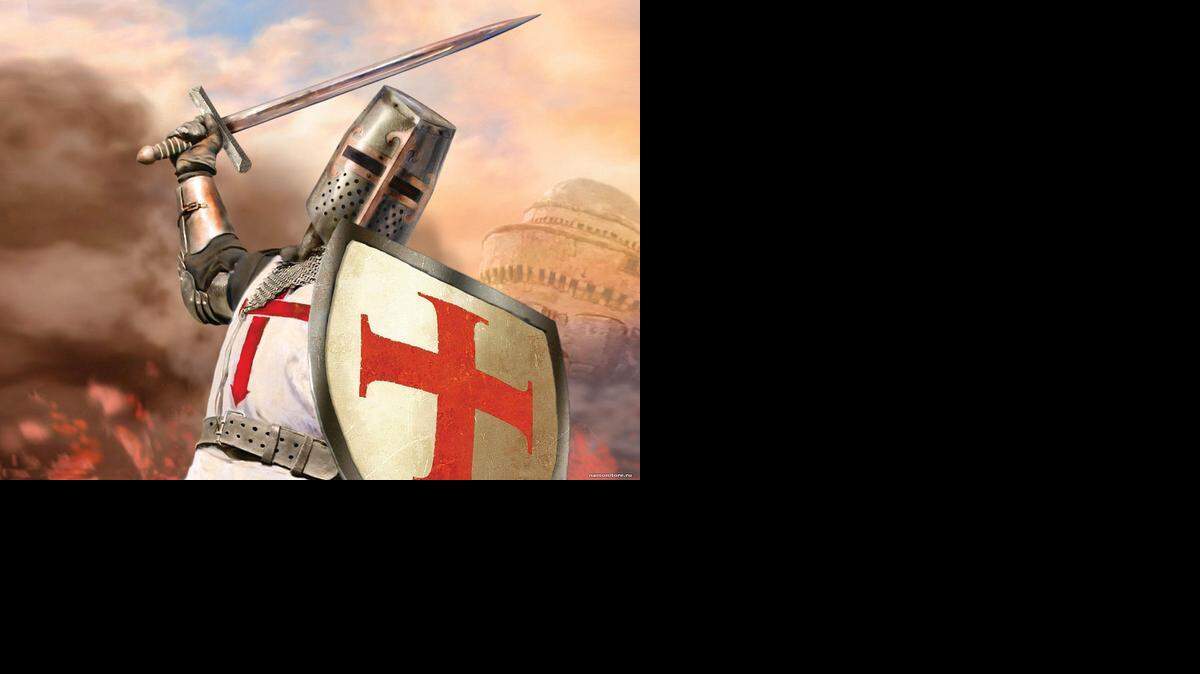
Atrocities committed during the Crusades are said to fuel the anger today of many Muslims throughout the world, some of whom are resorting to murderous acts steeped in revenge for the Crusades and that have people fearful of even more barbaric attacks.
Past and present brutal behavior, Crusade and jihad, all in the name of religion. But is religious warfare a full account of what went on in the Mediterranean world of 1050-1200 C.E.? Were Muslims reclaiming holy sites because of their staunchly held beliefs, and Christians because of theirs, or were there other factors that can account for the carnage?
Brian Catlos, professor of religious studies at the University of Colorado and author of several books on Muslims and Christians in the Middle Ages, unfolds a detailed history of power, politics and religion in the Middle East. Focusing on the 11th through the late 12th centuries, Catlos contends that religion was neither the sole nor overriding factor in Christian-Muslim battles. Yet the aftermath of those hostilities has clear and disturbing ramifications in today’s turbulent events in the Middle East.
Catlos begins not by focusing on a mostly Christian Europe or a predominantly Islamic Middle East; rather, he presents a broader picture of the post-Roman Empire period in Europe, Africa and Western Asia in which people shared traditions, customs and habits and engaged in commerce despite their religious and ethnic differences.
“Each individual belonged to a variety of formal and informal communities simultaneously, and the boundaries of these communities often crossed religious and ethnic lines,” he says.
So, what ignited the passions that led to rampaging armies of seemingly religious zealots seeking to conquer a city or region? For the most part, it was not religion that triggered the assaults, says Catlos, but the same enticements that have lured people in every age to extremist actions: power and wealth.
Catlos traces the relationships, tensions and feuds that were common both within and between Christian and Muslim tribes and families of that time. “In fact, the greatest tensions and the worst violence tended to take place among people of the same faith,” he says.
While leaders of any group sought power and wealth, they also realized “they had to grant significant liberties and privileges to the minorities among their subjects.” As long as the vanquished recognized the dominant group’s rules and customs, they usually could live in peace.
The most diabolical and well-known attack was the First Crusade when Crusaders captured Jerusalem in 1099. The traditional account usually begins with the Council of Clermont, an assembly of bishops called by Pope Urban II in 1095. The council’s agenda was to push for reform regarding the moral integrity and independence of the clergy and to standardize church ritual. Near the end of the council, Urban II called on the faithful to go to the aid of their brethren in the East who were suffering under the yoke of the Turks (Muslims) after a fateful battle in 1071. Historians believe that Urban’s appeal was the impetus for what would become the ill-fated First Crusade.
The aftermath resulted in a popular movement, a People’s Crusade, that set out across Europe “with no clear idea of where they were going, no maps, and no sense of what awaited them.”
Most were landless vagrants, recently freed from the breakdown of the feudal system and with no sense of purpose. Led by charismatic figures, they were told that God was calling them to this crusade. Following on their heels were knights, warriors from different ethnic groups, who were seeking fortune and glory sometimes under the guise of religious devotion.
Eventually a force made it to Jerusalem where a prolonged siege of the city began. Finally, on July 15, 1099, the walls were breached and a massacre ensued, “a deliberate act of genocide.”
Raymond of Aguillers, a monk who took part in the slaughter of Muslim men, women and children, recorded the stomach-churning account of a city “filled with corpses and blood.” “Indeed, it was a just and splendid judgment of God,” Raymond declared, “that this place should be filled with the blood of the unbelievers since it had suffered so long from their blasphemies.”
But did all the Crusaders believe as Raymond did that they were on a mission from God? Was their motivation to defend the church and their way of life against unbelievers? Catlos acknowledges that historians disagree on the nature and significance of the Crusades, but they generally agree that they were an anomaly, “having no precedent in the history of either Europe or the Middle East.” What Catlos debunks is the popular belief that every campaign, every battle, every interaction in the Middle Ages between people of different religions was always motivated by a commitment to religious purity. No simple template of Christian versus Muslim can begin to explain the complexities of the time, he asserts. Even after seven more crusades, commerce and alliances between different groups of Christians and Muslims continued, demonstrating that realpolitik can trump religious separatism.
What remains unchanged is that the quest for power, wealth and glory, endemic to the Middle East in the Middle Ages, is in many respects still a major driver today. But in spite of that, says Catlos, the peaceful interaction between peoples of different religions offers a glimmer of hope today for the region and for the rest of the world drawn in to its unstable history.
As Catlos sees it, “conflict among different peoples is not inevitable, as long as we are willing to make compromises as individuals and communities, and to regard one another as fundamentally well-intentioned, and as sharing the same basic goals.”
Well and good. But more than 900 years after the Crusades, that hope, diminished by centuries of mistrust and ongoing violence, is still as elusive as a desert mirage.
Tom Schaefer is a former columnist and religion editor for The Eagle. He lives in Wichita.
This story was originally published September 28, 2014 at 8:46 AM with the headline "Clash between Christians and Muslims in Middle Ages often not about religion."