
Why has WSU’s famous Miro mosaic, restored just 10 years ago, been covered up?
The recognizable mural that decorates the facade of Wichita State University’s Ulrich Museum of Art was gone for five years, having been removed, panel-by-panel, in 2011 so it could undergo a $2.2 million restoration.
It wasn’t reinstalled until fall 2016.
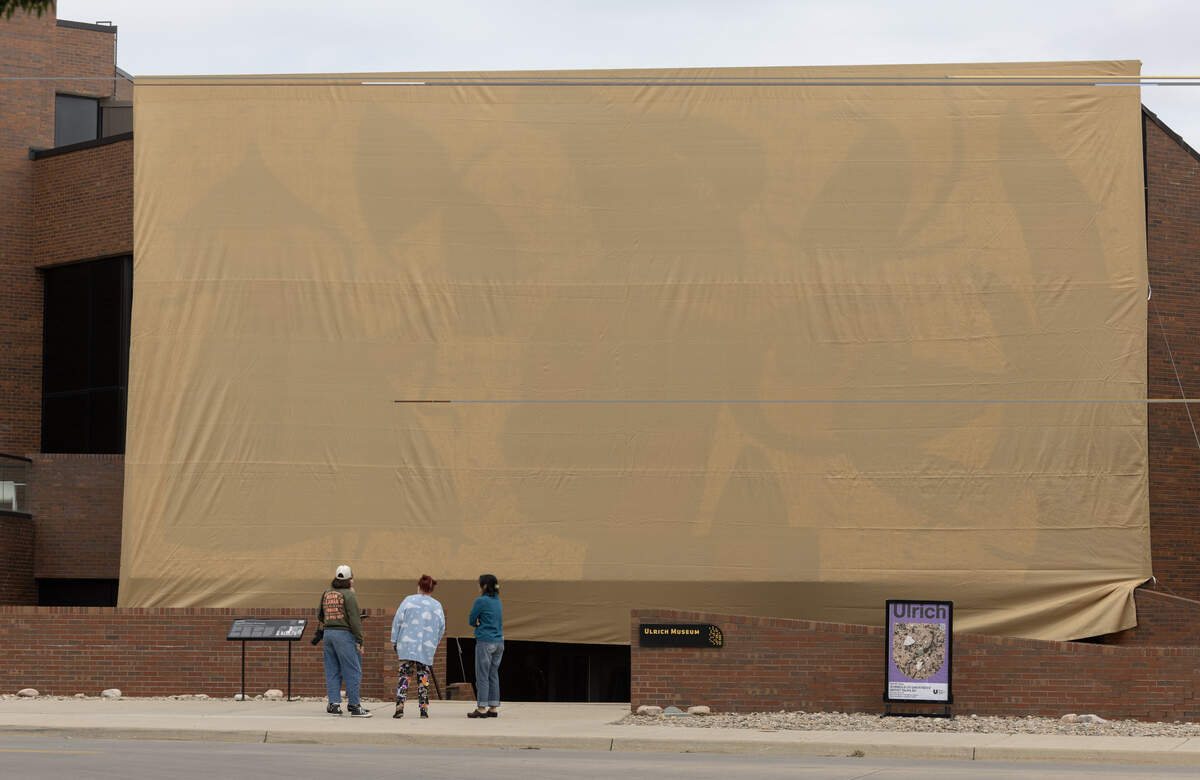
Now — a decade later— the mural has been obscured from view by a giant drop cloth. Soon, other pieces of art around campus will be covered as well.
What gives?
The planned art-veiling spree is part of a fundraiser designed to remind people about the importance of artwork in public spaces. The “Art Matters Adopt-a-Sculpture” campaign started in February, and the first visible piece of it happened on Tuesday, when WSU’s grounds crew covered the Miro.
The organizer of the campaign, the Ulrich Museum’s executive and creative director Vivian Zavataro, said she was inspired by artists Christo and Jeanne-Claude, known for creating art installations by wrapping large landmarks — like the Arc de Triomphe in Paris or the Museum of Contemporary Art in Chicago — in fabric.
Zavataro decided that covering WSU’s most recognizable art pieces in fabric might force people to think about what campus would be like without them.
“I think a lot of us take it for granted,” she said. “We walk around campus surrounded by beautiful sculptures, and I think a lot of us only notice if they’re gone.”
Campus art put up for adoption
In February, the museum put 57 pieces of campus art up for “adoption.” Donors were asked to choose one piece and commit to paying a certain amount for three years, minimum. Half of the money raised for each sculpture would go to an operation endowment, and half would cover education and exhibition programs on campus.
Once a sculpture was adopted, it would be covered up, according to the plan. Then, after a few weeks, it would be dramatically uncovered, symbolizing that it had been chosen.
The Miro was the first piece of art adopted: Art patrons Peri Widener and Merlin Reiser each committed $150,000, which allowed them to adopt the Miro for three years. The mosaic, titled “Personnages Oiseaux,” actually will be uncovered at 3 p.m. on Wednesday. (Museum staff had hoped to have it obscured earlier, but because it was so large, the veiling was delayed until Tuesday.)
So far, 32 of the 57 adoptable pieces have been spoken for by donors, who will be recognized on plaques placed near the pieces.
Unveilings in the coming months
The other adopted works will be covered then unveiled over the coming months, Zavataro said. Recognizable pieces like “Millipede” by Tom Otterness, which sits near the main WSU entrance, and the “Love” sculpture by Robert Indiana, which lives between the Ulrich and the McKnight Center, are still available for adoption.
Adoption fees depend on the piece: The most affordable can be adopted for $500 a year.
“There is something for everybody to adopt,” Zavataro said. “We wanted to make this campaign really accessible.”
For information about the sculptures still available and how to adopt one, visit foundation.wichita.edu/adopt-a-sculpture/
This story was originally published April 28, 2026 at 4:10 PM.
.jpg)