
North Newton sculptor defines success: “I want to have lived an interesting life”
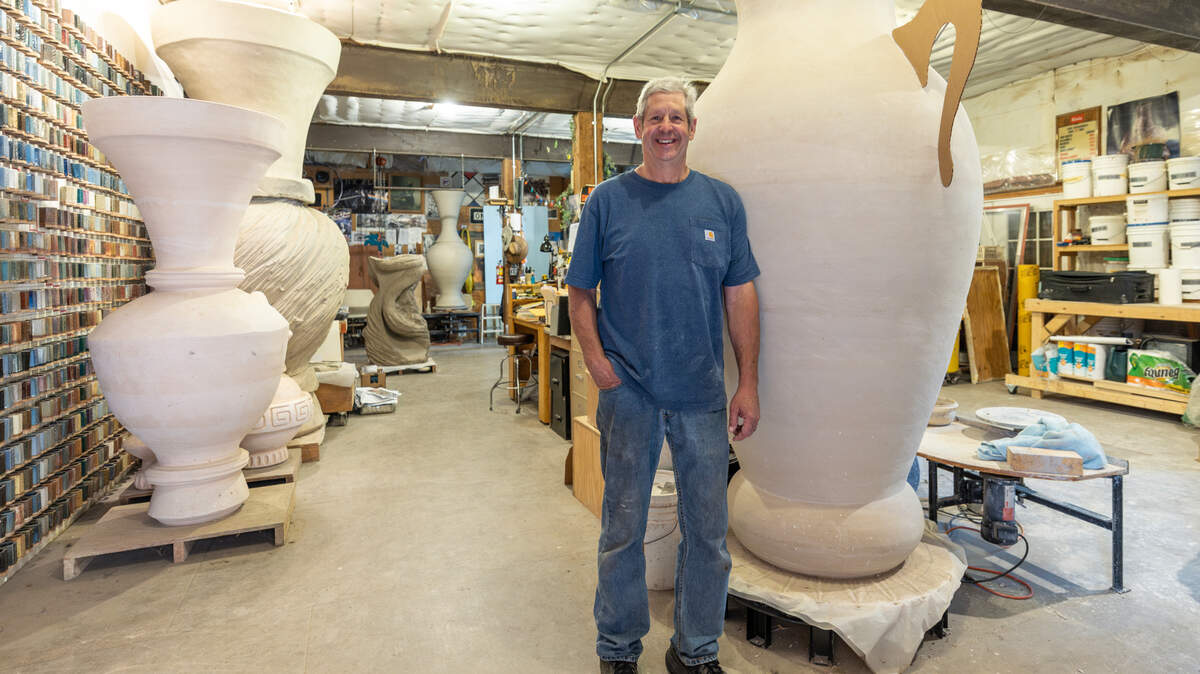
Sculptor Conrad Snider doesn’t mean to sound rude, but if people want to hire him to make pieces to their exact specifications, he has a customary response.
“I usually tell them they need to take a ceramics class and make it for themselves,” he said. “I don’t have enough time left in my life to make things that I don’t have a personal connection to.”
Part of the North Newton resident’s interest in sculpting is the ideas behind his work and where they come from. It’s not following someone else’s plan.
That’s “just being a technician, and that doesn’t hold any interest for me.”
However, he’s done a lot of public art projects, such as a recent installation for a sculpture tour in Salina, and he’ll work with communities to determine what’s unique about them or a particular building and have a back-and-forth exchange of ideas.
Other public pieces he’s done include “Concentricity,” the tree-and-scroll sculptures outside the Wichita Advanced Learning Library, “Opening Move” at the University of Kansas’ School of Business and Capitol Federal Hall, and three works for Dyck Arboretum in Hesston.
“I always wanted to make things,” Snider said.
Growing up in North Newton, he said, “I spent all my time with Legos and in the sandbox, and that’s kind of what I still do.”
He also painted and drew and then did a bit of sculpting in high school. In college, when he thought he wanted to be an architect, he discovered his passion for sculpting — even though he said that “every part is difficult and distasteful.”
“It’s a lot of hot, heavy, dirty, hard work.”
Even simply moving his pieces, most of which are larger than he is, is a puzzle to figure out how to get it done.
“All of those things are interesting to me,” Snider said.
Still, if someone were considering a career as a sculptor, he said, “I’d probably encourage them, if they have other skills, to do something else.”
Pace and patience
In addition to getting a ceramics and bachelor of fine arts degree from the Kansas City Art Institute, Snider also did a five-year apprenticeship with large-scale Japanese ceramics sculptor Jun Kaneko, spending time in his Omaha studio and traveling the world with him.
“I learned from him . . . how to function on a daily basis.”
Projects could take a couple of years or even longer.
Snider said he learned patience and pace, in part from the sculptor and in part from the clay.
“It kind of has its pace, and you have to follow its pace. You have to develop some patience to work with it.”
If you fire a piece too fast, the water in it turns to steam, and Snider said, “It will make the piece blow up.”
He compared most of a lifetime working in clay to being a musician or an athlete whose fingers and body know what to do.
“It becomes intuitive and kind of just happens.”
Snider often starts with sketches before working with clay, and then the clay almost guides him.
“Many times the final piece doesn’t look like the sketch, but it’s a part of the process,” he said. “You’ve kind of always got ideas that are changing and then coming together. It happens a little bit more in a fluid way.”
In some ways, the medium is simple, Snider said.
“If you’ve ever dug a hole in your backyard, you’ve worked with clay. That is the beauty of it.”
At the same time, he said it’s incredibly technical, especially for larger pieces, which are his primary focus.
Unlike a small ceramic piece that someone can hold in his hands and turn to examine, a larger piece forces its viewer to walk around it to see it in its entirety, which Snider said changes the relationship.
“We’re no longer dominant in the relationship with that object.”
He said he wants his pieces to be available on different levels, and he wants people to interact with them.
“I always encourage people to . . touch things,” Snider said. “That’s one of the things that I like about public art.”
It’s also something he said he has to think about while sculpting.
“Clay is something that should be outside,” he said. “Out where people can be around it and live with it.”
‘Always the risk’
At 61, Snider may be approaching retirement age, but as an independent artist, he said, “I won’t ever be able to afford to retire . . . and I don’t know what I’d retire to.”
His career also happens to be his hobby.
“There’s always the risk of what you love to do becoming what you have to do and not liking it,” Snider said.
That hasn’t happened to him.
Snider still feels a sense of wonder with his work “and have things be there that weren’t there before.”
There’s also a longevity with clay. Snider said Romans installed in-ground clay pipes 2,000 years ago that are still working.
“Having that go on beyond me and be a part of the world is something that draws me to it,” he said. “These things will be around as a record of our society.”
Part of what has helped Snider, he said, was diversifying by doing sculpting, handling installations for others and having a company that he purchased that designed and manufactured clay-making machines.
He said it was good to split his time, energy and thought process — and have more than one source of income.
Snider sold Muddy Elbow Manufacturing a couple of years after owning it for two decades.
He still has a studio in a former feed mill in downtown Newton.
Snider and his wife, Wichita attorney Diane Sorensen, live in North Newton on four acres with their cats and chickens.
Though he wouldn’t necessarily recommend the sculpting career path for others, Snider said he wouldn’t trade it for himself.
He likes “the independence of it and the freedom of it.”
Snider said the definition of success is different for different artists.
“You have to define success for yourself,” he said. “When I take my last breath, I want to have lived an interesting life.”
That’s why he offered a caveat for those who are considering the career.
“It’s going to be an incredibly hard life but the most amazing life they can imagine.”
This story was originally published July 5, 2023 at 5:05 AM with the headline "North Newton sculptor defines success: “I want to have lived an interesting life”."