
‘Big art star’ who created WAM commissioned sculpture featured in summer exhibition
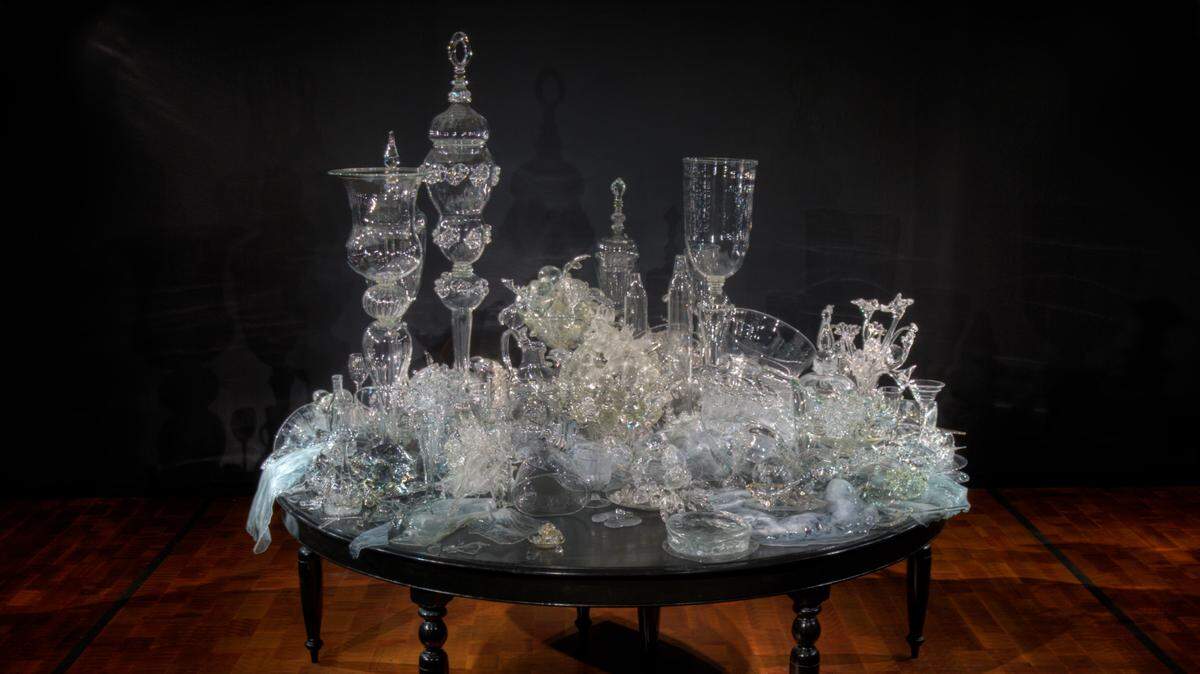
A happenstance journey through the Flint Hills of Kansas left Wisconsin-based artist Beth Lipman “breathless” and inspired to capture the unique prairie landscape in a commissioned piece for the Wichita Art Museum.
The resulting hanging sculpture, weighing more than 1.5 tons, now captures visitors’ attention when they enter WAM’s lobby. Lit up at night and visible through the glass-enclosed lobby, the sculpture made of glimmering clear glass, wood, ceramic and metal also captures the attention of passersby on Museum Boulevard.
To celebrate the installation of the commissioned piece called Living History and other work created by Lipman over the years, WAM has organized what’s called a mid-career survey of Lipman’s work. The summer exhibition, “Beth Lipman: All in Time,” opens June 25. Besides being able to visit the museum on a free-admission day, WAM has also planned some complementary activities and artmaking from 11 a.m. to 3 p.m. on opening day.
Before retiring from her 10-year term as WAM’s director earlier this month, Patricia McDonnell talked about how important it was for the museum to have a commissioned piece by Lipman.
“It’s a site-specific work by an artist who’s a big art star nationally, and it was part of the museum’s strategic plan to have a hanging sculpture to animate our lobby space,” McDonnell said, calling the installation a highlight of her decade with the museum. “I’m over the moon pleased with that sculpture.”
Lipman has created commissioned pieces for the Crystal Bridges Museum of American Art in Arkansas and the Chrysler Museum of Art in Virginia and is working on one for the Toledo Museum of Art in Ohio. Besides having earned a past Smithsonian research fellowship, she also was featured in the PBS documentary “Craft in America.”
While Lipman has been using glass and other materials to create elaborate still-life pieces since 1996, the exhibition will showcase more than a dozen pieces she’s done since 2010, making it a mid-career survey rather than a retrospective of her work going back to the beginning.
She recently had a similar survey exhibited at The Museum of Arts and Design in New York City, and several of the pieces in that exhibition will be displayed at WAM, Lipman said in a phone interview about a week before she was scheduled to return to Wichita to install the exhibition. She had been in Wichita in April to oversee the installation of Living History.
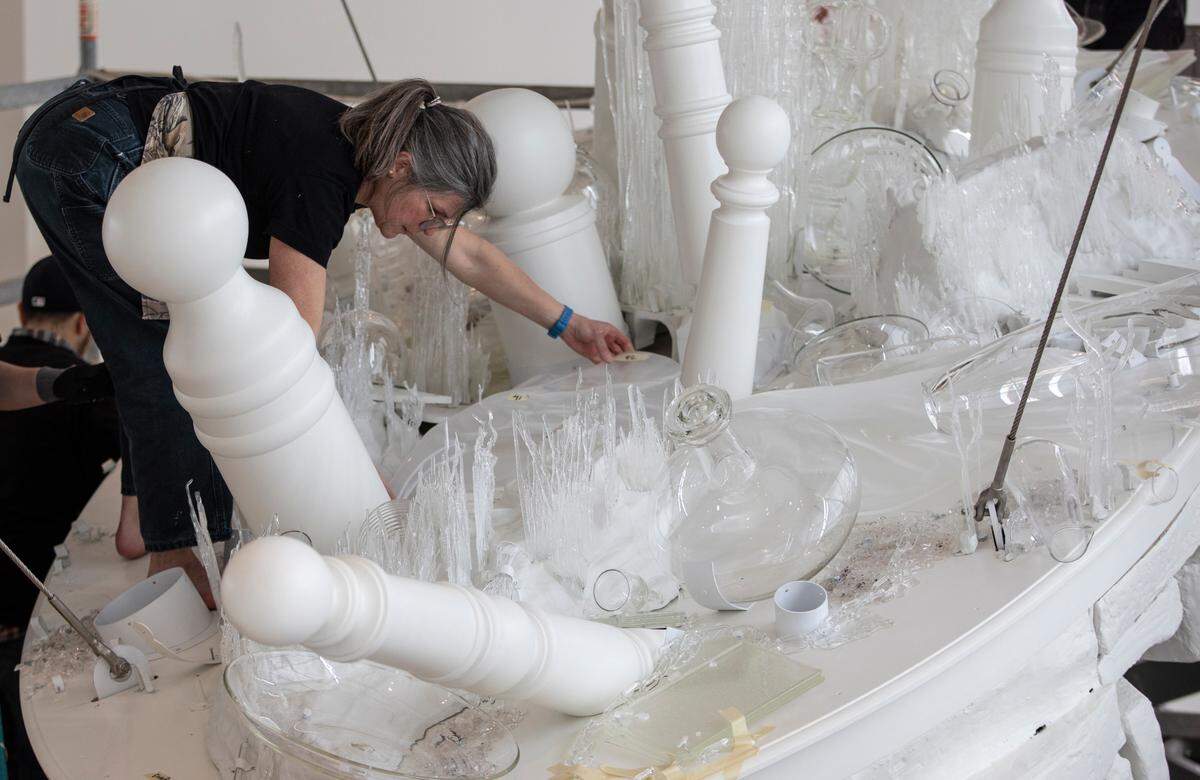
Originally, Lipman had planned to fly to Wichita in August 2020 to visit with WAM staff about her commissioned piece but because of the pandemic she instead drove from her home base in Sheboygan, Wisconsin, where the Pennsylvania native and Temple University alum has lived for the past 15 years.
The drive ended up being a major inspiration.
“The landscape really resonated with me. I was kind of breathless when I got to the Wichita Art Museum. I was raving about it. I didn’t know that much about the Flint Hills. It became apparent with the Flint Hills history as an uncultivated landscape that it was important and it aligned itself with my work.”
Besides incorporating at least five different grass types found in the Flint Hills and the Tallgrass Prairie National Preserve, the undercarriage, or sort of platform, on which the Living History still life was created is based on scans taken of a rock formation in Dead Man’s Gulch in northeast Gerry County. During one of the exhibition’s opening day activities on June 25, staff from the local Great Plains Nature Center will talk about the different grasses found in the Flint Hills.
Lipman also was influenced by her stay in Wichita in August 2020. Her jogs around Veterans Memorial Park in downtown Wichita led her to incorporate a bell she spotted in one of the memorials and soldiers’ helmets. WAM’s Pulse Field sculpture display at its main entrance — comprising 119 individual stems with solar luminarias — is also referenced in Living History.
“There are lots of different layers of things that are not extremely obvious when you’re looking at it, but they’re all embedded into the scope of the work that kind of cascades through the tall grasses and on top of Living History,” Lipman said.
“If you took Living History away from the Wichita Art Museum, it wouldn’t make much sense. It might be interesting to look at but in terms of the dialogue, if it was in Seattle, for example, it wouldn’t make any sense.”
Lipman said she was drawn to working in glass when she had a chance to work with the medium during a summer camp. At the Tyler School of Art and Architecture at Temple, she majored in both fiber and glass.
“Beth Lipman: All in Time” will be on display at WAM through Sept. 25. June 25 opening day activities include artmaking, live music by Pop and the Boys, food trucks and a 2 p.m. screening of films made about Lipman. Museum docents will also be available from 1 to 3 p.m. to talk about Living History commissioned sculpture and the exhibition.
‘Beth Lipman: All in Time’ exhibition
When: June 25-Sept. 25; special opening day activities from 11 a.m. to 3 p.m. Hours are 10 a.m.-5 p.m Tuesday-Saturday, noon-5 p.m. Sunday
Where: Wichita Art Museum, 1400 W. Museum Blvd.
Admission: $10 adults, $5 ages 60 and older, $3 ages 5-17 and college students with ID, and free for ages 5 and under and WAM members. Free admission for all ages on Saturdays. WAM is also a participant in the Sunflower Summer program, where Kansas families with children pre-K to seniors can visit an attraction for free by downloading the app.
More info: 316-268-4921 or wichitaartmuseum.org