
Wichita Art Museum’s summer exhibition displays one major glass artist’s ‘keepers’
As Richard “Dick” Marquis, considered a pioneer of American contemporary glass art, began making pieces in the 1960s, he started keeping some of his best and favorite works.
A retrospective exhibition of Marquis’ personal collection — including gifts he made for his wife — opened this weekend at the Wichita Art Museum, where it will remain on view until Sept. 5. The exhibition is aptly named “Richard Marquis: Keepers.”
What visitors will see are what museum executive director Patricia McDonnell calls “zany” pieces of art, likely to create a range of responses from “how did he do that” to humor, as one notices how Marquis fuses masterful glassmaking techniques with unexpected combinations of scale, color and even found objects to create his pieces.
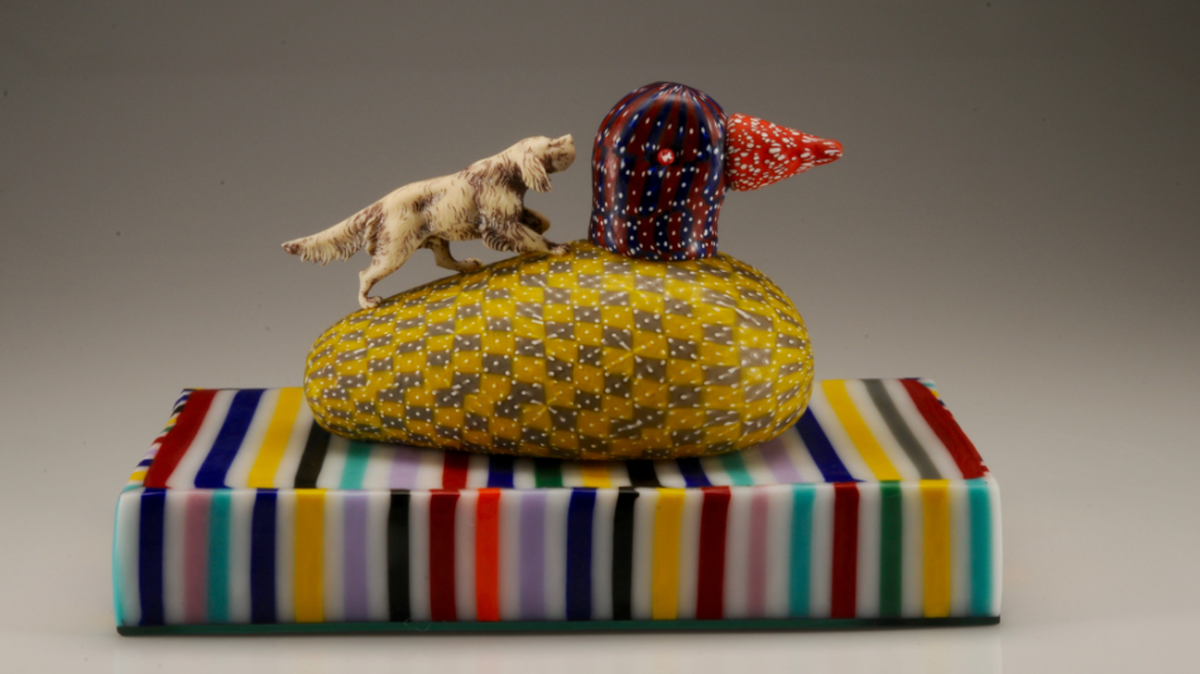
Marquis is especially skilled with the ancient technique murrine, where colored patterns or images made in glass rods are revealed when cut. The glass can be stretched like taffy, sliced to reveal the patterns or images and fused.
“His technique is mindboggling,” McDonnell said during a recent sneak-peak look at the exhibition. “You can’t believe a human being did that.”
The exhibition includes one of Marquis’ first works with murrine. For his master’s thesis when he was studying at the famed glass program at the University of California, Berkley, he recreated the letters and words comprising the Lord’s Prayer into the glass and kept sectioning and reducing the scale of the piece until the entire prayer fit on a piece of glass the size of a pinhead.
Marquis and his wife, Joanna, a mixed-media artist, are collectors of what the “Keepers” exhibition curator Vicky Halper calls “Americana” pieces. Some might call them vintage items, while others may even use the term junk. Some items from those collections — ranging from little metal cars to old shaving brushes to dog figurines to tin funnels and paint-by-numbers paintings — make their way into Marquis’ art pieces.
For example, Marquis created a sort of shadow box to display several shaving brushes. Look closely and you’ll see a Mr. Peanut figurine positioned between two brushes and then try to find the intricately made glass teapot within the collection.
“It’s a little like where’s Waldo,” said Halper, on a YouTube tour of the exhibition when it was displayed at the Museum of Glass in Tacoma, Washington. WAM partnered with the Museum of Glass to organize the exhibition.
In another piece, another of Marquis’ found objects, a duck figurine wearing a Shriner’s hat, sits atop a slightly askew vertical piece, created by stacking various glass pieces created by using different techniques. Marquis is also known for stacking pieces.
Marquis often mixes what Halper calls “the brilliance of the process” with humor and attention to detail and color.
“There’s humor but tight rigor in what he fuses and what he arranges,” Halper said.
Two heart-shaped boxes — the kind used to package Valentine’s Day chocolates — have been repurposed to hold two different types of glassworks. One holds what looks like decadently decorated pieces of chocolate and the other holds larger heart-shaped glass pieces. The two items are displayed next to Marquis’ “Ruby Heart Teapot,” a 5-by-6.5-inch blown glass piece created using the murrine technique. The items, along with snowman-themed pieces, were created as seasonal gifts Marquis gave to his wife.
Since Marquis started his artistic career as a potter, he kept using some of the traditional forms like teapots and goblets, Halper explained. As glassworks, he made them unusual and whimsical. One teapot in the exhibition has a huge bulbous base topped by a very tiny lid and spout. It’s an example of how Marquis likes to play with scale.
Marquis often has recurring themes in his work. Besides teapots, you’ll often find ducks or dogs represented.
Along with Dale Chilhuly, Marquis is among the artists credited with developing contemporary studio glass both in the U.S. and internationally. In 1969, he was awarded a Fulbright-Hays fellowship to work at the Venini glass factory on the island of Murano near Venice, Italy. The island is renowned for its glassmaking.
He was the second American to work with Venini’s glass designers, with the first being Chilhuly, but the first one allowed to work alongside the glassblowers on the studio floor, Harper explained.
He also studied and worked at the House of Waterford Crystal in Ireland. He paired two Waterford dog figurines rescued from the factory bins and paired them with one of his creations.
Marquis’ work is a reflection of when he came onto the art scene in the 1960s — a bit of California funk, the blurring of the lines between craft and art and the beginning of American contemporary art glass, said McDonnell of WAM.
“The 1960s and ‘70s were about breaking all the rules,” McDonnell said.
WAM is sponsoring two virtual talks related to “Richard Marquis: Keepers” to help visitors and those interested understand both Marquis’ importance and the studio glass movement.
Halper, the exhibition’s curator who also helped WAM reinstall its Stueben Glass collection pieces, will give a curator talk via Zoom at 6 p.m. Thursday, June 17.
Patrick Martin, an artist and professor at Emporia State, will give a Zoom talk at 6 p.m. Thursday, July 1, on “Thermal Links: Launching the Studio Glass Movement in the 1960s.” Martin has worked at the Chilhuly-founded Pilchuck Glass School in Washington.
Both of the Zoom presentations are free and require registrations. The events will be live-only and won’t be recorded for future playback.
“Richard Marquis: Keepers” exhibition at WAM
What: A retrospective exhibition of works by Richard Marquis, an influential, internationally renowned studio glass artist and pioneer of American contemporary glass art. All of the nearly 120 works are from Marquis’ personal collection.
Where: Wichita Art Museum, 1400 W. Museum Blvd.
When: through Sept. 5, WAM hours are 10 a.m.-5 p.m. Tuesday-Saturday, noon-5 p.m. Sunday, closed Mondays and major holidays
Admission: $10 adults, $5 ages 60 and up, $3 for college students with ID and youth ages 5-17, and free for children under 5 and WAM members Tuesday-Friday and Sunday. Free admission on Saturdays. Facemasks required.
More information: 316-268-4921 or wichitaartmuseum.org