
Look for these art installations around and inside Riverfront Stadium
Elizabeth Stevenson has some advice if you’re headed to an event during Riverfront Stadium’s debut season, which kicks off in earnest this Tuesday with the first homestand of the Wichita Wind Surge minor league baseball team.
Look everywhere, not just at the field, when you’re visiting the new facility on the west bank of the Arkansas River downtown.
“There’s artwork all over the stadium in unexpected places,” said Stevenson, director of Fisch Haus in the Commerce Street Art District and an art and architectural consultant in Wichita and Montreal who served as the stadium’s art consultant.
The Wind Surge, the Double-A affiliate of the Minnesota Twins, is playing a pandemic-altered 120-game schedule from May through September with two six-game homestands each month. Team officials have said there will be year-round public events at the stadium beyond baseball. Even if you don’t have a ticket to an event, it’s worth walking around the outside of the stadium to see the art installations by regional artists, many of them Wichitans.
“I thought it was a great idea, and a visionary move by the city and baseball team to include a significant public art presence in a sports stadium,” Stevenson said. “Those two worlds do not often collide, and I was excited to see how the artists would respond to such a unique commission.”
Riverfront Stadium was built from 2019 to 2020 and in December 2019, Wichita’s City Council adopted an ordinance that allotted 2% of public project funds to a pool of funding allocated for public art. There was an open call for artists for the stadium project, and those selected were then given a budget that included design, fabrication, installation and artist fee.
“The artists, as a group, began their process by mutually agreeing to a few ‘design language’ principles to think about as they worked through the schematic design phase,” Stevenson said. “They were interested in movement—spheres through space, materiality—referencing the materials used in the building itself, and the stadium location—placing the work in the context of the surrounding neighborhoods, road systems, river, etc.”
There is art installed above your head, other elements so subtle you might pass by without noticing, and some installations you won’t see unless you visit the bathroom. Here’s a guide to art inside and outside Riverfront Stadium.
Inside the stadium:
“Triple Play” is a three-piece light sculpture hanging under the canopy of the Maple Street entrance. Wichitans Stephen Atwood, Eric Schmidt and Kent Williams designed three massive pendants loaded with LED lights and reflectors that emit colors and light through thousands of holes in the skin of each of the 12-feet-tall cylinders. The light effects are devised to be interesting from outside the stadium as well as to anyone walking through the entry or sitting inside the stadium. The light radiators can be programmed for a calm effect and can be triggered to set off an exciting light show when the Wind Surge hits a home run, for example.
High on the concourse walls you’ll see “Around the Horn” by Wichitan Jonathan Wood with Kansas City Metalworks. The decorative piece is an abstraction of the Arkansas River that flows just outside the stadium.
“Sayonara!,” “Strike!” and “Wham!!!” are three titles from the series of 20 murals in the stadium’s bathrooms by Wichitans Rebekah Lewis and Joshua Tripoli, who together work as the Lupoli Collective. The designs are modern interpretations of classic designs inspired by baseball cards and comic books, using bold, bright colors and typography.
“Muqarnas Study Three” is an installation on the right field picnic area railings by Asheer Akram, a Kansas City sculptor and founder of Kansas City Metalworks. The artwork is a series of screening panels whose patterns are generated by geometric principles with roots in Islamic architecture. The design’s waves and ripples represent the motion of a ball flying through the air.
Rose Hansen drew the concept for “The Imposing Sky” and Ernie Sharp, her boyfriend and co-owner of their Wichita design and fabrication shop House of Sharp, made the 56-feet-long metal panorama of the city skyline. See it above the food court behind home plate.
Outside the stadium:
It’s hard to miss the 156-feet-wide by 20-feet-tall bright mural on the stadium’s south exterior. It took Brickmob, a collective of Wichita artists, about 500 hours and more than 30 gallons of paint to create the vibrant scene that incorporates a batter, Wichita flag elements and strategically placed words that make it a great place for a “Wichita Baseball” selfie. Get up close, too, and notice the timeline of past local baseball clubs honored along the bottom of the mural.
One of the hardest installations to spot if you’re not looking for it is integrated into the fencing on the west side of the stadium along Sycamore Street. Ellamonique Baccus, a Wichita artist and the executive director of Arts Partners, painted a baseball scene on the fencing. It is lenticular art, meaning what you see changes depending on your viewing angle. She collaborated on “Swing for the Fences” with Armando Minjarez, who made ceramic pieces as part of the work, and William “Bill” Bugner, who installed the ceramic.
A pedestal outside the Delano entrance will feature a different sculpture each year, starting with “Wind Engine,” a merger of natural objects and human-made machinery by local sculptor Mike Miller.
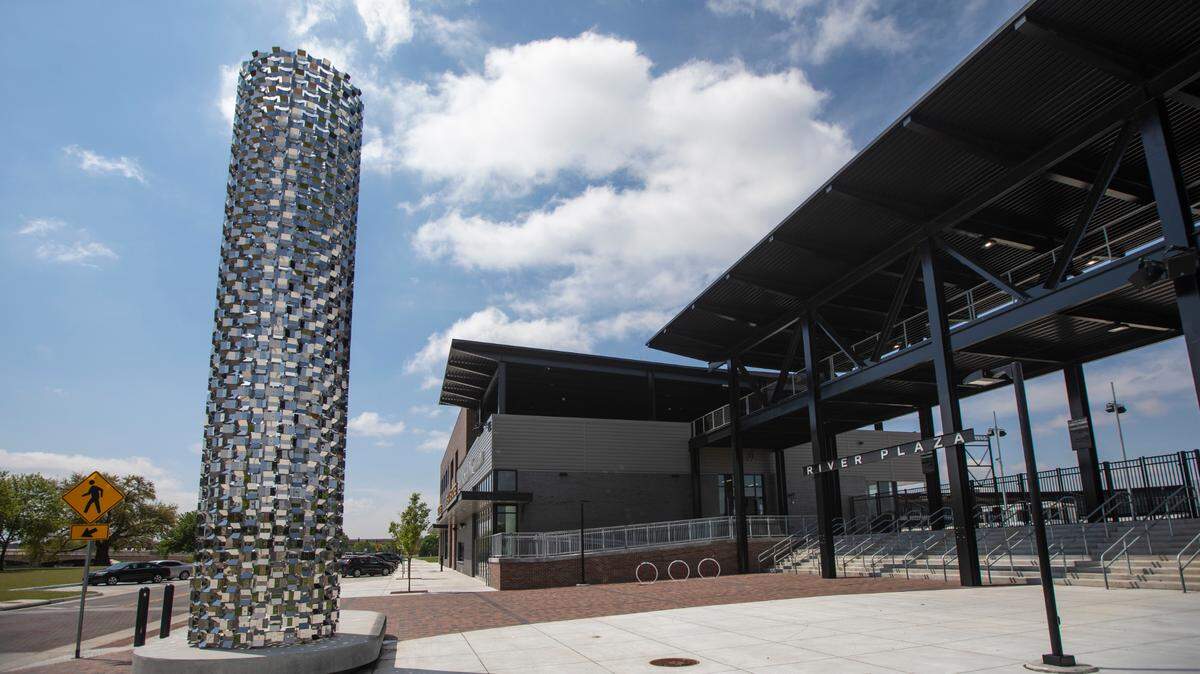
Off McLean Boulevard is the stadium’s ticket office, merchandise store and the River Plaza entrance. This is where you’ll find the 30-feet-tall, 8-feet-diameter “Faceted Column” with nearly 5,000 faceted mirror surfaces collecting and recasting images of the surroundings. Artist Derek Porter has studios in Kansas City and New York City.
The title of Brady Hatter’s artwork, “Point Of Convergence,” relates to the merging of old with new as well as to the baseball scene depicted — a baserunner, a catcher and an umpire coming together for a play at home plate. The Wichita artist designed a steel frame and mounted the cast concrete frieze created in 1997 by Randal Julian, Ty Smith and William Street that was on display at Lawrence-Dumont Stadium, which was demolished in 2018 to make room for the new stadium. The piece is on the south exterior.
Three bike racks at the main entrances combine function and art. The rack at the Delano entrance, designed by Gordon Schmidt, is seven separate stands that when viewed from the front reveal a layered Wichita flag design. The rack at the Maple Street entrance is a cutout of a blue bicycle and yellow letters ICT by Patrick Scanga, and William Stofer designed the “Batter Up!” rack outside the River Plaza entrance.
Stevenson said if you miss any of the art while at the stadium, soon the Wind Surge website will include a page dedicated to the art and artists.
This story was originally published May 7, 2021 at 4:02 AM.