
‘Into the Woods’ goes beyond happily ever after
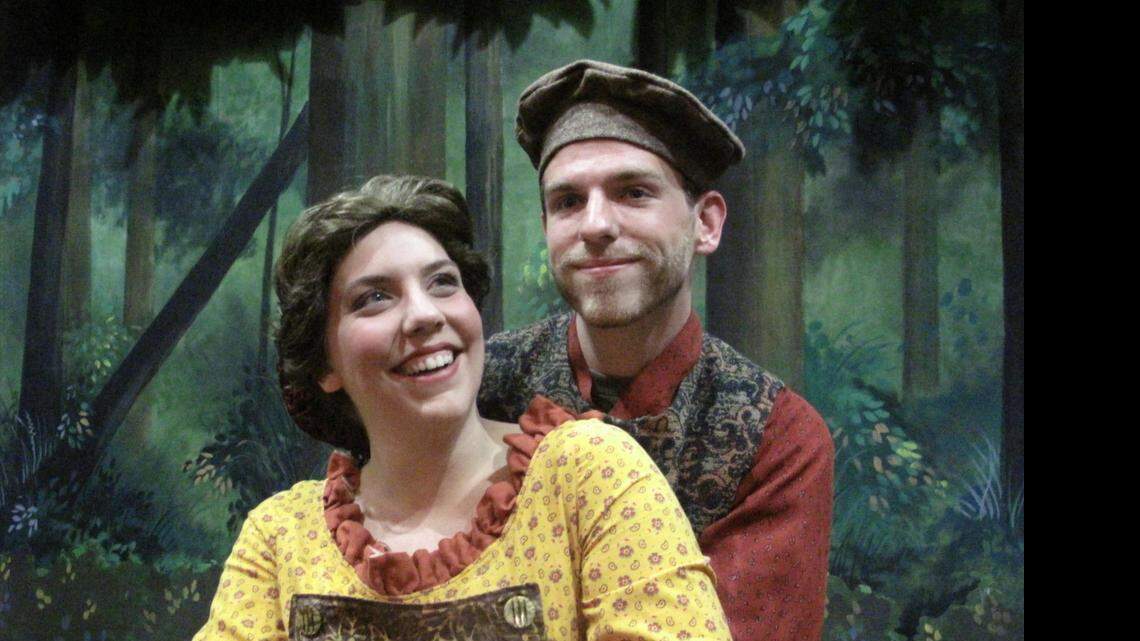
Stephen Sondheim’s idea of a witch may be a lot of unpleasant things: ugly, scary, blunt, intimidating, short-tempered and “able to zap people with her magic stick.”
“But she’s not a liar,” says Emily Monrad, who plays that pivotal character in Sondheim’s “Into the Woods,” opening Thursday as the spring musical for Wichita State University’s School of Performing Arts.
“She can say what she wants. She calls people out for what they do. She’s not afraid of real life. She doesn’t have to save face or pride,” says Monrad, an Overland Park senior.
“It’s a morality thing, which is the basis for all fairy tales in the first place,” says Monrad, who sees her character as complicated rather than evil. “I think of her not as a witch but as a woman. At one point, she says, ‘You’re not good, you’re not bad, you’re just nice. I’m not good, I’m not nice. I’m just right.’ ”
That sophisticated approach to classic fairy tales is key to Sondheim’s 1987 Tony-winning musical (and last Christmas’ movie version) that goes beyond “happily ever after” to explore what happens when familiar folks like Cinderella, Little Red Riding Hood and Jack – of beanstalk fame – actually get what they wish for. It’s a smart, cautionary tale about unintended consequences, epitomized by songs like “Children Will Listen” and “No One Is Alone.”
“It’s such a challenging show. It’s very difficult musically in Sondheim’s rhythmic schemes and wordplay. But it’s one that has a lot to say about taking responsibility for your actions, which is particularly relevant in today’s culture,” says Linda Starkey, director of WSU’s School of Performing Arts, who is directing the show. She also directed a version in 2002. “It’s about coming together as a community. And that is crucial for our culture.”
Besides Monrad as the witch, other key cast members include Michael Allen and Jennie Hughes as the baker and his wife, Emily Vargo as Little Red Riding Hood with Anthony Gasbarre as the wolf, Hannah Fernandes as Cinderella with Josh Brown as her prince, Joella Wolnik as Rapunzel with Jacob Groth as her prince, Gavin Myers as Jack with Alyson Golladay as his mother and Deiondre Teagle as their cow, Milky White.
The first act, says director Starkey, will seem comfortable to most people because it deals with familiar fairy tale characters going on quests for what they want, from adventure to wealth to love.
“They all want something. They all think their lives will be better once they get it,” Starkey says. “But Act II deals with the consequences of getting what they want. For audiences who hear ‘fairy tale’ and think ‘Disney,’ they may be surprised by how dark the show turns. It deals with tragedy but also with rebuilding.”
Hughes and Allen recognize that their characters – the baker and his wife – become victims of their own ambition and desperation to have a child. Their childlessness is the result of a curse from the witch next door, and they will do anything to break it.
“I love that the baker’s wife is strong-willed and passionate about wanting a child. That’s not a bad thing. I’m similar in that I have goals and know what I want,” says Hughes, a senior from Augusta.
“But her downfall is that her passion drives her to lie and cheat,” she says.
“The baker’s problem is that he’s a worrier. He tries to be the man of the house, but he fails at it. He’s very protective of his wife and wants to make decisions. He thinks he’s in control, but he isn’t because of his fear of the unknown. He is always worrying about what if, what if, what if,” says Allen, a Shawnee senior who also played this role four years ago in high school.
On the positive side, Allen says: “He is a good man. I love that he is the conscience of the show.”
Contrary to popular opinion, Cinderella wasn’t wishing for a prince to sweep her off her feet but rather for a night out to get away from her troubles, says Fernandes, who plays her.
“Cinderella is an iconic character known for her kindness even in the face of all the neglect and abuse that she suffered,” says Fernandes. “In the original Grimm fairy tale and in Sondheim, she doesn’t really need a prince to save her. That came from Disney. I think she was uncomfortable with that sort of attention. She just wanted a night off to put on a pretty dress and enjoy herself.”
For Myers, his character of beanstalk-climbing Jack is a “lovable kid” with “a sense of adventure” who probably needs “a little guidance.”
“I love Jack’s sense of adventure and his loyalty to friends. He’s a good kid, but he’s a very young lad who can get distracted. He gets sort of lost,” says Myers, a junior from Belle Plaine.
“He’s probably 13 or 14, right around puberty. He’s exploring what’s happening to himself as well as the world,” Myers says. “In the end, he has to learn to be himself.”
Vargo sees her character of Little Red Riding Hood as an impetuous brat who thinks the world should revolve around her.
“She’s a kid, maybe 11 to 13. She has no filter. She says whatever pops into her head. She doesn’t think anything bad will happen to her, because she lacks life experience,” says Vargo, a Gardner senior. “She gets that experience and grows up during the show, which makes her a little sadder but wiser.”
Vargo says she admires Red’s fearlessness and curiosity and personally identifies with the latter quality. “I’m very curious myself about people and why they are what they are. That’s why I got into acting – to find out.”
If You Go
‘Into the Woods’
What: Stephen Sondheim’s sophisticated musical take on classic fairy tales presented by the Wichita State University School of Performing Arts
Where: Wilner Auditorium, 1845 Fairmount (off 17th and Hillside) on the WSU campus
When: 7:30 p.m. Thursday-Saturday, 2 p.m. Sunday
Tickets: $16 adults, $14 seniors/military/faculty, $6 students, free for WSU students with ID; 316-978-3233 or www.wichita.edu/fineartsboxoffice
This story was originally published April 24, 2015 at 10:05 AM with the headline "‘Into the Woods’ goes beyond happily ever after."