
Photos capture ‘a country on the cusp of change’
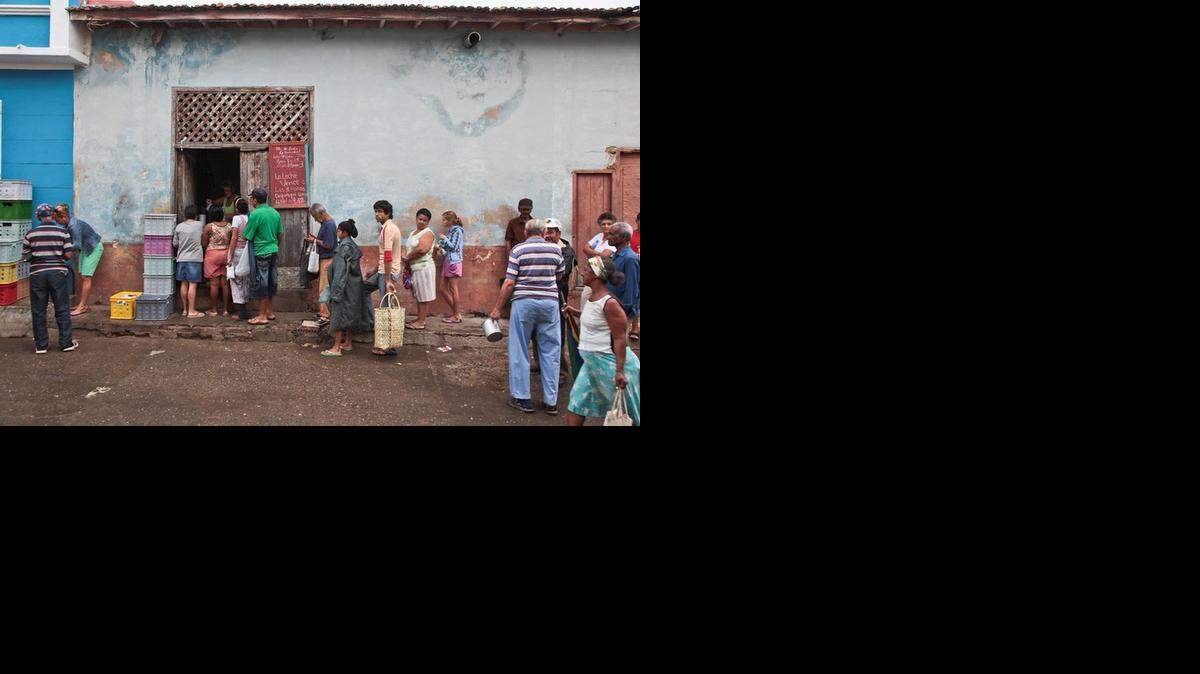
When Larry Schwarm started teaching at Wichita State University two years ago, he wanted to offer something unique. The professor of photography set a goal to take students on an international trip each spring that would allow them to document their discovery of new cultures. The expedition he and six students took to Cuba in March 2014 did just that, but it also ended up capturing what is likely to be the end of an era.
Those images, which explore the people, architecture, landscapes and colors of the embargoed nation, are part of a new exhibit at Newman University’s Steckline Gallery called “Travels to Cuba.” It features 35 photographs from the trip taken by Schwarm and his students – Mallory Chambers, Dwight Corrin, Gloria Esparza, Kelsy Gossett, Tyler Longfellow and Bruce Ward. The show opens Friday with a special evening reception, and the works will be on display through March 20. A luncheon artist’s talk featuring Schwarm and some of the students will take place on Tuesday.
Schwarm said he was drawn to Cuba because of its closed-off nature.
“The forbidden fruit thing was part of it,” he said of his motivation for organizing the trip. “All of my adult life, Cuba has been a mystery to me. I was in high school when the Cuban missile crisis happened. Growing up, Cuba was considered an evil country, closed off to Americans. The whole idea that you can’t go … that’s something you never tell an artist.”
President Obama’s announcement in December that the United States would begin taking steps to normalize relations with the communist country means that a land largely untouched by American influence will start to gradually reflect its neighbor to the north, Schwarm said. The images that he and the students took portray a country largely unaffected by the technological advances of the western world. They show a simpler way of life, a throwback of sorts. Crumbling infrastructure, manual typewriters and vintage cars and clothes also demonstrate the effects of severed trade ties.
“I wanted to give students a unique opportunity, and what better than a country that’s been generally closed off to Americans for the last 50 years? It’s communist, socialist, a dictatorship: all these things that students have never experienced before, and it’s only 80 miles off the coast of Florida.”
The images capture everyday life, offering a glimpse into a people and land unfamiliar to most Americans. Kelsy Gossett’s “Boy Looking in Window” demonstrates the paradox of old ways colliding with new possibilities: a young boy lifts himself up through a window against a crumbling building. Gossett’s “Family on Their Porch” shows a happy family living in simple quarters south of Trinidad. Gloria Esparza’s “Man on Painted Balcony” demonstrates the richness of how faded color and aging architecture collide in Havana. Schwarm snapped a political statement in Cienfuegos with a punchy billboard that reads “Cuba Is Stronger Than the American Blockade.”
“These photographs are really compelling in terms of what they captured,” Schwarm said. “Unbeknownst to us, we got in on what is probably the end of an era. Change will happen gradually, but it’s coming. If we were to go a year from now, things would look very different.”
This was Schwarm’s second trip to Cuba, though the first time with students. In 2012, he received a license from the U.S. to travel there to photograph agricultural practices. For this trip, he and the students spent about half of their time in Havana and the other parts traveling through the countryside on their way to visit Trinidad, Santa Clara and the Bay of Pigs.
Schwarm said he has mixed feelings about the new direction the United States is taking with Cuba.
“The mixed part is being very selfish on my part. Cuba as we saw it is so unique in the world. I’m afraid from our perspective that once the embargo is lifted and we start having open travel back and forth, that Cuba is going to get Americanized very fast. On the other hand, I think they’re going to love it. I think it’s really good for them.”
He hopes this exhibit will be a window into a unique time in Cuba’s history and is happy he and the students got to see what he calls “a country on the cusp of change.” The people of Cuba, he said, really are the subjects that make the exhibit resonate.
“We were all seeing it through American eyes,” he said of the trip. “I picked the photos for this show I thought were the most interesting, not the usual tourist pictures. The show will represent a lot of photographs of people … I encouraged my students to interact with people a lot and engage them in conversation. As a result, they’re friendly photographs.”
If you go
Travels in Cuba
What: Photographs that document “a country on the cusp of change” taken by Wichita State University professor Larry Schwarm and his students during their March 2014 trip
When: 5-7 p.m. Final Friday opening reception. Works on display through March 20 during regular gallery hours, 9 a.m. to 4 p.m. Monday-Friday, or by appointment. Art for lunch talk noon-1 p.m. Tuesday.
Where: Newman University’s Steckline Gallery, inside the De Mattias Fine Arts Center, 3100 McCormick
How much: Free
Information: www.newmanu.edu/stecklinegallery or 316-942-4291
This story was originally published February 26, 2015 at 4:16 PM with the headline "Photos capture ‘a country on the cusp of change’."