
Wichita Art Museum’s new exhibition shines a light on complex issues
The “Anila Quayyum Agha: Interwoven” exhibition now open at the Wichita Art Museum wastes no time in providing a wow factor for visitors.
It happens with the very first piece, where the effects created by the installation are just as interesting as the piece itself, which is suspended from the ceiling.
The gallery’s red walls, carpeted floor and ceiling along with visitors are bathed in complex shadows created by a single light shining through the intricate floral motifs and patterns that were laser cut into the lacquered red steel panels of the suspended cube. The piece is called “All the Flowers Are for Me (Red).”
“One of the things I love about it … is that you become a part of the art in a way that’s really profound,” said Jeremiah William McCarthy, the curator who helped bring together about 40 pieces that Agha has created over the past two decades for the touring exhibition.
“Interwoven” debuted at the Westmoreland Museum of American Art in Pennsylvania before coming to Wichita, where it will remain on display until Sunday, April 20. Admission to the special exhibition is $12 and free for WAM members, college students with an ID and youth 18 and younger.
The shadows cast by “All the Flowers Are for Me (Red),” which Agha created in 2016, help eliminate differences while the light creates unity, said both McCarthy and Agha during a preview tour of the exhibition before it opened Jan. 25 at WAM.
Agha’s work tends to center on themes exploring differences and commonalities, the immigrant experience and the role of women.
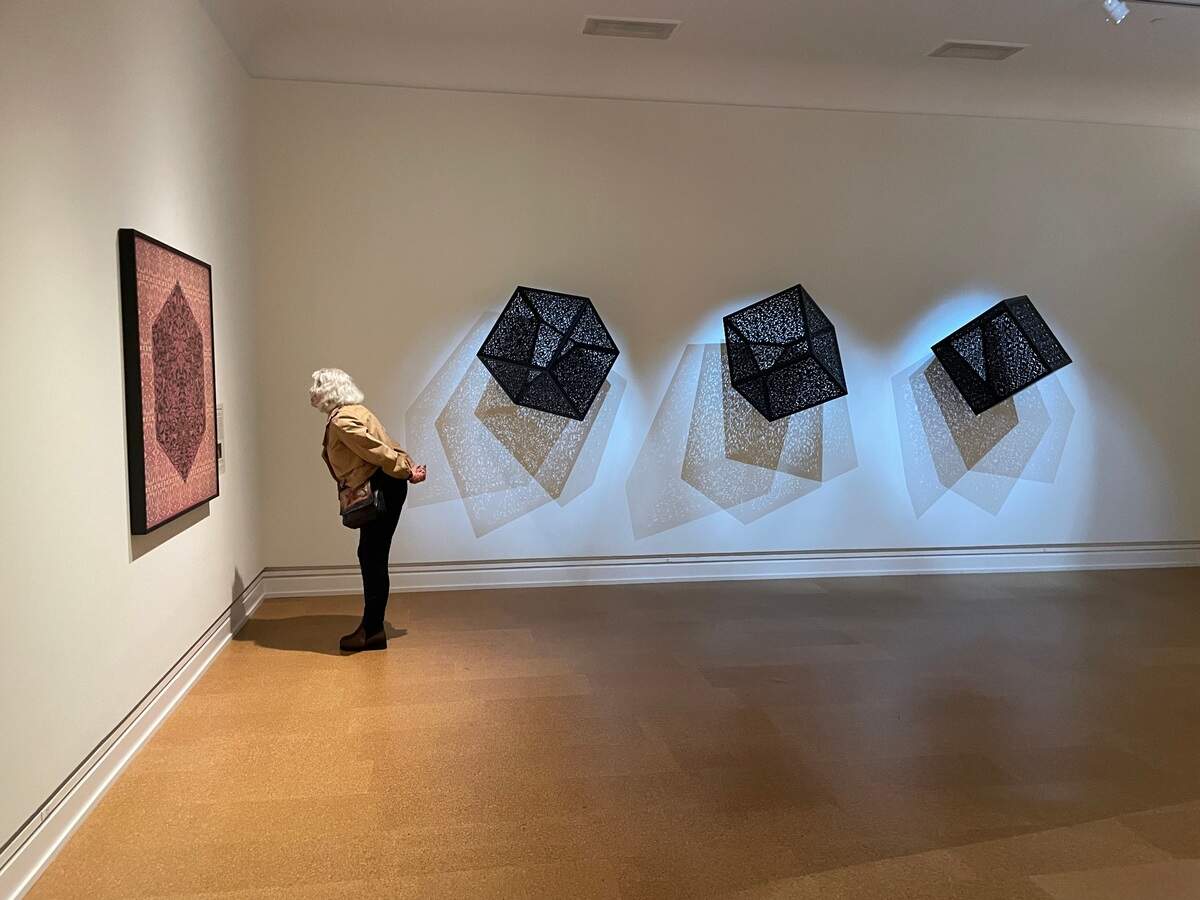
Another light installation in the exhibition — a set of four 4-foot cubes called “Itinerant Shadows” that jut out from a white wall — is an example of creating perceptions, Agha said.
One’s perceptions of the black cubes, also made from laser-cut lacquered steel, can change depending on how you look at the piece (from the side or directly in front) or what you look at (the light, the shadows and the patterns).
“That goes back to identities and how people are received or perceived,” Agha said.
“I’ve lived and visited so many parts of the world and I’ve seen hierarchies. I’ve seen gender hierarchies, racial hierarchies or economic hierarchies and it hurts my heart and soul to think of undervaluing somebody based on things that are maybe not even in their control,” she said.
Agha is originally from Lahore, Pakistan, where she studied textile design and earned a bachelor’s degree from the National College of Arts in 1989. She came to the U.S. 25 years ago and earned a Master of Fine Arts in fiber arts from the University of North Texas in 2004.
She’s also traveled extensively, including to countries in parts of Asia, Europe and the Middle East.
One of the biggest influences on her art career was a 2011 trip to the centuries-old Alhambra palace and fortress in Granada, Spain. It’s one of the best examples of historic Islamic architecture.
She noticed how visitors seemed to be in awe of the complex, and she also noticed the interplay of light and shadows in different spaces.
That led her to one of her first large-scale light installations, this one featuring a laser-cut wooden cube, in 2013.
The piece, called “Intersections,” accomplished the rare feat of winning both the juried and public grand prizes in the 2014 ArtPrize competition in Grand Rapids, Mich.
“Overnight, it turns you into someone who can realize the ambitions you’ve always had … and it revs up a career,” McCarthy said.
That’s because each grand prize comes with a $200,000 purse. Agha was the sole winner of the public grand prize voted on by attendees and split the juried award, determined by judges, with another artist.
Since winning the competition, Agha’s luminous installations have been shown in and acquired by several museums, and articles about her and her work have appeared in The New York Times, The Art Newspaper, which is a publication covering art news from around the world, and other publications.
What gives this exhibition breadth is that it includes several other works besides the light installations — including works created by various methods and media including embroidery, painting, drawing, waxes, Mylar and more — and works made before she won the ArtPrize competition. It’s not unusual for Agha to revisit past works, and continue what she calls “the conversation” of the pieces by making new works with similar elements.
A multimedia piece called “Hessiat (Essence)” that Agha made in 2004 when she was in grad school shows she was already exploring some of the themes that have come to define her work, particularly since the piece deals with how women are perceived or defined. The handwritten text in the lower left corner of the piece is a disparaging definition of a woman in Urdu, the national Pakistani language, from a 1985 dictionary.
The final installation in the WAM exhibition is another large-scale piece that Agha first created in 2010. The work consists of 529 10-foot strands of red beads that are suspended from the ceiling and end with 10-inch black upholstery needles. Black glass tile flooring underneath the strands provides a reflection effect.
‘Anila Quayyum Agha: Interwoven’ exhibition
What: a touring exhibition of two decades of Anila Quayyum Agha’s works that include large-scale laser-cut steel pieces that create light and shadows and smaller pieces that incorporate mediums such as embroidery, beads, hand- and laser-cut materials, drawing and painting
Where: Wichita Art Museum, 1400 W. Museum Blvd.
When: through Sunday, April 20. WAM hours are 10 a.m.-5 p.m. Wednesdays through Sundays, with extended hours until 9 p.m. on Fridays.
Admission: $12, free for WAM members, college students with ID and youth 18 and younger
More info: 316-261-4921, wam.org