
Walnut Valley Festival is turning 50. A new book traces its roots, explains its appeal
Winfield’s Walnut Valley Festival — an annual gathering of acoustic musicians and acoustic music lovers that always draws people from all over the country to Kansas during the third week of September — will hit a big milestone this year when it turns 50.
And now fans of the event, set for Sept. 14-18 at the Winfield Fairgrounds, can access its history through a new book just put out by a local historian and longtime festival regular.
Seth Bate, the program manager for coaching and leadership development at Wichita State University’s Community Engagement Institute, has just written a book that looks back at the festival’s history and examines what it has come to mean to its devotees. The book, titled “Winfield’s Walnut Valley Festival,” was just released by Arcadia’s History Press and is for sale at bookstores and through the festival’s website.
In addition outlining the festival’s founding in 1972 by three Winfield locals who wanted to promote Mossman Guitars made at a now defunct factory near Winfield, the 176-page book also features first-person essays by performers, festival workers and festival attendees as well as around 100 images captured over the decades.
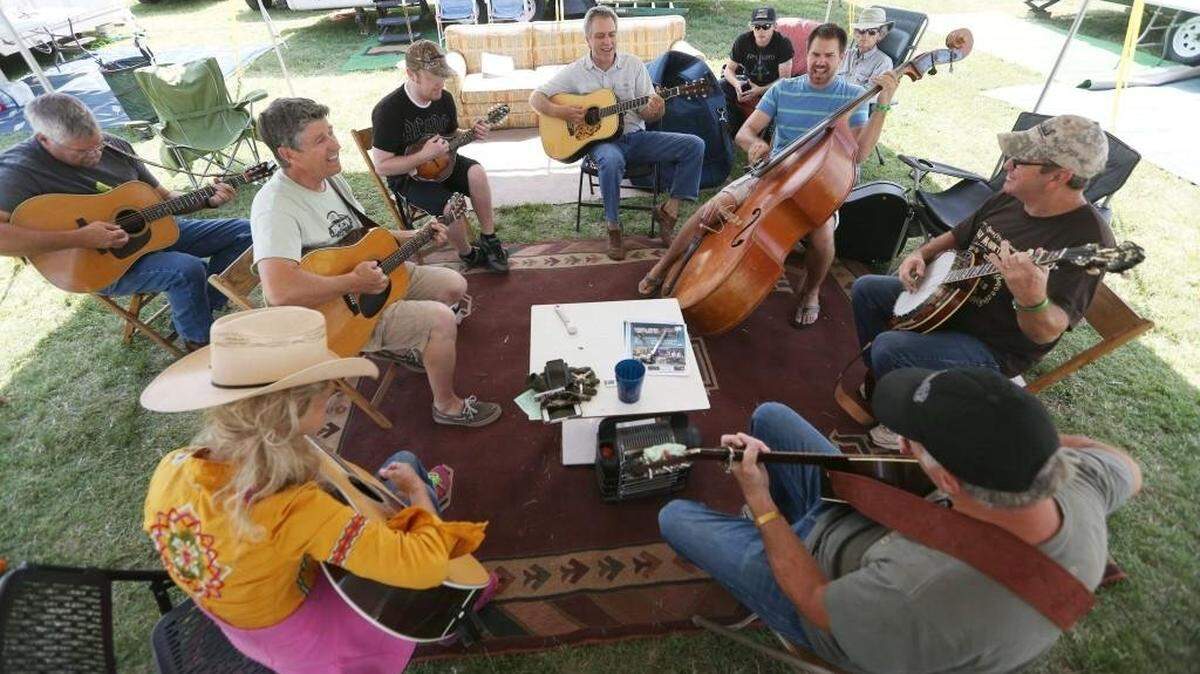
The festival, well-known as the home of the Walnut Valley National Guitar Flat-Picking Championships, today features four stages full of folk, bluegrass and acoustic musicians playing hammer dulcimer, guitar, banjo, autoharp, mandolin and more. People come from across the world for the festival, and many locals take off work for its duration, lining up weeks in advance to claim campground spaces. Some of the best music at the festival is produced by campers picking away around campfires.

It’s known as a musician’s festival, and it attracts some of the best from around the world. A 13-year-old Alison Krauss was a Walnut Valley fiddle champion in 1984. Marti Erwin of The Chicks placed second in the fiddle contest in 1987 and third in 1989.
Bate, who grew up in an Air Force family full of music lovers, moved to Kansas in 1989 and attended his first Walnut Valley Festival, not fully understanding what it was. But once through the gates, he discovered campgrounds full of people playing music, and he was amazed. Before long, Bate — who sings and plays guitar and autoharp — had signed up to work as an festival emcee and a member of the stage crew.
“I felt at home right away,” he said.
In 2018, Bate — who has a music and theater degree — was working on a master’s thesis in the local and community history program at WSU and decided to focus his paper on the story of the Walnut Valley Festival. While talking to organizers of the event for his thesis, the idea of producing a book to commemorate its 50th anniversary was tossed around.
Bate said he was already at an advantage because his father-in-law was one of the three people who formed the Walnut Valley Association. Though no longer involved in the festival, his father-in-law shared his memories, Bate said. Current organizers also let him dig through old meeting minutes and festival fliers, and he was able to interview other festival pioneers as well.
Through his research, Bate developed a theory about how the festival became a world-famous event that has managed to endure and thrive, even through the COVID-19 pandemic, which led to the event being canceled in 2020.
“My belief is that part of the reason the Walnut Valley festival has sustained for so long is that it’s changed very little,” he said. “By about the third festival, all of the pieces that people who love the festival now count on were there in recognizable form.”

Another aspect of the festival’s history Bate found fascinating was the fact that its attendees shaped it into what it is today, adding their own traditions that the original organizers never planned or could have foreseen.
“I think one thing that was a theme early on is the festival being a place that can hold both a spot where people can party and celebrate and be a little countercultural and a place that can be family-friendly and conservative and comfortable all at the same time,” he said. “And I think that’s magical.”
Tickets for this year’s festival, which will feature performances by Bela Fleck, Rhonda Vincent & The Rage, The Steel Wheels, John McCutcheon and more, are $60 to $100 in advance through Friday at www.wvfest.com/festival-tickets. They’re $20 to $125 at the gate.
Bate will be selling and signing copies of his book, which costs $23.99, at 6 p.m. Sept. 13 at Ladybird Brewing, 523 Main St. in Winfield. He’ll also sign books at various times throughout the Walnut Valley Festival as well as at 4:30 p.m. Nov. 21 at the Cowley County Historical Society Museum in Winfield.
This story was originally published August 25, 2022 at 2:28 PM.
.jpg)