
The Plains are home to buffalo that roam — and here’s where you can see them
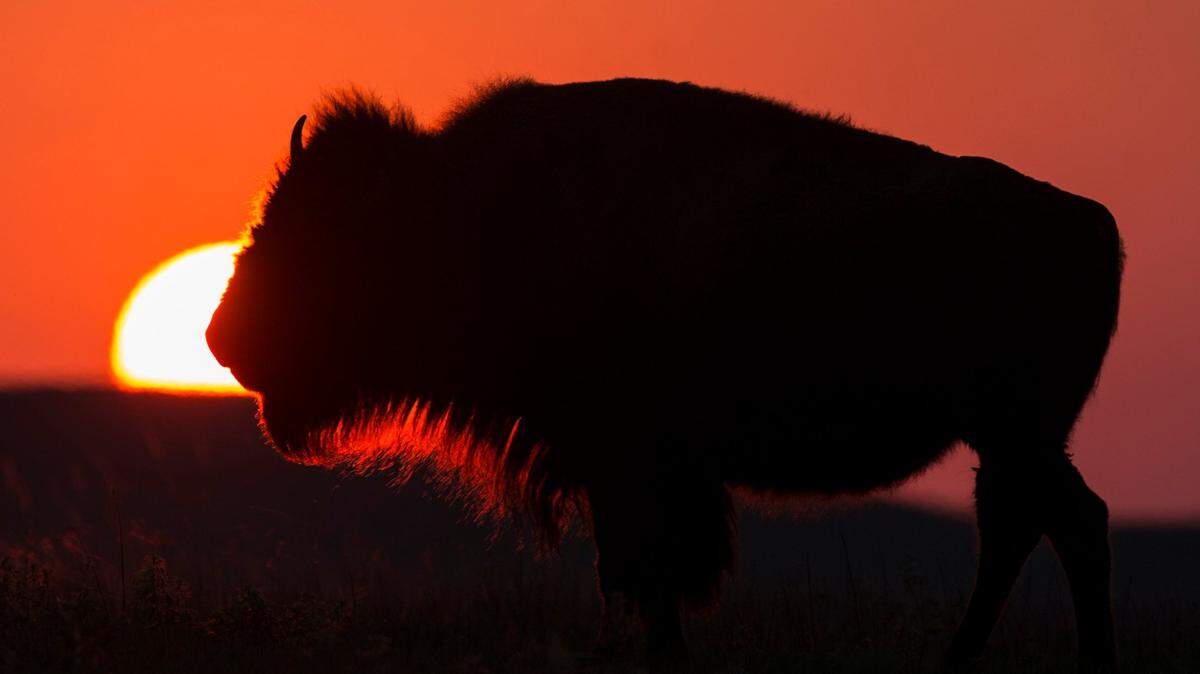
There’s something wondrous about watching bison. Maybe it’s their sheer size — they are the largest mammal in North America, and a full-grown bull can stand 6.5 feet at the shoulder and weigh up to 2,000 pounds.
Or it could be the personality many display while spending as many as 11 hours a day foraging. I’ve watched a group line up to take turns at a sign-turned-scratching post; witnessed them slowly, gracefully crossing the Little Missouri River; rolled up the windows when they started wallowing in dry dirt, stirring up a cloud of dust; captured video as a lone bull meandered across a meadow at sunset while emitting pig-like grunts and watched a baby roll around in the grass next to its mother and then start watching us in our vehicle.
Maybe it’s knowing the heartbreaking history that wild bison numbers — once estimated at 30 million — dwindled to several hundred in the 1800s because of overhunting. It’s estimated that 20,000 bison now roam wild on state, federal and tribal lands and as many as half a million more in privately owned herds.
Today bison live in all 50 states, though I have a hard time envisioning anywhere better to see them than the Great Plains. I’ve had a chance to see bison in the stack of states from Theodore Roosevelt National Park in North Dakota to several protected areas in Oklahoma.
Maxwell Wildlife Refuge is the closest public land for Wichitans to see a free-roaming bison herd, and tours have just restarted there after a pandemic hiatus.
The 2,800-acre ranch near Canton, about 60 miles north of Wichita, is managed by the state, and a nonprofit group, The Friends of Maxwell, coordinates tours. to see bison and other wildlife.
You can drive through the refuge on a 2.5-mile road from dawn to dusk, and you may or may not see any of the 220 bison living there.
“The bison at Maxwell are not kept in a zoo-type situation; they are free-range and there are a lot of hills here,” said Betty Redden, director of The Friends of Maxwell. “The whole herd can just drop over a hill and nobody can see anything. Then sometimes the herd is right on the main road, and you’ve got to weave around and through them.”
A tour on a tram through the pastures is a sure way to see the bison. Staff goes out an hour prior and drops feed cubes along the trail, then a guide brings the visitor tram back and narrates the tour. They are offered year-round, almost always in the morning when the animals are most active. The bison are always part of the tour, but you’ll also see elk in the winter, baby bison and wildflowers in the spring and more wildflowers and colorful grasses in the fall.
The group is taking reservations for spring themed tours: Baby Bison Spectacular on May 23 (10 and 11 a.m. start times) and Spring Wildflowers (9 and 11 a.m.) on June 19 are 45 minutes and cost $15 for adults, $7.50 for children. A 90-minute Babies and Wildflowers Photo Tour on June 5 starts at 8 a.m. and costs $30. Most other Saturdays starting this month there will be regular tours as long as there is a minimum of 10 people signed up ($15 adults/$7.50 children). During the busy summer months, there are typically tours three to four days each week.
Reservations are required for all tours. Because the visitor center is not open regular hours, they are only taking reservations by e-mail at Maxwellwildliferefuge@gmail.com. Get more information at maxwellwildliferefuge.com.
They also plan to return to their lineup of special events this year: look for a Fall Rendezvous Oct. 1-3 followed by Christmas on the Prairie.
“Our priority is to educate people on the last of the virgin native prairie that has not been broken, soil tilled and plants grown on,” Redden said. “And a tour is the best way to see it.”
Tallgrass Prairie National Preserve
Sixty miles directly east of Maxwell is another area to explore the native prairie and the grazing bison. Tallgrass Prairie National Preserve is a public-private preserve that opened 25 years ago through a co-management agreement between the National Park Service and The Nature Conservancy. The groups added 13 bison in 2009, after a century and a half absence of bison, and this year their herd is about 100 bison. Though bus tours are not operating, you can follow a walking trail that cuts through the 1,100-acre field.
Farther south, across the Oklahoma border, is a continuation of the tallgrass prairie that has been repopulated with bison; Kansans refer to the Flint Hills and Oklahomans call their piece the Osage Hills. The Nature Conservancy manages the Joseph H. Williams Tallgrass Prairie Preserve where the 1,700-bison population is expected to reach 2,300 after a flurry of births in April and May.
The preserve is a few miles north of Pawhuska and visitation doubled in 2016 after Ree Drummond opened The Pioneer Woman store and restaurant in town. You don’t walk among the bison here but on a recent drive along the main gravel road, we were just a few feet from the creatures and safely in our vehicles.
Bob Hamilton, who grew up south of Wichita in Wellington, is director of Tallgrass Prairie Preserve in Oklahoma. He says I’m not alone, of course, in being mesmerized with watching bison.
“They are charismatic megafauna,” he said. “They are the quintessential symbol of the American West, that early settlement history, the wild west of the plains and they have a lot of cultural significance of course, especially with Native Americans.”
And there’s a scientific reason government, organizations and individuals have put resources toward helping bison make a comeback.
“From our perspective, they are an incredibly important part of the ecology of the prairie,” Hamilton said. “In scientific circles, they’re considered to be a keystone species. In other words, their presence out there on the prairie and their behaviors creates a lot of niches, a lot of additional habitat opportunities for other species. So as we work to restore the prairie the best we can and protect the biological diversity of the prairie, bison are essential to that because they were the primary grazer historically.”
Heather Brown, chief of Interpretation and Visitor Services at Kansas’ Tallgrass Prairie National Preserve, said there are places where you can walk in the bison’s pasture and not see any fences or other manmade materials.
“It’s almost like stepping back in time 200 to 300 years when they were freely roaming in North America,” she said. “It’s quite an experience.”
Brown emphasizes that while majestic to look at, and typically slowly grazing, bison are wild and react to people sometimes. No trees offer cover in the pasture, so anyone walking through must keep a distance of at least 100 yards from the bison as bison can run as fast as 35 miles per hour.
Other tips: it’s OK to go off trail in order to go around the herd. If you can’t get around the herd, return to the visitor center and choose another trail; don’t turn your back on a bison to take a selfie.
These rules also apply to the destinations where you’ll see bison from your vehicle. Too often visitors get out of their vehicle when bison are nearby or don’t drive slowly enough on roads shared with the bison.
Where to see bison in the Great Plains
The Sedgwick County Zoo and other regional zoos have bison habitats but the focus of this list are some of the places where bison are grazing in open environments accessible to the public.
Because these are large units of land and the animals are free to roam, you’re not guaranteed a sighting and rangers can’t give you an exact location to look. It’s OK, though, to ask a ranger if they’ve had any reports on where the bison have been sighted on the day you’re visiting.
Kansas
▪ Currently, the only way to see the bison at the Tallgrass Prairie National Preserve near Strong City is by hiking in the Windmill Pasture. Bus tours are still paused. The pasture in 1,100 acres so you’re not guaranteed a sighting, but this is the best chance to see the herd of 80 bison, with 20 calves expected starting this month.
You’ll walk a half-mile from the visitor center to access the pasture, then the Scenic Overlook Trail cuts through the pasture to a hilltop on the far side. It’s 3 miles one-way to the overlook, though you can turn around at any point or connect with other backcountry hikes for a longer excursion. Be sure to use the gates when crossing between pastures instead of walking across the cattle guard.
There’s no charge to visit; find more information at nps.gov/tapr.
▪ The 51-head herd at Sandsage Bison Range & Wildlife Area near Garden City dates back to 1924, making it the first publicly owned bison herd in the state. The Friends of Sandsage Bison Range typically operate tours on the 3,670-acre refuge but they’ve not yet determined if tours will happen this year. Watch their website (https://fosbrgc.wixsite.com/fosbr) or Facebook page (facebook.com/friendsofsandsage) for updates.
▪ Private bison ranches offer public tours seasonally – typically May through October – with reservations. Duff’s Buffalo Ranch (duffsbuffaloranch.com) near Scott City in western Kansas can easily be combined with a trip to see Little Jerusalem Badlands and Lake Scott state parks. In northeast Kansas, find tours at Lazy Heart D Bison Ranch (https://lazyheartdranch.weebly.com/) about 10 miles north of Wamego and Plumlee Buffalo Ranch (http://www.plumleeranch.com/) about 10 miles south of Wamego.
Oklahoma
▪ The Nature Conservancy’s Joseph H. Williams Tallgrass Prairie Preserve is 44,000 acres just north of Pawhuska and not far from the Kansas border. It’s free to drive on the gravel county road that takes you through the 25,000-acre bison pasture. Five scenic turnouts allow you to pull over from the road traffic, and you’ll see vehicles stopped along the side of the road when bison are nearby. Do not exit your vehicle when bison are present.
The preserve overwintered 1,700 bison that have already calved nearly 200 of the 500-600 expected this spring. You’ll likely see plenty of bison along the main road — we did during our late March visit — but if not, there is a bison loop that extends the drive a few miles and gets less vehicle traffic.
From the south entrance, it’s about 10 miles to the visitor center, which is fenced off from the bison. While the center is still closed, you can access the preserve’s hiking trails here and also see outside displays about the area.
▪ Wichita Mountains National Wildlife Refuge near Medicine Park in southwestern Oklahoma has a free-roaming herd of nearly 700 bison, who have access to nearly all of the refuge’s 59,000 acres. Less than half — 22,000 acres — are open to the public, though on both visits there I’ve found a few bison at the north range pasture across from Prairie Dog Town.
A volunteer at the visitor center, which remains closed due to COVID-19, told me you’ll improve your chances of seeing bison if you’re there on a weekday when they have fewer visitors or if you head to the less trafficked west side of the refuge. It’s free to enter, and you can find information on things to do at fws.gov/refuge/Wichita_Mountains or via the Friends of Wichitas organization friendsofthewichitas.org.
▪ A herd of 200 bison roams freely on the 3,700-acres of Woolaroc, the ranch founded in 1925 by oilman Frank Phillips and named for the woods-lakes-rocks you’ll see. It’s about 12 miles southwest of Bartlesville. You’ll have a chance to see the bison on the 2-mile drive into the preserve, after you’ve passed the admission gate. Improve your chances by timing your entry for noon, when staff puts out food for the bison near the main road. Learn more at woolaroc.org.
Nebraska
▪ Drive the 3.5 mile wildlife drive at Fort Niobrara National Wildlife Refuge near Valentine in the far northcentral part of the state for a chance to see the 350 bison on 19,131 acres. Details at fws.gov/refuge/fort_niobrara.
South Dakota
▪ Custer State Park in the southwest corner of the state, is home to more than 1,400 bison — one of the world’s largest publicly-owned herds — that graze among 71,000 acres in South Dakota’s Black Hills. We saw bison and their calves, which are born rusty red-orange and nicknamed red dogs, just a few feet off the road as we drove the 18-mile Wildlife Loop State Scenic Byway last June. The park also offers a two-hour Buffalo Safari with a guide in an open-air Jeep.
Custer’s first babies were born the first week in April and they are expecting a record 475 calves this season. For a chance to see a thundering herd, visit during the Custer State Park Buffalo Roundup and Arts Festival planned for Sept. 23-25 this year.
Get details of park fees and attractions at gfp.sd.gov/parks/detail/custer-state-park.
▪ We also visited the 1,200-head herd at Badlands National Park, accessible from I-90 in the western part of the state. The bison have access to most of the North Unit of the park, minus the hiking trails, but are mostly seen in the wilderness areas accessed by the Sage Creek Rim Road. Visit nps.gov/badl for maps and other information.
North Dakota
▪ Theodore Roosevelt National Park, near the town of Medora in the western part of the state, has about 700 bison. With more than 70,000 acres within the park’s units, though, I wondered how many we’d actually see. We saw hundreds near the visitor center, at the side of the road or sometimes in the road during the course of two days there, and more than a thousand if you count those we saw from a distance, either grazing in meadows or crossing the Little Missouri River.
Take the scenic drives in both the north and south units and you’re likely to see the bison. We stayed in the town of Medora and came back to the park an hour before sunset to watch them migrating for the night. Check https://www.nps.gov/thro/ for any road closures.
The park honors the president’s contributions to conservation and federal protection of land and wildlife and his connection to the area before he became president. He first visited the area to hunt bison in 1883. Then in 1905, while president of the United States, he formed the American Bison Society with William Hornaday to save the disappearing bison.
This story was originally published May 9, 2021 at 4:36 AM.