
This trailblazing Oscar-winner was born in Wichita, and a new memorial tells her story
Back in 2011, The Kansas African American Museum posted a trail marker on a path that goes by 925 N. Wichita — the site of Oscar-winning actress Hattie McDaniel’s childhood home.
The orange sign noted the historical significance of the site, but at some point, it was removed when the sign’s sponsor went out of business.
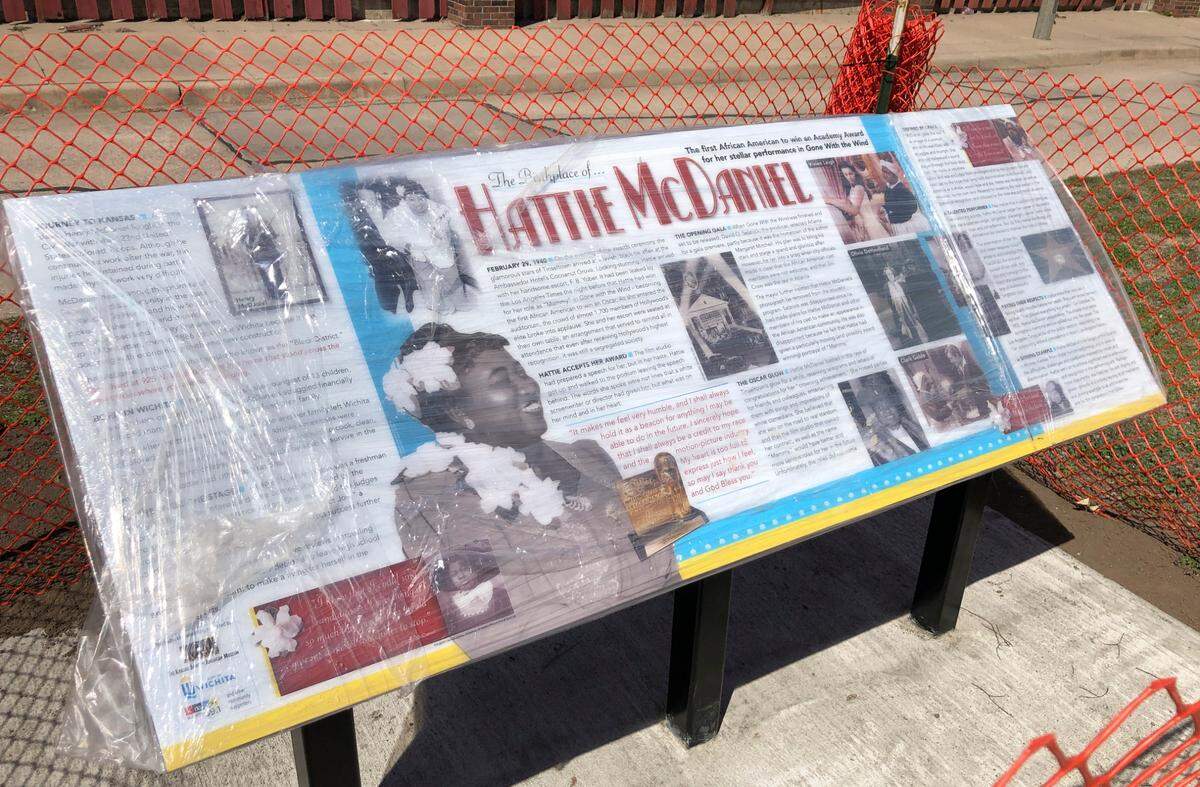
Now, a colorful new memorial covered with photos of McDaniel from throughout her career and outlining her life story, has been put in place across the street from the site of her childhood home. At noon on Wednesday, a dedication ceremony marked with speeches about the actress will take place. The public is invited.
The new memorial is part of a cooperative effort between The Kansas African American Museum, The City of Wichita and KMUW, where Carla Eckels works as the director of cultural diversity, news and engagement.
Eckels said that a couple of years ago, she was working on a story about McDaniel — who in 1940 was the first Black actor ever to receive an Academy Award, which she won in the supporting actress category for her portrayal of Mammy in “Gone With the Wind.”
Eckels took Wichita-born actress Karla Burns, a McDaniel historian and Tony Award nominee who has frequently portrayed McDaniel in a musical called “Hi-Hat Hattie,” to the site of McDaniel’s childhood home to interview her. While there, Burns noted that the sign that had previously mentioned McDaniel’s birthplace was gone.
“She was surprised the marker was not there,” Eckels said. “And once we put the story out there, people were calling me, tweeting me, emailing me saying, ‘Hey, what’s up with the marker? What can we do to get it replaced?’”
Eckels said she got in touch with The Kansas African American Museum, which helped her set up a fund where people could donate toward a new marker. Before long, they had the money they needed.
The new marker, which was installed this week, is about six feet long and printed in full color. It tells the story of McDaniel, whose father, former slave and Civil War veteran Henry McDaniel, relocated his large family to Wichita in 1886, lured by the promise of booming construction.
Hattie, the youngest of 13 children, was born in 1893 and spent her first five years of life in Wichita before her family moved on to Colorado. As she grew up in the Denver area, McDaniel showed promise as a performer and left school to work with a traveling minstrel group. She eventually moved to Los Angeles, where she picked up jobs in radio and film. Though she would go on to win the Oscar for her role in “Gone With the Wind,” McDaniel was not allowed to attend the film’s premiere in Atlanta because it was held in a whites-only theater.
She dealt with segregation and discrimination throughout her career, Eckels said, and often would have to eat at different tables than her fellow actors. Burns, who is in the hospital recovering from a spinal injury, will not be able to attend Wednesday’s dedication but has often said that McDaniel paved the way for actors like her. Burns, who also was born in Wichita, has had a long and award-winning career as an actress and opera singer.
Eckels said that Wichita should be proud to be the birthplace of McDaniel, who was not only a Hollywood icon but also an outspoken civil rights activist. When she lived in Los Angeles, Eckels said, McDaniel fought against segregated housing.
She died of breast cancer in 1952 at age 57.
“I would love for people from literally all over the world to come to Wichita, to her birth place, and learn more about her,” Eckels said.
Anyone who visits the new memorial and reads about McDaniel will learn that they are standing directly across the street from where her childhood home stood. That structure is long gone and there are apartments on the land now.
The memorial sits on an island that runs down the middle of the street and includes a walking path, a couple of benches and a patch of grass.
Paris Cunningham, the curator of The Kansas African American Museum, said that she’s not sure many people know that such a significant woman was born in Wichita. McDaniel, who also was the first African-American woman to sing on the radio and who starred in a 1950s television show called “Beulah,” was posthumously named a winner of the museum’s Trailblazer award in 2020. Eckels was also named a winner that year.
“It‘s just a great piece of history that is often overlooked,” Cunningham said. “We just want to bring light to that and make sure that people know that wonderful and great people do come out of Wichita.”
.jpg)