
‘Art We Love’ offers peek inside minds of artists, archives of Wichita Art Museum
Two weeks remain to see “Art We Love: CityArts Artists’ Selections from the Wichita Art Museum Collection,” a special exhibition at the Wichita Art Museum that takes us inside the creative minds of local artists and behind the doors of the museum’s archives.
Five artists who have exhibited at CityArts, the community arts center managed by the city’s Arts and Cultural Services Division, were asked to select art for this exhibition. Seven artworks were chosen from the Wichita Art Museum’s permanent collection that were not already on public display.
Running through Aug. 23, the exhibition recasts previous programs that invited community members into the museum’s curatorial process. “Art We Love” has been part of WAM’s planning for its 85th anniversary celebration since last year, and the it’s expected to become a series that should repeat in the future.
“This is a new project inspired to make a better connection between different city art entities,” said Patricia McDonnell, WAM’s director. “CityArts is wholly city of Wichita and Wichita Art Museum is a private-public partnership that is a city facility. And we have very similar missions to engage and inspire and be part of the wonderful arts community that is here in Wichita.”
Artists invited for this round are Lauren Fitzgerald, Bill Goffrier, Matthew Hilyard, Jim Simpson and Dale Strattman. Selections range from works that inspired the artist to pieces that reflect the artist’s own technique or content.
Strattman, a photographer who taught art in Wichita for more than 40 years, said his choice was easy to make. He watched John Schrup create the oil painting “1965, #1 Wichita.”
“He was one of my most inspirational art instructors when I first started studying art at Wichita State, and he was kind of like a pied piper in that he really inspired so many students to embrace art,” said Strattman, who credits Schrup with helping him find his artistic course and also influencing his career as an art teacher. “He had a little studio set up down in his apartment near campus and students just kind of hung around with him. We watched him work on that painting, and I remember him getting a lot of recognition for it after he entered it in the Kansas Artist Annual exhibit.”
The painting came into the Wichita Art Museum’s permanent collection through a purchase award after taking the top prize in the Eleventh Kansas Artist Annual exhibit in 1965.
Fitzgerald, who creates artwork using layers of hand cut paper, chose two pieces that she wanted the public to see together: “Sarah Bernhardt as Gismonda,” an 1894 color lithograph by Alphonse M. Mucha, and “Big Brother and the Holding Company,” a 1966 serigraph on paper by Mouse Studios, a collaboration of Alton Kelley and Stanley Mouse.
The participating artists were asked to submit statements on the pieces they chose, and an edited version appears printed next to their selections. Fitzgerald’s submitted statement reads: “A direct link exists between art nouveau and rock posters of the 60s and 70s, which is why I’ve always fancied these two artworks together. Both speak to the era in which they were created; one during an age of industrial revolution, the other, social revolution. Both celebrate nature with flowing lines and organic forms, each in their own way. Both were created to appeal to the populous and considered disposable; now they’re revered and belong in a museum.”
Several participants chose works by an artist that they first saw on visits to WAM during their childhood. For Goffrier that was Henry Varnum Poor, a fellow painter and a native Kansan.
“As a kid, I loved visiting the Wichita Art Museum,” he said. “Many paintings were special to me, and I was taking painting lessons for the first time.”
Poor’s painting “In Western Garb” is a portrait that stood out to a young Goffrier for “how informal, non-classical and truly Midwestern it was. It established in me a lifelong love of regional artists who had unique visions.”
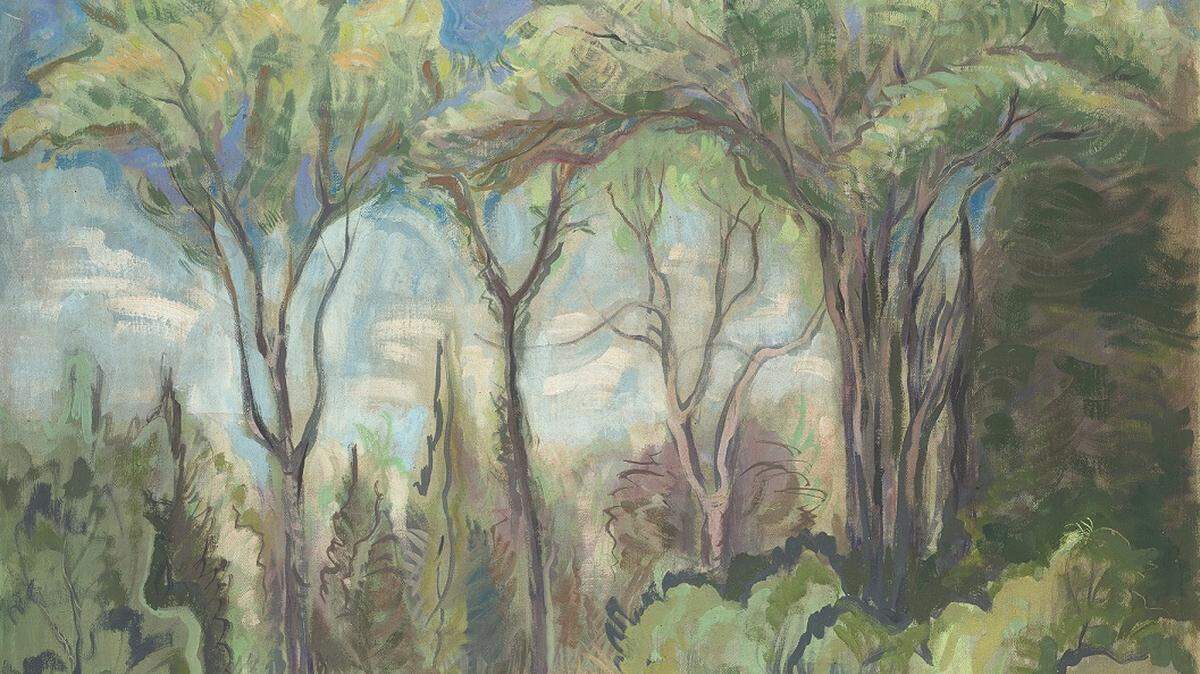
For “Art We Love,” he chose two paintings by Poor. “Green and Sunny Glade” is a late-career landscape that suggests the artist’s ability to explore and expand.
“It’s a loosely brushed but carefully balanced composition, seemingly in response to his experience of light and nature,” Goffrier said. “I find joy in the vocabulary of playful, linear marks which define and unite the elements of landscape.”
Hilyard, an abstract artist, is another lifelong visitor to WAM. He used his invitation to bring a favorite artwork into the public eye for the first time in a decade or more. He chose an untitled 1975 painting by Larry Poons because, “This pour painting inspires me to be more fearless in my own art making.”
He said he connects on several levels with the piece that measures roughly 96 inches tall by 34 inches wide.
“It’s fairly monumental in size, and then you come closer and you can see the thickness of the paint, layers and layers of pigment and that gravity is taking hold of and controlling this composition,” Hilyard said. “You start to consider how they made it and step back to look at it some more. You’re really engaged for more than 10 seconds, and as a local artist, if someone stands in front of your work for more than 10 seconds it’s a success.”
He said visitors should consider “Art We Love” a chance to pick the brains of local artists to learn what motivates and inspires them.
“You can go on Google and learn about any artist,” Hilyard said, “but with the brief statements included in this exhibition, it is like getting inside the mind of a local artist. We hope what you see inspires you, whether you’re an artist or not.”
Simpson, a professional graphic designer and artist, selected “Farm Composition No. 1,” a large oil painting completed in 1950 by Abraham Rattner. He said the use of heavy black line work and vivid colorful shapes related to the work he creates.
“I related to it on another level in that a lot of my imagery is like the content of this pieced: it has to do with age and decay, renewal and hope – things that go hand-in-hand for me,” he said. “It’s always a neat experience to see an artist who you can see a commonality with.”
He had an appointment scheduled to walk through the archives at the museum but it was about the time stay-at-home orders related to COVID-19 went into effect. Several of the artists were able to make their visits in person – a highlight in itself, they said – while Simpson and others had to peruse the collection online. The roughly 10,000 object permanent collection is included in an online database accessible to the public at wichitaartmuseum.org.
Simpson said the online catalog is a great resource for the public but believes “Art We Love” provides a reason to visit in person safely.
“I hope the public gets out and starts going to some of the galleries and museums soon,” he said. “I know everybody’s a little anxious about that, but all of the galleries and museums I’ve been to in the last month or two, have been super vigilant and putting in a lot of precautions to be responsible in how they’re conducting shows. I think an art show is one of the easiest ways to get rid of cabin fever. You can get out and do something but still be able to do it at a safe distance.”
Gallery hours at the Wichita Art Museum, 1400 W. Museum Blvd., are 10 a.m. to 5 p.m. Tuesday through Saturday and noon to 5 p.m. Sunday. Admission is free on Saturday, otherwise tickets are $10 adults, $5 ages 60 and older and $3 ages 5 to 17.