
Wichita Symphony returns to iconic ‘Carmina Burina’
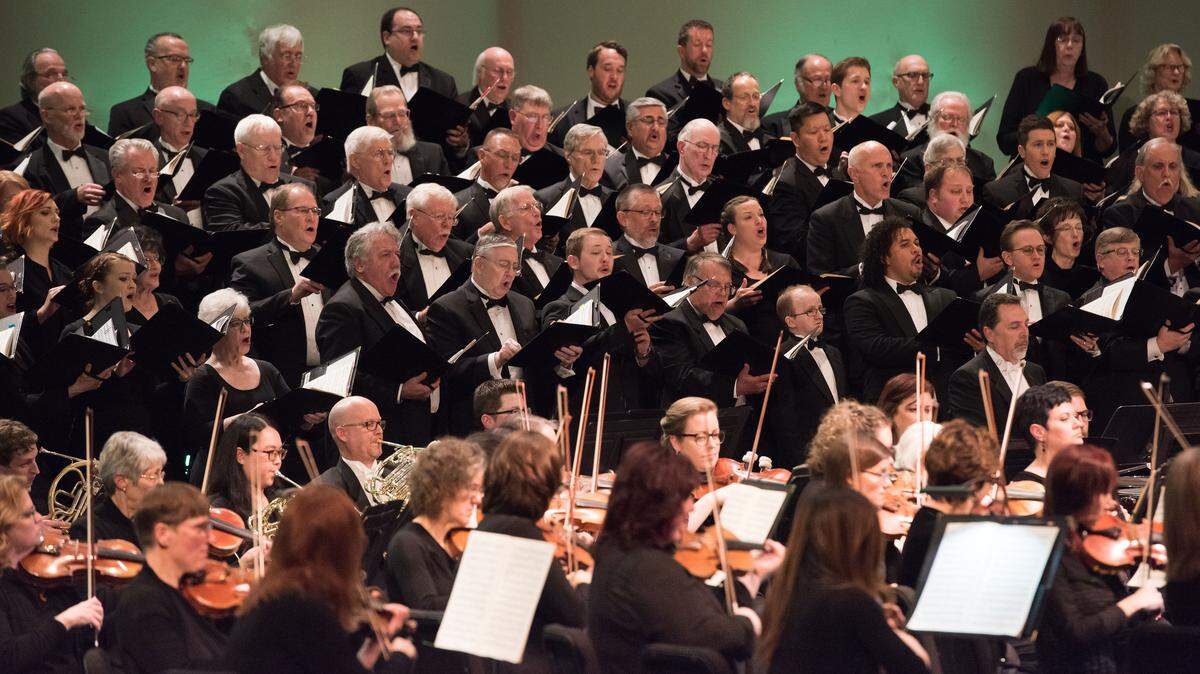
There’s more to Carl Orff’s “Carmina Burana” than its epic, iconic introduction, Daniel Hege said.
“It is one of the most beloved pieces out there,” the Wichita Symphony Orchestra conductor and musical director said of the piece, the highlight of two concerts next weekend. “In fact, people who know very little about choral music realize they recognize it very quickly. The opening number in ‘Carmina Burana’ is used so frequently in movies and commercials and in a lot of pop culture that people say, ‘Oh, this is that piece?’”
Indeed, the “O Fortuna” introduction has its own Wikipedia page, pointing out its 15 uses in films (as varied as “Speed,” “The Doors” and “Jackass: The Movie”), six film trailers, 20 TV series and specials, 14 radio and reality TV shows (as varied as Sean Hannity, Rachel Maddow and Howard Stern), seven TV commercials (Applebee’s, Domino’s), four video games and seven sports events (the New England Patriots and Washington Redskins each used it for team introductions).
While the rest of the 60-65 minute composition may not be as recognizable (the intro returns at the conclusion as kind of a bookend), Hege says both the lyrics and the music are a variety of moods and emotions.
“The music is very direct and it’s very communicative, immediately,” he said. “There’s nothing in it that’s too abstract. It’s very visceral. The text and the poetry that is used is also very direct and talks a lot about … fun things, in a way: The pleasures and the perils of drinking and gluttony and gambling and lust. People can relate to those in kind of a safe space of making art and music.”
The lyrics talk about a sort of wheel of fortune, he said, about individuals having the fate to live their lives, and about the fickleness of fortune and wealth.
“Those poems were written back in the 12th and 13th centuries, kind of medieval poetry,” Hege said. “It’s interesting that in the 21st century these are also themes we have to deal with.”
Hege said “Carmina Burina” is “a lot of fun” for the instrumentalists, singers and even the conductor.
“It has some pathos, but it also has a lot of humor, a lot of swagger to it. It’s the kind of music that hits you immediately,” he said. “It’s visceral, athletic music – that’s why it’s such a big hit with so many people.”
Last performed by the Wichita Symphony in 2012, “Carmina Burina” features two grand pianos, a full percussion section, an adult and a children’s chorus, and three vocal soloists: soprano Adelaide Boedecker, tenor Jonathan Blalock and baritone Luis Orozco.
“With all of these elements going on, it’s just a lot for the audience to be stimulated by – visually and aurally,” Hege said. “People respond to the rhythmic aspect of it. Even though it’s so long, there’s so much variety. The movements are usually quite short and they have just enough repetition in each verse, it kind of gets into their system a little bit.”
The surprisingly simplicity of the piece is one of its draws, Hege said.
“The harmonies that you get in here are not complex harmonies. It’s very straight-forward, and that’s why people can respond to it so easily,” he said. “There’s not a lot to process. You can simply take it in.”
“Carmina Burina” is preceded by a new piece written by Stacy Garrop, as the symphony continues to feature modern, female composers this season.
“Pandora Undone” is part of a “Mythology Symphony” that Garrop wrote between 2007-2013, Hege said.
The symbolism in “Pandora” works well as an introduction to “Carmina Burina,” Hege said.
“I felt like the idea of Pandora’s Box and coming undone fit that issue of fate and wondering about the future,” he said.
WICHITA SYMPHONY ORCHESTRA, FEATURING ‘CARMINA BURINA’ AND ‘PANDORA UNDONE’
When: 7:30 p.m. Saturday, Nov. 23 and 3 p.m. Sunday, Nov. 24
Where: Century II concert hall, 225 W. Douglas
Tickets: $30-$80, with discounts for students, military and seniors, from wichitasymphony.org, by phone at 316-267-7658 or at the symphony box office at Century II