Wichita sculptor’s work ranges from Hobbit trilogy to Harry Potter to the zoo
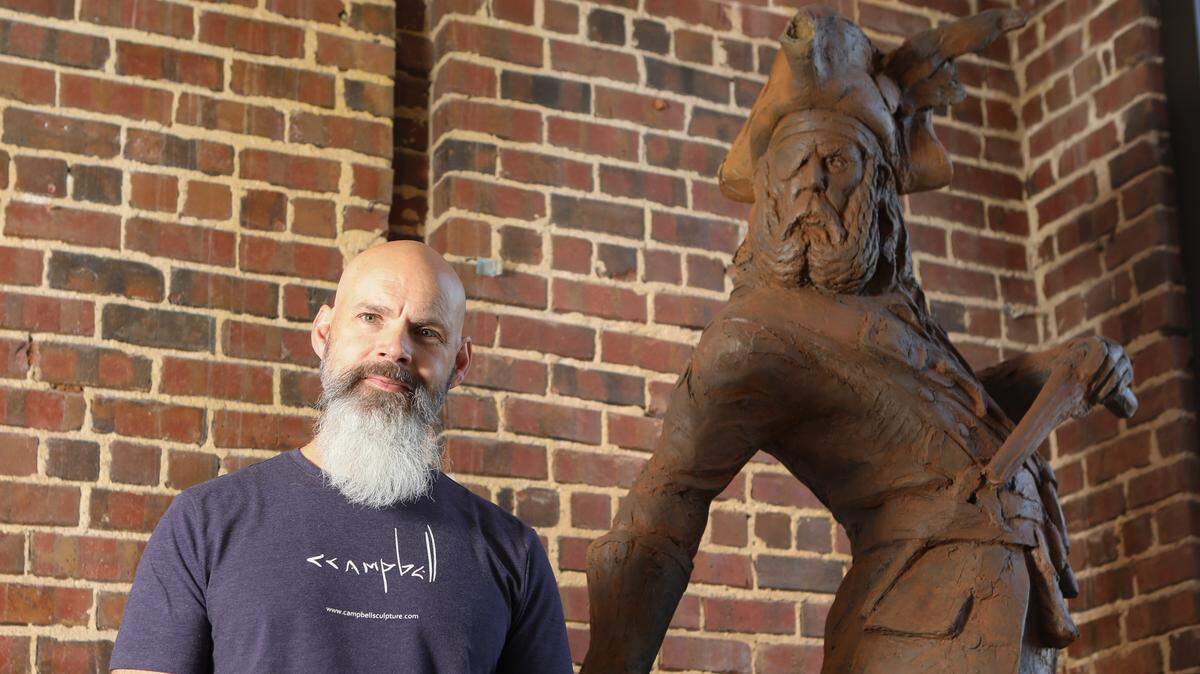
Craig Campbell was working the door at Wichita’s old Cowboy Club, sketching as he often did to pass the time, when a friend asked if he’d ever tried sculpting.
Campbell replied that he hadn’t because “it looks like a lot of work.”
“He said, ‘I don’t think you could do it,’” Campbell recalls. “My sculpturing career essentially started on a dare.”
It’s a career that Campbell couldn’t imagine while spending what he calls “way too many years” as a bouncer. He’s been to New Zealand to work on the Hobbit movies directed by Peter Jackson, created action toy figures and many of the concrete and bronze animal sculptures at the Sedgwick County Zoo, filled commissions for numerous private clients and snagged a role in a History Channel TV series – all while flying more or less under the radar of Wichita’s art world.
“Actually, my whole career is out away from here,” Campbell said.
Last month, ten artists traveled here from around the country to study figure sculpting with Campbell using water-based clay.
“He’s a great teacher and a very humble individual,” said Jesse Horton, one of those students and an artist who splits his time between Hawaii and Colorado. “He’s extremely prolific in what he’s done, and what he’s done has not always been considered ‘the fine art world’ as far as galleries, but he has as much experience as anyone I’ve ever met, and that includes some people higher up in the art world.”
Campbell – whose physique suggests he could still make an effective bouncer – describes his approach as “always pushing forward, always looking for the next project and building a strong network of people, patrons and clients.”
Campbell moved to Wichita in 1990 as a 22-year-old from Michigan, where he’d been a sales rep for Anheuser-Busch. Always fond of drawing, he took quickly to three-dimensional art. The day after being issued the challenge by his friend, he went to the library, checked out a book on sculpting, bought a beginner’s kit and created an action figure.
“I was hooked. I was super proud of that.”
Campbell went on to major in art at Wichita State University with an emphasis on figurative and realistic works. Within a year of starting his studies, he put together a portfolio and applied for work modeling figures for a large toy maker that had advertised in the back of a comic book. He got the work.
“I’ve done work for toy and collectibles companies – like Harry Potter and all the Alien movies and the Terminator movies and The Matrix, then moved into doing theming. I did a lot of work for zoos and theme parks.”
At the Sedgwick County Zoo, Campbell’s sculptures include a bronze eagle and lion and concrete gorillas, tigers, elephants and an orangutan. Campbell said he worked on “every major exhibit at the zoo except the penguins because I was overseas.”
Campbell spent four years in New Zealand working on the Hobbit triology, one of a half-dozen sculptors recruited from around the world through his connection with San Diego’s famous Comic-Con convention. Duties included sculpting prosthetics, costumes and weapons, set elements and figures that were used to produce special effects with digital technology. He spent a lot of time on “Orcs,” as the movies’ goblins were known.
“It was definitely full on,” Campbell said of working on a major movie set. “You’re working 20 hours a day, for months on end.” His wife, Heidi, who studied ceramics at WSU, worked in the production’s paint shop.
While in New Zealand, Campbell also helped produce a huge sculpture for the World Rugby Cup in Auckland depicting nine 10-foot-high players involved in a “scrum,” plus an even larger “golem” figure for the airport in Wellington, that nation’s capital. Another experience, sculpting in front of a huge crowd in Auckland, led him into teaching.
“I learned that there are people out there who have never touched clay. That made me want to start workshops.”
Through his artwork, Campbell met Britain’s Prince Charles in New Zealand but was even more excited to encounter actress Linda Carter of “Wonder Woman” fame.
“I got to spend 30, 40 minutes with her, teaching her (about) sculpture, just talking.”
The Campbells considered applying for dual residency but eventually decided to return to the United States to be close to family.
Two days after landing in the United States, while they were driving across the West to get “reacclimated,” Craig was asked to appear in a History Channel show called “Monument Guys.” The show focused on two brothers who own the Crucible Foundry in Norman, Okla., as they created bronze monuments of everybody from Harry Truman to Houdini for schools and other clients.
Initially brought in as a “support artist,” Campbell ended up one of the show’s stars.
“Apparently it worked for them,” he said. “I know I can work quick. They just kept sticking the camera in my face.
“It was a strange and humbling experience.”
The show’s six episodes can be found online and through streaming services. Horton said that Campbell is probably best known for the “dynamism” of his sculpture – that is, his ability to capture motion in objects that aren’t moving. Campbell’s people, animals and fanciful creatures rarely repose; instead, they’re huge rugby players stretching for a ball, or a bison – mascot of Bucknell University – lowering its massive head as if to charge.
Horton speculates that Campbell “learned to read gesture” while working as a bouncer, a notion Campbell says is probably true. “You can’t hear anything in a loud club so you have pay really close attention to intent and movement.”
Campbell said he’s been approached about doing another TV show but can’t reveal any details at this point. He intends to keep teaching and creating art with Heidi, his chief color consultant who also keeps the books for their business.
Heidi calls her husband a “don’t-judge-a-book-by-the-cover person. He looks like this rough-and-tumble guy, but he’s just much more thoughtful and concerned about humanity than you’d expect. He’s a great dog dad. He’s just a good soul.”
Campbell works out of a Wichita studio as well as the Mud Haus, a downtown venue on East Douglas where some of his sculpture is displayed. Making a full-time living through art is rare in Wichita or anywhere else, but Campbell’s willingness to travel and tackle a variety of projects has allowed him to do so.
That long-ago dare from a friend led Campbell to exactly the right art medium for a guy who likes to work with his hands.
“If you can imagine the construction trades, it’s all of them combined,” he said of sculpting. “It’s everything physical. Then you’ve gotta throw talent and ability on top of that and you’ve got a sculpture.”
This story was originally published November 18, 2019 at 5:01 AM.