
Bobby Witt Jr. needs help. This Royals formula isn’t sustainable in the long-term
The pitch arrived a few inches off the inside part of the plate, probably just about where Astros pitcher Hunter Brown intended it.
Didn’t matter.
Royals shortstop Bobby Witt Jr. is hitting everything these days, and he redirected the pitch down the third-base line, a double Sunday extending his career-best hitting streak to 19 games.
Witt has been on a tear recently, even by his own standards, hitting .357 with a .420 on-base percentage and 10 extra-base hits over the last 19 games.
The problem? He’s just about the only one.
In that same 19-game stretch, the rest of the Royals have combined to hit .199 with a .534 OPS. It’s ugly, frustrating and not really all that small of a sample size.
Oh, and one more description that’s going to garner some of the focus here: Unsustainable.
Yes, the Royals are 14-15 after a homestand encouraging by its record but with only a few slightly encouraging signs from a lineup that still pushed across just eight runs over a three-game weekend series.
That the Royals have managed to tread water through 29 games has the illusion of keeping them near last year’s pace of an eventual postseason team.
In reality, though, the depth of the offensive struggles aren’t particularly close to the historical pace of any postseason teams.
The Royals have scored just 3.14 runs per game this season, better than only the Rangers across baseball. Since 1900, no MLB team has made the playoffs after averaging worse than 3.5 runs over a full season. In the past three decades, only two teams have qualified for the playoffs scoring fewer than 4.0 runs per game: the 2014 Cardinals and the 2013 Pirates.
KC is nearly a full run shy of that cutoff.
The Royals haven’t hit for power; they have a league-low 13 home runs. They haven’t hit for average; their .225 batting average ranks 25th. They walk less frequently than everyone outside of the Angels and Rangers.
It’s hard to pinpoint what they do well offensively, other than employ the guy who led off this column, Bobby Witt Jr.
Combine it together, and that’s how you post a collective .615 OPS through 29 games. For perspective of that number, I’ll point out that no team in the Wild Card Era (1995) has finished with a winning record while posting an OPS below .670.
The Royals are 55 points shy of .670.
The top of the KC lineup
OK, so it’s been a tough 29 games offensively.
But why?
For all of the talk about the role players, the top of the lineup, the core on which this team is built, hasn’t held up its end of the bargain.
Jonathan India, the man brought in to provide a jolt at the top, has scored eight runs all year. He is intended to maximize the talents of Witt by reaching base in front of one of the game’s best hitters, but Witt has driven himself in as many times as he’s driven India across the plate (two). I don’t care if it’s the initial 29 games or 29 sandwiched into mid-July. That’s a heck of a statistic.
India has a track record that offers optimism he will figure it out, but he is hitting in the ball in the air more frequently than any point in his career — 51.3% of his contact produces flyballs, per Fangraphs, and he’s never before eclipsed 40%. It’s a confounding development after moving from a home run friendly park to one that swallows fly balls.
Vinnie Pasquantino, the man whose run-producing ability protected Witt a year ago, is hitting .181. He told MLB Network a couple of weeks ago he’s trying to get accustomed to increased bat speed this year. It’s a fascinating exercise to determine whether the improved bat speed is really helping him, and it’s not surprising he’s engaging in the exercise himself.
He is about as meticulous with dissecting his plate appearance as anyone you’ll find. If his production is bothering you, I assure you it’s bothering him more.
But no matter how quickly his bat is moving through the zone, there are a couple of things within his control: He has chased more pitches out of the zone than any time in his career — 3.1% higher than a year ago — and he’s also taken called strikes more frequently than any other year.
That combination falls in line with a lot of Kansas City hitters. A team that prides itself swing decisions, which it continues to underscore and emphasize, has the ninth-highest chase percentage in the league — yet has seen the fifth-highest percentage of called strikes, per Fangraphs data. They just don’t produce enough power to justify that discrepancy.
Salvador Perez, the cleanup man, hasn’t really gotten going either, but he hasn’t gotten much luck, either. This might be hard to believe, but Perez is actually 11th in baseball in expected slugging percentage, a statistic measured based on metrics such as exit velocity and launch angle. His xSLG is .589, according to Fangraphs.
His real slugging percentage? That would be .364, which ranks 109th.
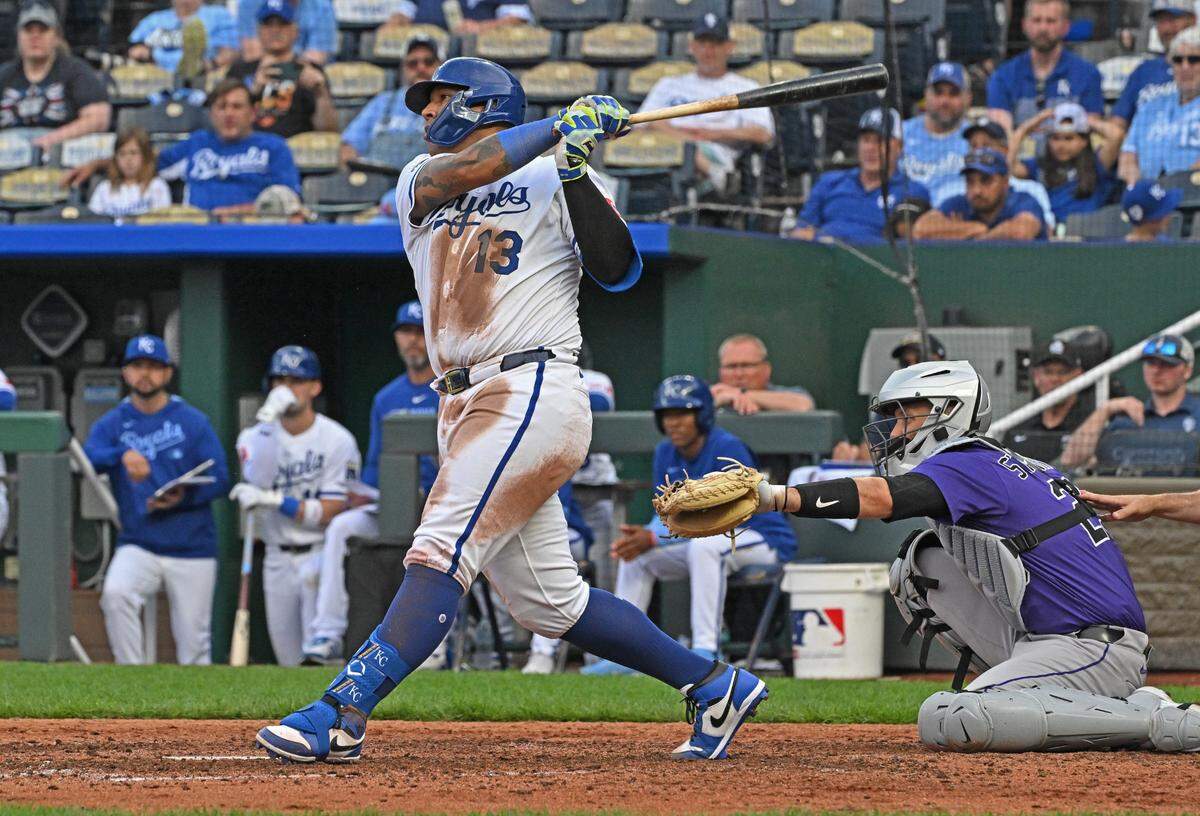
By that metric, Perez has been the unluckiest hitter in the game this season. Nobody has a bigger gap between the illusion and the reality.
In fact, if you’re trying to find something to hang onto, start there. The Royals, oddly enough, still rank middle of the pack in hard-hit rate on Statcast, and their average exit velocity is actually slightly better than middle of the pack.
The April scoring drought
It’s only April, though, right?
The weather will heat up. The ball will start to carry. The pitchers on the opposing mound will soften, even as soon as this week’s road trip.
That’s not mean to come across as flippant. That’s real. So when someone asks me whether the offense will get better, the answer should be obvious.
Of course.
But it too carries an obvious follow-up.
It has to.
I mentioned earlier the team OPS stands at .615. Forget about dragging that number out over a full season, because that’s not where the Royals will finish.
So let’s try this instead: Since 1981, only two clubs have posted an OPS that low through April and later bounced back to reach the playoffs. The 2015 Rangers had a .611 OPS through April, and the 2012 A’s were at .609 by the conclusion of the first month.
Say that again: Two teams in 45 years.
There are two games remaining in the Royals’ opening month.
This opening month doesn’t mean everything, but it does mean something.
Or it has, anyway.
There are 133 games left on the schedule. It’s to be determined if the Royals can offer an exception. The fact that they reached the playoffs last year — with an above-average offense in terms of scoring, by the way — provides a foundation other teams did not have.
But this much already has been determined: The current model is not a sustainable one. A transition from Bobby Witt Jr. and Co. to Bobby Witt Jr. and Woes won’t last, even if the Royals have somehow managed 14-15 and navigated a difficult schedule to get there.
Having the fourth-best team ERA in baseball has kept them afloat, especially beneficial when that rotation has accounted for more innings than any other. That’s half the equation, you know, and the Royals nail that half.
The team has some resiliency. Maybe that late-September drought a year ago helped, in retrospect. They bounced back, made the playoffs, and then won a series once there. That’s an experience you hope will matter. Probably does.
That’s all to form an optimistic suggestion that 3.14 won’t be the number that sticks around. And I don’t believe it will, but this stretch is building some evidence to the contrary.
The larger point, though, is what this exercise has not only theorized but just about outright proven: It can’t be the number that sticks around, or the Royals won’t stick around in a playoff race.
This story was originally published April 29, 2025 at 10:51 AM with the headline "Bobby Witt Jr. needs help. This Royals formula isn’t sustainable in the long-term."