
Here’s what we know and still don’t know about Wichita’s homeless services campus
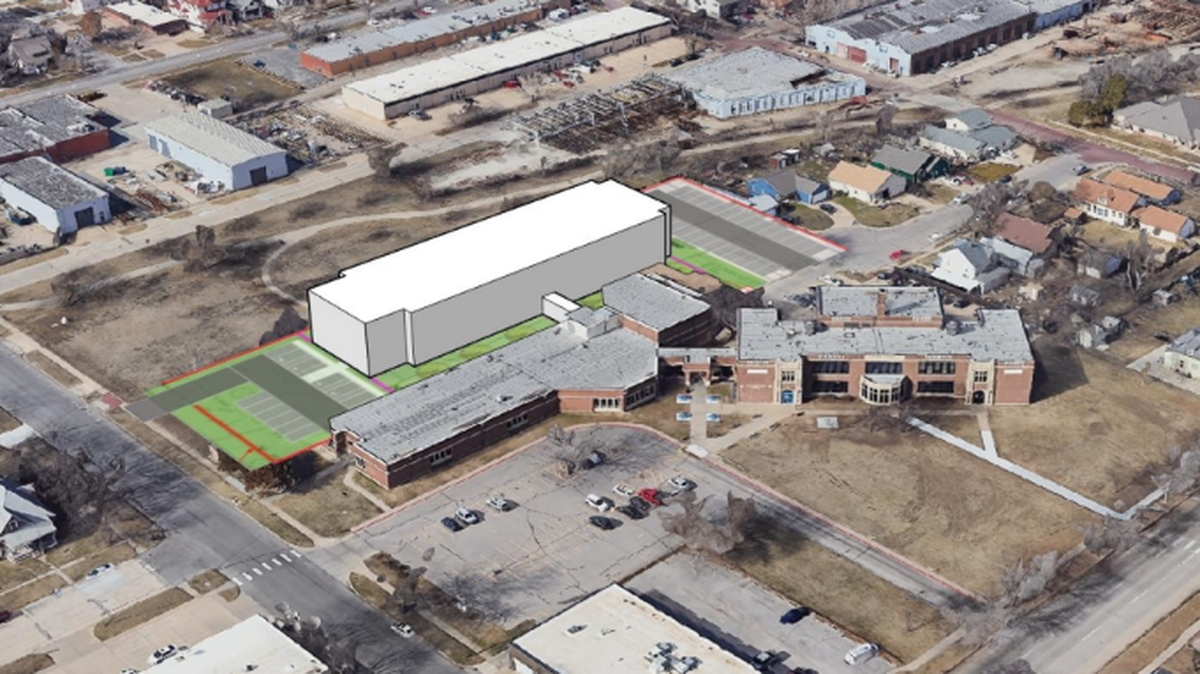
Roughly 100 residents came out Saturday to hear more about Wichita’s preliminary plans to transform recently closed Park Elementary School into a homeless resource campus.
The two-hour meeting at the Advanced Learning Library got heated at times, with Historic Midtown neighbors raising a number of questions about the proposed Multi-Agency Center, including how safe it will be and what impact it might have on their property values.
If a deal is reached between the city and the Wichita school board to sell Park for $1, officials say it will be ready to serve as an emergency winter shelter by mid-November and fully equipped as a year-round shelter with wraparound services by 2026.
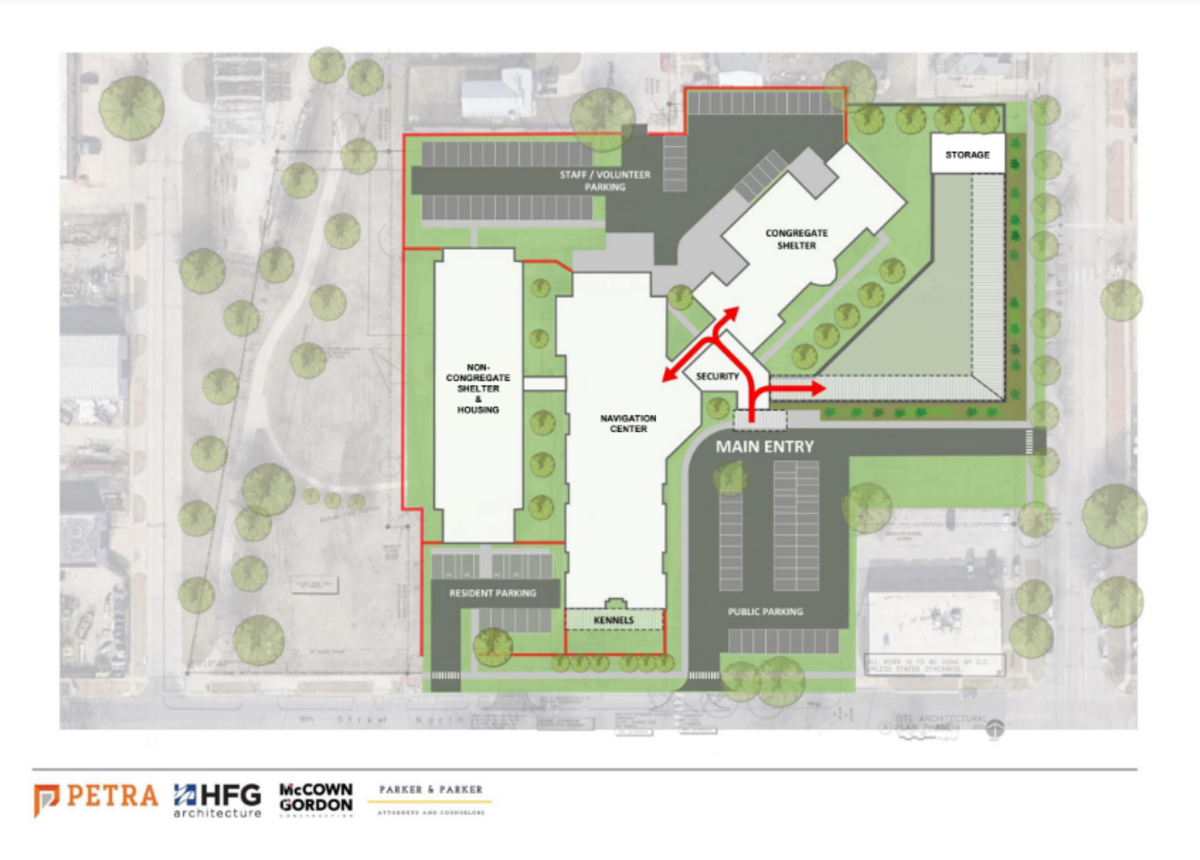
Officials also shared a basic layout for how the various components of the MAC, including shelter space, supportive housing units and a navigation center for connecting people to resources would fit inside the existing school and possible expansion.
Is the Park Elementary deal final?
The school board is set to vote on two measures at its Monday evening meeting — one to declare Park a surplus property and another for the conditional sale of the elementary building to the city.
If all goes to plan, the City Council will vote Tuesday on an option agreement with the district, which would open a due diligence period for the city to inspect the property. However, as with any closed school building, the state Legislature has first right of refusal on the property if lawmakers adopt a resolution to acquire it.
When Assistant City Manager Troy Anderson said the deal was still in its preliminary stages, he was met with a ripple of laughter from the audience and an interjection of “Yeah right.”
“No decision has been made. I know that you all keep making the suggestion that it has. No decision has been made,” Anderson said. “USD 259 still has to make a decision Monday night and City Council still has to make a decision Tuesday morning. And again, that just gets an option on the property.”
He said the city still has an option on the former Riverside Hospital complex.
“If there were unlimited dollars, we would want this somewhere else — not in your neighborhood, not in here or there,” Mayor Lily Wu said to Midtown residents in response to their objections. When asked after the meeting, she didn’t say where she would prefer the facility to be located, only that it would ideally be built from the ground up.
How much will it cost?
When city officials announced Thursday that they were considering Park as a possible site for the MAC, they declined to answer questions about project cost and funding, saying more information about both would be available at Saturday’s meeting. That proved not to be the case.
“The answer is, we don’t know yet,” Anderson said.
The city’s initial vision for the MAC was an $80 million facility at the Riverside Hospital complex in West River Plaza.
“Obviously, Park Elementary is not the same scale as West River Plaza, so it’s arguably going to be less. How much less? Probably quite a bit less, right?” Anderson said.
He couldn’t say how much the city is prepared to spend on the project. Initial plans called for a $20 million city investment, including $7 million in ARPA funds and $13 million in proceeds from the sale of city properties. Wichita officials had hoped to secure up to $20 million in state matching funds and another $20 million in Low Income Housing Tax Credits, but neither panned out.
Anderson said beyond the initial construction of the MAC, staff are working to get a grasp on how much it will cost to operate the facility. He said there will likely be a role for “corporate and philanthropic sponsors” to play in sustaining operations.
What services will be provided?
The 24/7 year-round shelter will be low-barrier, not no-barrier, as has previously been stated. That means that although nobody will be turned away for not having an ID or for being under the influence, they won’t be allowed in with drugs or weapons, Anderson said.
City staff provided a rundown of wraparound services that will likely be available at the MAC. They include an activity center, aging/disability services, bed bug treatment, clothing closet, computer lab, driver’s license/ID services, domestic violence/trafficking support, food pantry, meal provider (3 meals a day), hair cuts, housing providers, laundry, animal kennels, law enforcement/Homeless Outreach Team, legal services, mail room, medical/EMS services, mental health, quarantine room, showers, SNAP/DCF, SOAR (a program for connecting qualifying homeless residents with benefits), storage, substance abuse services, United Way, veteran services, veterinarian and workforce services.
“People who are unhoused often face so many barriers outside of just their housing needs,” Vice Mayor Maggie Ballard said. “The MAC will be able to provide services in one location and take away many of the hardships that unhoused residents face to seek help.”
The plan is to provide continued support through case management. Once people have been moved to transitional housing, the goal will be to get them approved to participate in the city’s affordable housing voucher program.
How many shelter beds will there be?
The MAC will have both congregate and non-congregate shelters. Non-congregate shelters provide clients with their own bedroom and bathroom facilities while congregate shelters provide shared bedrooms and bathrooms.
Anderson said two preliminary floor plans have been developed for the Park Elementary site. One includes 166 beds and the other, which features more congregate facilities, would allow for 198 beds. Both options could be expanded during emergency winter shelter operations to add 76 beds, bringing the total number of beds to either 242 or 274.
“We’re talking about bringing everybody here from Sedgwick County. Do you think that’s going to be enough?” one audience member asked.
Officials agreed the facility would serve the need, alleviating pressure on a strained provider network. Wu noted that Union Resuce Mission, one of the city’s only year-round shelters, serves only men.
“There’s no space — especially for a woman right now,” she said. “Especially if she is camping, we don’t have a shelter space for her unless she’s a domestic violence victim.”
How will it affect property values?
Residents repeatedly voiced their worries about the impact the MAC could have on their property values and quality of life. The Lord’s Diner, and The Inn, a shelter service provided by HumanKind, are already located in Midtown.
“Why would anyone move to Historic Midtown?” one person asked.
Anderson said property value assessments are generally based on the price of comparable properties sold in proximity to the house in question and adjusted for other factors.
“We don’t know what the impact’s going to be at this point in time,” he said.
Some attendees disputed his logic.
“There won’t be comparables to another house next to the largest homeless center in the city. You won’t find a home like that,” one meeting-goer interjected.
Anderson pointed out that if the deal doesn’t go through, Park will remain a vacant elementary school.
“Today, for all intents and purposes, it’s an abandoned building, which also has an impact on property values,” he said.
Wu instructed staff to collect information and report back on the potential impact the project could have on property values in the area.
What security measures will be in place?
The emergency winter shelter, most recently located in northeast Wichita at 21st and Opportunity Drive, was equipped with a metal detector and had a screening procedure to ensure operators always knew who was entering and leaving. Anderson said the MAC would have similar features.
Police Chief Joe Sullivan said after the meeting that there was an increase in radio calls for trespassing and nuisance complaints around the emergency shelter but no significant increase in violent crime.
“The impact was not what people feared,” he said.
Officials agreed there will be ongoing conversations about how best to secure the facility.
“One thing that I think we didn’t make a strong enough focus is, we’re going to emphasize safety,” Wu said after the meeting. “Safety is the number-one thing that we want — not just for our unhoused population but also the neighbors around that area.
“Whether it’s a perimeter of masonry, an officer walking around. These are all parts of the things we still have to talk through, but safety will be the number one.”
Will this change how the city enforces its no-camping law?
Ballard, whose City Council district includes Midtown, said she receives five to 10 emails a day about encampments.
“Right now, we don’t have a shelter. We have nothing,” Ballard said. “They’re on the rivers. They’re downtown. They’re in people’s yards. They’re in people’s businesses. They’re everywhere. And it’s because they don’t have a shelter to go to.”
Wichita has a no-camping ordinance, but under that law, people can legally camp if there’s no shelter available for them to stay at. There’s currently a case before the U.S. Supreme Court challenging the constitutionality of camping bans.
“Right now, people are often frustrated because the [Homeless Outreach Team] cannot move as quickly often as they would like them to,” Sullivan said. “We don’t have a place to take them, so the idea that if we have a place to take you, a humane, safe place to take people to find shelter, it will give us more enforcement authority on the street and enable us to enforce the camping ordinance.”
Wu said she also wants to see strengthened enforcement.
“I don’t believe it’s compassionate for people to be living on our sidewalks or underneath our bridges. It’s not compassionate,” Wu said. “We need to have a space for people to have proper sheltering and connect them to the right resources.”
This story was originally published June 8, 2024 at 10:33 PM.